


Generator hookup

Cargo Master

Joined: Jan 2004
Posts: 2,512
Likes: 8
From: Cook Forest and Irwin PA
Couple last comments before I unsubscribe to this thread.
(I quoted you in full this time)
You do NOT have the same power company that I do.
The power company does supply a neutral - its the center tap on the transformer secondary. This neutral is NOT connected to the ground wire on the pole. In fact
the ONLY connection to earth ground is at one point, usually the service disconnect neutral. This is why you have to KNOW what type generator you have so you can select the appropriate transfer switch - 2 pole if your generator neutral floats, 3 pole if it's bonded to frame.
I did clip this post of yours, it was rather long and windy:
As someone who has worked in the electrical/electronics field for 40 some years, with industrial single and three phase to 460 volts and 10 KV line, as well as aircraft and mainframe computer electrical systems, I think I probably do understand .........
Bye Bye
(I quoted you in full this time)
You do NOT have the same power company that I do.
The power company does supply a neutral - its the center tap on the transformer secondary. This neutral is NOT connected to the ground wire on the pole. In fact
the ONLY connection to earth ground is at one point, usually the service disconnect neutral. This is why you have to KNOW what type generator you have so you can select the appropriate transfer switch - 2 pole if your generator neutral floats, 3 pole if it's bonded to frame.
I did clip this post of yours, it was rather long and windy:
As someone who has worked in the electrical/electronics field for 40 some years, with industrial single and three phase to 460 volts and 10 KV line, as well as aircraft and mainframe computer electrical systems, I think I probably do understand .........
Bye Bye
I claim 'something'
You disagree
You post a picture that cleverly does NOT show the topic (although if one imports the picture and blows it up it also shows the centertap tied to ground and catenary as well, but you really gotta blow it up)
I post not only one but 2 pictures, went thru the trouble to use some windows software pacakge to label the connections, the picture shows what I was talking about - and then some...
You ignore the fact the picture is there, restate your opposition and then say 'bye bye' without admitting you were wrong, or in lieu of explicitly stating that, agree that my evidence shows I was in fact right.
Off topic: but you have an integrity problem. And you just showed it in public. That should be of more of concern to you, than anyone else.
Posting Guru
Joined: May 2006
Posts: 1,028
Likes: 0
From: Edmonton, AB.
DNFXDLI & Alchymist - You guys are wasting your time. I'm also an electrician with about 30 years under my belt. Obviously Quaddriver knows more about this than we could ever understand. In fact maybe he should be contributing to the NEC code book on the next update, since it's flawed and written poorly. I only wish I had not wasted so much of my adult life learning this trade since I've been wrong all these years.
Sorry for the sarcasm....but I couldn't resist.
Sorry for the sarcasm....but I couldn't resist.
Cargo Master
Joined: Jan 2004
Posts: 2,512
Likes: 8
From: Cook Forest and Irwin PA
DNFXDLI & Alchymist - You guys are wasting your time. I'm also an electrician with about 30 years under my belt. Obviously Quaddriver knows more about this than we could ever understand. In fact maybe he should be contributing to the NEC code book on the next update, since it's flawed and written poorly. I only wish I had not wasted so much of my adult life learning this trade since I've been wrong all these years.
Sorry for the sarcasm....but I couldn't resist.
Sorry for the sarcasm....but I couldn't resist.
In the meantime, I took your compadre's photo, blew it up 3x and highlighted a few features.

1) Clearly, there is a wire from the POCO Neutral/Ground to the center tap. Exactly as mine has.
2) to the left of the N/G insulator, are two wires connecting to the pole ground - EXACTLY as I have it
3) following the ends of the drawn barbell, we see that the center tap is ALSO the catenary, which is grounded - EXACTLY as I have
4) there is yet another wire from the center tap to the pole ground
Gee, this is precisely as my pole is wired. Instead of a number of splices on the N/G, they hit the center tap 3 times. Electrically, the effect is the same.
So yes, his picture was worth a 100 words in itself.
Posting Guru
Joined: May 2006
Posts: 1,028
Likes: 0
From: Edmonton, AB.
Sorry dude..... I don't want to jump into this at this stage. The other two guys are right on point. The reason I mentioned the NEC or in my case the CEC (which is derived from the NEC) is there are parts of sections that refer to grounding and bonding also the residential service. There is a chance we know what we're talking about. DNFXDLI & Alchymist have spent some time explaining the way it is. All I'm saying is, maybe your mis-interpreting what your seeing and should check with your power company or local inspection authority as to the correct configuration. What I see in your photo that you've blown up is the secondary side of the xfmr connection, the two hot leads and neutral strand supporting the cables. The neutral coming from the center tap on the xfmr. Neutral and ground are not the same thing and neutral doesn't come from a ground at the pole.
Cargo Master
Joined: Jan 2004
Posts: 2,512
Likes: 8
From: Cook Forest and Irwin PA
Sorry dude..... I don't want to jump into this at this stage. The other two guys are right on point. The reason I mentioned the NEC or in my case the CEC (which is derived from the NEC) is there are parts of sections that refer to grounding and bonding also the residential service. There is a chance we know what we're talking about. DNFXDLI & Alchymist have spent some time explaining the way it is. All I'm saying is, maybe your mis-interpreting what your seeing and should check with your power company or local inspection authority as to the correct configuration. What I see in your photo that you've blown up is the secondary side of the xfmr connection, the two hot leads and neutral strand supporting the cables. The neutral coming from the center tap on the xfmr. Neutral and ground are not the same thing and neutral doesn't come from a ground at the pole.
Ever read Mike Holts page? (electrician who runs a website similar to this). In a few hundred places around it he says stuff like this:
Your utility transformer has a center tapped secondary that supplies the 120-0-120 V to the service drop. The center tap is called neutral and should be connected to a ground rod at the transformer pad or pole
If the ground rod at the transformer has good connections to the transformer center tap, then a measuring probe in contact with that ground rod or very close to it in the adjacent earth will be close to the potential of the center tap
Posting Guru
Joined: May 2006
Posts: 1,028
Likes: 0
From: Edmonton, AB.
Both statements are true enough. However the first is typically in the jurisdiction of the supply authority and doesn't concern you. The second statement seems to be from a text book rather than the code book. The only ground you are concerned with as a homeowner is the one on your gas main or water main for the house and it is NOT tied to neutral. The power company is responsible for its equipment and whether or not it is grounded varies in different areas and also depending on the application.
Cargo Master
Joined: Jan 2004
Posts: 2,512
Likes: 8
From: Cook Forest and Irwin PA
Both statements are true enough. However the first is typically in the jurisdiction of the supply authority and doesn't concern you. The second statement seems to be from a text book rather than the code book. The only ground you are concerned with as a homeowner is the one on your gas main or water main for the house and it is NOT tied to neutral. The power company is responsible for its equipment and whether or not it is grounded varies in different areas and also depending on the application.
Both statements I quoted are his, not from a code book and the jurisdiction has nothing to do with it. AS I have been pointing out all along - neutral is tied to ground at every opportunity. This is not to protect humans. Well in a way it is, having everything electrical explode at once might be considered dangerous.

Post Fiend
Joined: Jun 2003
Posts: 5,983
Likes: 2
FWIW, here's my set up:
We begin with the new 2psi system and meter.

And here is a better view of the 'stack' with the regulator reducing pressure to 7-11" WC to the remainder of the house.
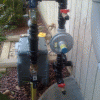
Here is the regulator at the 'far' end (about 125 feet away from the house) that steps down the 2psi to the 7-11" WC needed for the genset.
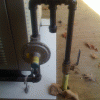
Here is the 'T' into the genset, with an additional valve on the end to hook up Propane should the NG supply fail.

Here are the interconnects between the genset and the ATS. Note the 200A conductors that the inspector 'insisted' was necessary (although the genset breaker is only rated for 100A). Also, you can see the wiring for the ventilation fans (generator is enclosed in an additional enclosure) and the 'ice cube' relay that controls them. There is also the control wiring, (red loop) that I'll connect to the reed switches and time delay to perform a system shutdown if the ventilation fans fail.

Here is the 'starboard' side of the genset, nothing much to see here except the battery.

Here is a bit of a disappointment. The overflow for the cooling system is scantily attached (I think they could have done a better job.)

Here is the broad view of the meter and ATS. I had to lower the meter some to move it left of the service entry to facilitate the ATS's connection to the LB Body entering the structure.

Just another view with the ATS's cover off.

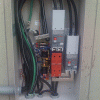
And finally the interconnections to the ATS. Notice the extra bonding conductor between the Neutral bar and Ground buss (another inspector requirement).
We begin with the new 2psi system and meter.
And here is a better view of the 'stack' with the regulator reducing pressure to 7-11" WC to the remainder of the house.
Here is the regulator at the 'far' end (about 125 feet away from the house) that steps down the 2psi to the 7-11" WC needed for the genset.
Here is the 'T' into the genset, with an additional valve on the end to hook up Propane should the NG supply fail.
Here are the interconnects between the genset and the ATS. Note the 200A conductors that the inspector 'insisted' was necessary (although the genset breaker is only rated for 100A). Also, you can see the wiring for the ventilation fans (generator is enclosed in an additional enclosure) and the 'ice cube' relay that controls them. There is also the control wiring, (red loop) that I'll connect to the reed switches and time delay to perform a system shutdown if the ventilation fans fail.
Here is the 'starboard' side of the genset, nothing much to see here except the battery.
Here is a bit of a disappointment. The overflow for the cooling system is scantily attached (I think they could have done a better job.)
Here is the broad view of the meter and ATS. I had to lower the meter some to move it left of the service entry to facilitate the ATS's connection to the LB Body entering the structure.
Just another view with the ATS's cover off.
And finally the interconnections to the ATS. Notice the extra bonding conductor between the Neutral bar and Ground buss (another inspector requirement).
FTE Stories
Ford Trucks for Ford Truck Enthusiasts

3 Best / 3 Worst Parts of Modern Ford Ownership
Brett Foote
10 Amazing Upgrades That Solve Common Ford Truck Owner Headaches
Pouria Savadkouei
Every 2026 Ford Engine Explained
Brett Foote
10 Ugly Ford Trucks That We Still Kinda Love
Joe Kucinski
10 Things Every Truck Owner NEEDS (2026 Edition)
Michael S. Palmer
Rezvani's Latest Post-Apocalyptic Monster Is a Ford F-150 Raptor Underneath
Verdad Gallardo
Top 10 Most Expensive Ford Trucks Ever Sold on Bring a Trailer
Joe Kucinski
2027 Ford Super Duty Buyer's Guide (Every Model, Engine, & Package)
Brett Foote
Top 10 Ford Truck Tragedies
Joe Kucinski
Post Fiend
Joined: Jun 2003
Posts: 5,983
Likes: 2
When the generator is considered a 'separately derrived service'?
Cargo Master
Joined: Jan 2004
Posts: 2,512
Likes: 8
From: Cook Forest and Irwin PA
No one ever defined this, so pulling back on education 25+ years old.....
There is a saying 'electricty takes the shortest path to ground'
Thats actually false.
It takes ALL paths. But it takes it according to an application of the 'parallel resistor law'
In short: if you have a wire, and you, touching a drill, and you both touch ground, most of the current will travel in the wire inversely proportional to your resistance vs the wire. You will do better if you are dry wearing rubber soled boots rather than naked and dripping wet with saltwater.
But anyways...
read my discussions on why 'neutrals are tied to earths' and just believe the reasons are true.
so now take a genset manufacturer who intends his generator to be a SOLE SOURCE of power. I.e. a contractor genset for a job site (you know, those things suspended from cranes in construction zones on the highway) or a whole house generator.
The genset has a neutral, which as discussed is not required to be 0 volts, and the genset is grounded to earth and it is bonded to other stuff like water pipes, gas pipes, foundation rebars etc. (bonded does not mean grounded btw)
When you do this, if you dont switch the netrual from the panel what do you have?
since the neutral at the panel is bonded to the equipment ground to protect humans, when the generator is running, the neutral wire AND the ground wire back to the genset pretty much split the current (they are parallel resistors of very very low resistance), BUT
If the neutral is not switched, therefore the neutral back to the pole, then to that ground, then back across the neutral to the next pole, and that ground etc etc all split up the current according to the parallel resistor law. It might be a biotch to calculate, but it is measurable.
Imagine the linemans surprise when, while standing in a mudpuddle, he pees on the neutral wire and gets a tickle.
Of course what this is also saying, in such a setup the POCO neutral must be bonded BEFORE the make-break-make switch and not where it normally is (some strap usually)
So what is derived? (bad bad choice of words but I didnt make it) what is derived is the neutral/ground split of current back to the power source.
Please note, we never seem to care how much current is flowing thru the ground back to the source. Mebbe mother nature does. I know worms do ('Squirm' circa 1978)
Would it surprise you to learn that the vast majorty of power consumed flowsto source via ground water and not the neutral lines?
anyways, nice genset setup - I am jealous. Mine is on my to-do list - far behind 'build new house in yard next to garage, knock down old one and fill in the hole to give a 2 lane driveway'
There is a saying 'electricty takes the shortest path to ground'
Thats actually false.
It takes ALL paths. But it takes it according to an application of the 'parallel resistor law'
In short: if you have a wire, and you, touching a drill, and you both touch ground, most of the current will travel in the wire inversely proportional to your resistance vs the wire. You will do better if you are dry wearing rubber soled boots rather than naked and dripping wet with saltwater.
But anyways...
read my discussions on why 'neutrals are tied to earths' and just believe the reasons are true.
so now take a genset manufacturer who intends his generator to be a SOLE SOURCE of power. I.e. a contractor genset for a job site (you know, those things suspended from cranes in construction zones on the highway) or a whole house generator.
The genset has a neutral, which as discussed is not required to be 0 volts, and the genset is grounded to earth and it is bonded to other stuff like water pipes, gas pipes, foundation rebars etc. (bonded does not mean grounded btw)
When you do this, if you dont switch the netrual from the panel what do you have?
since the neutral at the panel is bonded to the equipment ground to protect humans, when the generator is running, the neutral wire AND the ground wire back to the genset pretty much split the current (they are parallel resistors of very very low resistance), BUT
If the neutral is not switched, therefore the neutral back to the pole, then to that ground, then back across the neutral to the next pole, and that ground etc etc all split up the current according to the parallel resistor law. It might be a biotch to calculate, but it is measurable.
Imagine the linemans surprise when, while standing in a mudpuddle, he pees on the neutral wire and gets a tickle.
Of course what this is also saying, in such a setup the POCO neutral must be bonded BEFORE the make-break-make switch and not where it normally is (some strap usually)
So what is derived? (bad bad choice of words but I didnt make it) what is derived is the neutral/ground split of current back to the power source.
Please note, we never seem to care how much current is flowing thru the ground back to the source. Mebbe mother nature does. I know worms do ('Squirm' circa 1978)
Would it surprise you to learn that the vast majorty of power consumed flowsto source via ground water and not the neutral lines?
anyways, nice genset setup - I am jealous. Mine is on my to-do list - far behind 'build new house in yard next to garage, knock down old one and fill in the hole to give a 2 lane driveway'

Junior User
Joined: Nov 2008
Posts: 97
Likes: 0

Nice set-up FTE...they did nice pipework....nothing really beats an automatice transfer switch. We are in the process of qouting a home with a 600A 120/240 service and the owner wants a 100KVa back-up generator...will post a picture or two if it goes ahead.

Posting Guru
Joined: Nov 2006
Posts: 1,347
Likes: 0
Quaddriver, you are completely wrong and the other three guys are totally right. How do I know this you might ask. Well my dad worked for over 30 years for Met-Ed/GPU/First Energy. The 4th wire you are showing is the common ground not coming off the taps, but off the transformer body itself. The three taps are 120, 120, 0. The center tap is the neutral. If you bother to look in your panel with the cover off, you will find 4 wires coming into your box. They are the 120, 120, 0(neutral) and the ground wire going to a ground rod at your meter base. (Unless you are still on some ancient 60 amp service)
Cargo Master
Joined: Jan 2004
Posts: 2,512
Likes: 8
From: Cook Forest and Irwin PA
Quaddriver, you are completely wrong and the other three guys are totally right. How do I know this you might ask. Well my dad worked for over 30 years for Met-Ed/GPU/First Energy. The 4th wire you are showing is the common ground not coming off the taps, but off the transformer body itself. The three taps are 120, 120, 0. The center tap is the neutral. If you bother to look in your panel with the cover off, you will find 4 wires coming into your box. They are the 120, 120, 0(neutral) and the ground wire going to a ground rod at your meter base. (Unless you are still on some ancient 60 amp service)
I (and at least one other) have posted a few pictures of transformers with ground wire connections all over the place. Even went thru the trouble of labelling each wire. Did you miss those pictures?
BTW - if you ask, your dad will tell you that each utility pole is wired as I explained: the neutral is grounded and so is the center tap. And the pole he beuatifully installed on my property demonstrates this and is labelled correctly.

Thread
Thread Starter
Forum
Replies
Last Post
X-70STANG-F150
General NON-Automotive Conversation
6
Oct 24, 2008 04:49 PM
Zoltrix
General NON-Automotive Conversation
37
Jun 8, 2007 03:36 PM
