



drive shaft question

Thread Starter
|
New User
Joined: Nov 2008
Posts: 9
Likes: 0
From: Bowling Green, ky
just courious but anyone that has a 4x4 with the carrier bearing could you go and see where the slip shaft is on it? or better yet maybe take a picture and post it?
Like I said before I have one for a 2wd but I didn't think it would work. but now with everyone back and forth about it I am wondering if it will or not.
Like I said before I have one for a 2wd but I didn't think it would work. but now with everyone back and forth about it I am wondering if it will or not.
Ford Parts Specialist
Joined: Nov 2006
Posts: 88,826
Likes: 784
From: Simi Valley, CA

4817: Coupling Assy Application Charts (coupling assy = rear half of rear driveshaft)
Section 48.2, page 17:
1977 F150 4WD 351M/400
133" = D3TZ4817BP = C6, NP435 & Warner T-18
155" = D8TZ4817BP = C6, NP435
D3TZ-4817-BP was also used on 4WD 1973/76 F100's & 4WD 1975/76 F150's with the 133" wheelbase.
Center support kit: D9TZ4800A.
Hotshot
Joined: Dec 2003
Posts: 18,423
Likes: 9
From: iowa
but what is the front part of the shaft? I believe I heard somewhere that the rear part of the shaft was the same and it was from the slip joint forward that was changed for the wheel base differences and for use with a carrier bearing (I don't have a book of coarse and that is old second hand info from memory)
Ford Parts Specialist
Joined: Nov 2006
Posts: 88,826
Likes: 784
From: Simi Valley, CA
but what is the front part of the shaft? I believe I heard somewhere that the rear part of the shaft was the same and it was from the slip joint forward that was changed for the wheel base differences and for use with a carrier bearing (I don't have a book of coarse and that is old second hand info from memory)
I would be willing to relate all this to you, but I'm not typing it here...it's too damn much trouble....and I don't want to spend hours staring at microfiche slides, then writing it all down, then coming back to the laptop and typing it all over again.
The HUGE microfiche viewer is on one side of the 8' round table, the puter is on the other side. I have to get up, walk around the table, dodging 5 obstructions in the process.
The second I move, the obstructions follow me. When I return to the laptop, I have to step over and around the obstructions again.
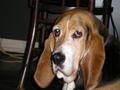
5 obstructions: Basset Hounds...they follow me everywhere, even to the loo!
Ford Parts Specialist
Joined: Nov 2006
Posts: 88,826
Likes: 784
From: Simi Valley, CA
It is not EZ, in fact I hated to look this stuff up when these trucks were new, because of all the variables.
Here's what is needed to compare.
Engine size, trans type for both trucks, part time or full time transfer case, and what the rear axle ratio is.
You have half the info, now I need the other half.
Sorry, I don't mean to come across as an azzhat, but when it comes to 4WD's, looking parts up for them is a royal PITA!
Dana 44 front ends: There are 50 front axle parts lists alone just for 1973/79 F100/150's = FIFTY!
When 4WD is present, the only way to look up brake drums or rotors & related parts are in those 50 parts lists.
These brake parts are not listed separately like the 2WD brake parts are.
Thread Starter
|
New User
Joined: Nov 2008
Posts: 9
Likes: 0
From: Bowling Green, ky
sorry, I didn't think some of that mattered...
76 2wd f100, 302/c4, 3.00
76 4x4 f100, 390/435/205(part time), 3.50
both are long wheelbase
when you look it up can you tell if parts of the shaft work even if other parts don't? like the rear part or the front part? it will deffinatly save me some coin if I only have to buy half of the driveshaft...
thanks!
76 2wd f100, 302/c4, 3.00
76 4x4 f100, 390/435/205(part time), 3.50
both are long wheelbase
when you look it up can you tell if parts of the shaft work even if other parts don't? like the rear part or the front part? it will deffinatly save me some coin if I only have to buy half of the driveshaft...
thanks!
Ford Parts Specialist
Joined: Nov 2006
Posts: 88,826
Likes: 784
From: Simi Valley, CA
sorry, I didn't think some of that mattered...
76 2wd f100, 302/c4, 3.00
76 4x4 f100, 390/435/205(part time), 3.50
both are long wheelbase
when you look it up can you tell if parts of the shaft work even if other parts don't? like the rear part or the front part? it will deffinatly save me some coin if I only have to buy half of the driveshaft...
thanks!
76 2wd f100, 302/c4, 3.00
76 4x4 f100, 390/435/205(part time), 3.50
both are long wheelbase
when you look it up can you tell if parts of the shaft work even if other parts don't? like the rear part or the front part? it will deffinatly save me some coin if I only have to buy half of the driveshaft...
thanks!
Everything else is different.
D3TZ4602B .. Driveshaft / F100 2WD
C7TZ4602B .. Driveshaft / F100 4WD
-----------------------------------
D3TZ4817AF .. Coupling Shaft / F100 2WD
D3TZ4817BP .. Coupling Shaft / F100 4WD
FTE Stories
Ford Trucks for Ford Truck Enthusiasts

AEV FXL Super Duty - the Super Duty Raptor Ford Doesn't Make
Brett Foote
Lobo Vs Lobo: Proof the F-150 Lobo Should Be Even Lower!
Michael S. Palmer
Ford's 2001 Explorer Sportsman Concept Looks For a New Home
Verdad Gallardo
10 Best Ford Truck Engines We Miss the Most!
Joe Kucinski
2026 Shelby F-150 Off-Road: Better Than a Raptor R?
Brett Foote
2027 Super Duty Carhartt Package First Look: 12 Things You NEED to Know!
Michael S. Palmer
10 Most Surprising 2026 Ford Truck Features!
Joe Kucinski
Top 10 Ford Trucks Coming to Mecum Indy 2026
Brett Foote
5 Best / 5 Worst Ford Truck Wheels of All Time
Joe Kucinski
Senior User
Joined: Feb 2003
Posts: 247
Likes: 0
From: Greenville, NC
Just as a side thought here, the reason 2wd LB trucks take a carrier bearing and the 4wd LB don't is because the transfer case shortens the driveshaft enough that it doesn't need the carrier bearing.
Ford Parts Specialist
Joined: Nov 2006
Posts: 88,826
Likes: 784
From: Simi Valley, CA
Originally Posted by jumbofordman
The reason 2WD lb trucks take a carrier bearing and the 4WD lb trucks don't is because the transfer case shortens the driveshaft enough that it doesn't need a carrier bearing.
Take a look at what is typed above, which came directly from the 1973/79 Ford truck parts catalog.
Two piece driveshaft 1976 F100 4WD 133" wheelbase, which uses the same carrier bearing as the 2WD: D9TZ4800A.
If the truck had a one piece driveshaft, there would be no need for a carrier bearing.
But, as you can plainly see, this truck (and other F100/150 4WD's) have two piece driveshafts...and carrier bearings.
Thread Starter
|
New User
Joined: Nov 2008
Posts: 9
Likes: 0
From: Bowling Green, ky
I guess I have a question about some of this also. you are showing different part numbers but does it have diagrams or differences in measurements in the parts?
lets face it I don't think motor size has anything to do with length differece but maybe in strength of the drive shaft. meaning the wall thickness might be different for a 460 driveshaft vs. a 302 driveshaft because of the hp/tq. and I can see the gear ratio having that same difference. BUT it could be the same length, and that would explain the difference in part number.
the big factor I see is the transmission/transfer case length. the thing I was hoping for was that the c4 case I have is so long that maybe it was the same as the np435/205 combo I am planing on runing. so I guess I can measure and see if it will work but the other problem I run into is the whole slip yoke thing. my c4 has a slip yoke in the tranny and the 205 is fixed.
thanks for the help, maybe this question will bring up tons more tech that someone else can learn from!
lets face it I don't think motor size has anything to do with length differece but maybe in strength of the drive shaft. meaning the wall thickness might be different for a 460 driveshaft vs. a 302 driveshaft because of the hp/tq. and I can see the gear ratio having that same difference. BUT it could be the same length, and that would explain the difference in part number.
the big factor I see is the transmission/transfer case length. the thing I was hoping for was that the c4 case I have is so long that maybe it was the same as the np435/205 combo I am planing on runing. so I guess I can measure and see if it will work but the other problem I run into is the whole slip yoke thing. my c4 has a slip yoke in the tranny and the 205 is fixed.
thanks for the help, maybe this question will bring up tons more tech that someone else can learn from!
Thread Starter
|
New User
Joined: Nov 2008
Posts: 9
Likes: 0
From: Bowling Green, ky
in your applications the driveshafts will not interchange. One is going to have a slip yoke, and one will have bolt on style and they can not be crossed.
is the slip yoke part of the shaft on the front section or on the rear section of the driveshaft?
Hotshot
Joined: Dec 2003
Posts: 18,423
Likes: 9
From: iowa
A slip yoke will always be the front section because that terminology refers to the yoke that slips into the transmission, the slip joint which is part of a driveshaft when used in a application where the back of the transmission has a bolt on yoke can be either depending on application..
Thats what makes the difference in the drive shafts and why they can't be interchanged, a slip yoke type of shaft is a set length and the method for changing the distance is the slipping in and out of the tailshaft of the transmission, the slip joint type of shafts, the adjustment to accomodate the length changes from suspension movement is built into the shaft itself, thus the shaft will actually change lengths.
Thats what makes the difference in the drive shafts and why they can't be interchanged, a slip yoke type of shaft is a set length and the method for changing the distance is the slipping in and out of the tailshaft of the transmission, the slip joint type of shafts, the adjustment to accomodate the length changes from suspension movement is built into the shaft itself, thus the shaft will actually change lengths.
Thread Starter
|
New User
Joined: Nov 2008
Posts: 9
Likes: 0
From: Bowling Green, ky
I don't think you understand what I am asking.
I understand the differences between the rear output styles(slip yoke and fixed)
I also understand why you have to have the type of driveshaft to match the style of yoke on either the tranny or transfer case.
what I am asking is:
on the carrier bearing style drive shaft, is the slip joint on the drive shaft between the tranny and the carrier bearing or between the carrier bearing and rear?
I understand the differences between the rear output styles(slip yoke and fixed)
I also understand why you have to have the type of driveshaft to match the style of yoke on either the tranny or transfer case.
what I am asking is:
on the carrier bearing style drive shaft, is the slip joint on the drive shaft between the tranny and the carrier bearing or between the carrier bearing and rear?