



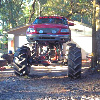
 Im putting some on myself.......

Draglink

Postmaster
Joined: Oct 2008
Posts: 3,026
Likes: 0
From: Renton, WA
 You stated;
"The steering box is not anywhere close to the front spring so the point in which an arch would begin to beging would make it as close to impossible as can be.
Very difficult to make two points pivot on similar archs wneh they are attached at different points, and have different length levers"
I should have used a diferant term, let's call it a parellel arc. The relationship between the spring pivot and drag link pivot at the pitman arm, are always the same as the relationship betwwen the axle and the steering arm. Alowing the draglink and spring to move in a paellel arc, preventing bumpsteer.
A good example of this parellel arc that is still in use and becoming more popular is in independant suspension systems. All three links move in a parellel arc. Both the upper and lower control arms, and most important the tie rod between the idler arm and steering arm.
You also stated;
"Now we should talk about the change in caster when the brakes are applied"
This equally true with all leaf spring suspension systems regardless of steering system.
So like I said before, I will give you that crossover steering is the better design I never said it wasn't. But your overly harsh and incorrect in your condemation of this design.

Post Fiend
Joined: Jul 2006
Posts: 6,948
Likes: 44
You stated;"The steering box is not anywhere close to the front spring so the point in which an arch would begin to beging would make it as close to impossible as can be.
Very difficult to make two points pivot on similar archs wneh they are attached at different points, and have different length levers"
I should have used a diferant term, let's call it a parellel arc. The relationship between the spring pivot and drag link pivot at the pitman arm, are always the same as the relationship betwwen the axle and the steering arm. Alowing the draglink and spring to move in a paellel arc, preventing bumpsteer.
A good example of this parellel arc that is still in use and becoming more popular is in independant suspension systems. All three links move in a parellel arc. Both the upper and lower control arms, and most important the tie rod between the idler arm and steering arm.
You also stated;
"Now we should talk about the change in caster when the brakes are applied"
This equally true with all leaf spring suspension systems regardless of steering system.
So like I said before, I will give you that crossover steering is the better design I never said it wasn't. But your overly harsh and incorrect in your condemation of this design.
Again I have to quote the entire thing!
Yes the box is not anywhere close to the fixed portion of the spring, and one thing you have not considered in any arguement is that the pivot point for the drag link is not fixed like the spring is. In this case the archs cant be even close since the arch for the spring changes during suspensions cycles. The drag link cant change lengths, and the only variance has to be the position of the pitman arm. This is called bumpsteer!
X-over does not do this with any front to rear movement axle movement.
SImple geometry here.,
Your parellel arch theory is incorrect in this case. This theory can be considered with multi link suspesnsions, but the drag link in a push pull system will never operate similar to a multi link system, and still cant operate at the same archs, since the pitman arm actually moves.
Basic geometry tells us that in order to have equal movement, and repeatable motion, two points (fixed) must remain the same. With a link connected to a pitman arm that can swing over a foot, this becomes impossible.
Again try to compress the driver side suspension on a push / pull system and turn the wheel to the left. The radius becomes limited, and if the vehicle can actually articulate far enough, the steering box will run out of travel before the wheels can be turned.
This means a full turn will onlt result in a trucj that can go straight. If you have not experienced this, you have not had a full sized truck an a real trail.
Moab and Johnson Valley is tough on steering systems, and we have not even talked about how many coolers it takes to make a system survive.
The extreme off-road exadurates everything that the street has to offer, and there is no room for any weak systems. There is a reason that we do not see this old style steering on the trail, or on a vehicle that has been modified.
Lift makes the old style steering system a thing of the past.
Your IFS example actually proves my point. Notice that the steering is not done by the push pull system, it is performed by the side to side method.
As the control arms move up and down, the tie rods are permitted to move in the same direction. This is the identical theory behind x-over and a solid axle.
Keep typing and proving my point.
Also not that in an IFS system there is a center link, that is fixed to two ends, and two tie rods. The tie rods are of equal length as the control arms, and the center link becomes the fixed portion of the system.
The tie rods will move on the same arch since they run parallel to tha control arms, and not against them.
Could you use a push pull steering design on an IFS system?????
No. Again, my you have enforced my point.
Geometry tells us that opposing forces can play together, but it still does not make it right, or in this case the most efficient.
Stock truck, push / pull barely liveable.
Modified / lifted truck, push / pull not even close to acceptabe.
Can it work, yes, it has been for years, but it does not mean that it is, or ever was even close to being right. It only meant that it was accepted, and many did not know the difference.
Heak we still see some pretty "scary steering" out there, and hopefully we have learned enough to know the difference.
Brake dive and axle wrap will have little effect on x-over steering.
Since the drag link is so far from the box, and the axle can ony rotate a few degrees (hopefully) the drag link or TRE's can accomodate the movement and not transfer this to the driver through the steering box. This would only twist the drag link and not change its length. The TRE's or spherical rod ends are designed to twist, so it will have little to no effect on the length of the drag link.
Wow, this is almost frusterating.
I have asked this before, and dont get me wrong, I do enjoy a decent debate, but you have actually proven my point time and time again, and I suspect that you have not driven similar vehicles equiped with these two types of steering.
Anyone that still has a push / pull system, believes that it is adequate, and for most, it might be. Heak Some people might even buy shoes that dont fit, just because they were a good deal. Might even invest in some insoles, or new laces in an attempt to correct the prolem, but the bottom line is that the shoes were designed for a different foot, and no matter how mucj you throw at them, they are not correct for the application.
The same is true for this old style steering system.
Yes I am hard on this style system, and I appreciate that you acknowledge that the x-over design is superior.
However, I am hard on the stock design because I do not see any advantage to the stock design. Perhaps If anyone could shed some light, and provide me with one advantage of the push / pull system, I might think differently.
Ok, I will start with the first advantage:
The truck is already equiped with the steering system, and it has been modified, yet still seems to work.
(Perhaps this is more of an excuse, and not an advantage)
Serious, I am eager to learn anything good about a push pull system.

Postmaster
Joined: Oct 2008
Posts: 3,026
Likes: 0
From: Renton, WA

The better steering system depends entirely on the suspension system used. With a panhard bar, crossover is better. Without, this system is better.
You are correct that axle wrap will have will have an effect on this system, but this is not bumpsteer.
Post Fiend
Joined: Jul 2006
Posts: 6,948
Likes: 44
Two of my trucks run x-over without a panhard (trac bar) and still the steering is better than any, and even the best push / pull system I have ever seen, driven or heard of.
Again, tell me please where the push / pull system has an advantage.
I actually though of another one since the last time I asked.
Limited space might exclude the use of x-over, but that does not give the stock design an advantage, it only means the owner of a stock truck has to settle for the poor design.
Chances are that this owner might never see the advantages anyway.

The push / pull system has, nor will ever be superior to any type of crossover system.
Once again, show me an advantage. I have listed two, and these are really not advantages.
I have not seen anything that justifies the use of push / pull.
Eager to learn though. I might have over looked something during my builds.
Postmaster
Joined: Oct 2008
Posts: 3,026
Likes: 0
From: Renton, WA
If you are running crossover without a panhard you have bumpsteer it's simple geometry.
I have explained twice the advantages of what you call the push / pull system and don't feel like doing it again.
I personally run a cross-over with a panhard.
The ideal live axle suspension/steering would be a triangulated four link, with a "push/pull" steering system with the steering box mounted just above the frame mount for the outer/lower link and the draglink parellel and equal in length to that link and attached to a bell crank on the axle. Everything else is a compromise.
I have explained twice the advantages of what you call the push / pull system and don't feel like doing it again.
I personally run a cross-over with a panhard.
The ideal live axle suspension/steering would be a triangulated four link, with a "push/pull" steering system with the steering box mounted just above the frame mount for the outer/lower link and the draglink parellel and equal in length to that link and attached to a bell crank on the axle. Everything else is a compromise.
Post Fiend
Joined: Jul 2006
Posts: 6,948
Likes: 44
If you are running crossover without a panhard you have bumpsteer it's simple geometry.
I have explained twice the advantages of what you call the push / pull system and don't feel like doing it again.
I personally run a cross-over with a panhard.
The ideal live axle suspension/steering would be a triangulated four link, with a "push/pull" steering system with the steering box mounted just above the frame mount for the outer/lower link and the draglink parellel and equal in length to that link and attached to a bell crank on the axle. Everything else is a compromise.
I have explained twice the advantages of what you call the push / pull system and don't feel like doing it again.
I personally run a cross-over with a panhard.
The ideal live axle suspension/steering would be a triangulated four link, with a "push/pull" steering system with the steering box mounted just above the frame mount for the outer/lower link and the draglink parellel and equal in length to that link and attached to a bell crank on the axle. Everything else is a compromise.
If the spring does an adequate job of locating the axle laterally, the force will not be placed on the drag link and the vehicle will not bumpsteer. Weak springs, or springs with mega arch might benifit from a trac bar.
If the axle does not move from left to right, it will be impossible to affect the steering during normal suspension cycles.
Just as a note, I use a trac bar on a leaf sprung vehicle because I also use Johnny Joints in the shackle. This created a wobble, and to eliminate the wobble, a trac bar was added. This was not because the vehicle had any "bumpsteer".
A properly designed x-over will all but eliminate the bumpsteer problem.
Too much lift, and too much angle on the drag link will contribute to bumpsteer, but as mentioned earlier this is not a properly designed system, but even an improperly designed x-over is still advantageous when compared to a push / pull system.
Since we have already aggreed that the axle on the same leaf sprung vehicle does move towards the shackle during suspension cycles, then this will indeed place additional tension on the drag link (push / pull) and cause bumpsteer. Cant avoid that, regardless of how many times you try to explain it.
You have explained it twice and both times you have agreed, but not willing to admit that not a single time ever mentioned an "advantage" of the push / pull system over an x-over style system.
Yup, read everything again, and I do not see anything that can prove an advantage. Difference between a fact and an opinion.
Your basic geometry concept leaves something to be desired.
Your "ideal live axle suspension / steering" concept is interesting. WHile creative, not very practical. Can you show me 1 vehicle that actually uses a steering box located behind the front axle, and has a drag link that runs parallel to the lower axle locating link. Seems that my geometry would indicate that this would get hung up, and bent during any off road use, other than on and off of the trailer.
Your creative concept has no mention of the lengths of the 4 links, and this alone could cause severe pinion angle changes during suspension cycles, and if this was the case, your ideal concept would also bumpsteer.
Maybe you can provide a picture of this ideal concept, and even provide a pic of this system being used.
You use x-over yourself????? Why?
I already know why. The same reason we all use it. X-over is far superior to any push / pull design.
That was the point from the beginning, and I stand by that until proven otherwise. When I see the aftermarket, and competition vehicles using your "ideal concept", I may re-consider, but until then, I will stick with the superior system X-over.

Thread Starter
|
Tuned

Joined: Apr 2006
Posts: 335
Likes: 2
From: N of Houston, TX
You just killed your own argument, Opossum! C'mon man I was hoping this thread would make it to 5 or 6 pages 
FTE Stories
Ford Trucks for Ford Truck Enthusiasts

3 Best / 3 Worst Parts of Modern Ford Ownership
Brett Foote
10 Amazing Upgrades That Solve Common Ford Truck Owner Headaches
Pouria Savadkouei
Every 2026 Ford Engine Explained
Brett Foote
10 Ugly Ford Trucks That We Still Kinda Love
Joe Kucinski
10 Things Every Truck Owner NEEDS (2026 Edition)
Michael S. Palmer
Rezvani's Latest Post-Apocalyptic Monster Is a Ford F-150 Raptor Underneath
Verdad Gallardo
Top 10 Most Expensive Ford Trucks Ever Sold on Bring a Trailer
Joe Kucinski
2027 Ford Super Duty Buyer's Guide (Every Model, Engine, & Package)
Brett Foote
Top 10 Ford Truck Tragedies
Joe Kucinski
Postmaster
Joined: Oct 2008
Posts: 3,026
Likes: 0
From: Renton, WA
Your "ideal live axle suspension / steering" concept is interesting. WHile creative, not very practical. Can you show me 1 vehicle that actually uses a steering box located behind the front axle, and has a drag link that runs parallel to the lower axle locating link. Seems that my geometry would indicate that this would get hung up, and bent during any off road use, other than on and off of the trailer.
Your creative concept has no mention of the lengths of the 4 links, and this alone could cause severe pinion angle changes during suspension cycles, and if this was the case, your ideal concept would also bumpsteer.
Maybe you can provide a picture of this ideal concept, and even provide a pic of this system being used.
You use x-over yourself????? Why?
I already know why. The same reason we all use it. X-over is far superior to any push / pull design.
That was the point from the beginning, and I stand by that until proven otherwise. When I see the aftermarket, and competition vehicles using your "ideal concept", I may re-consider, but until then, I will stick with the superior system X-over.
Your creative concept has no mention of the lengths of the 4 links, and this alone could cause severe pinion angle changes during suspension cycles, and if this was the case, your ideal concept would also bumpsteer.
Maybe you can provide a picture of this ideal concept, and even provide a pic of this system being used.
You use x-over yourself????? Why?
I already know why. The same reason we all use it. X-over is far superior to any push / pull design.
That was the point from the beginning, and I stand by that until proven otherwise. When I see the aftermarket, and competition vehicles using your "ideal concept", I may re-consider, but until then, I will stick with the superior system X-over.
Like I said I beleive that is an ideal concept, but practical design is rarely ideal. No I don't beleive I have yet seen a system exactly like that and don't really see building one for myself (if I was doing that much work I'd do an independent suspension) But I beleive it work work well on a buggy.
I have owned two vehicles that had the steering box behind the front axle. One of them had a terrible design it was a '55 M-38A1 Jeep (military CJ-5) these factory systems sucked, I never even botherd with it. The other was great though it was a '54 M-37 a military power wagon, this sucker articulated well and did not bumpsteer. It used a steering box behind the axle right at the base of the column. And the rest of the steering system very simaler to the ford except the box was in back and shackles were in the front.
The lengths of the arms really, that's your argument that I didn't mention exact arm lengths.
I use x-over because it was a very easy upgrade to my factory system. All I had to do was add a steering arm and modify my panhard bar bracket. The panhard is larglely why I did it. The leveler Panhard reduced the side to side movement of the axle during suspension cycles. My panhard is now both equal length to my draglink and always parallel. This truly eleminates all my bumpsteer.
Postmaster
Joined: Oct 2008
Posts: 3,026
Likes: 0
From: Renton, WA
 I didn't have the other system to begin with. X-over was a natural upgrade for me.
Thread Starter
|
Tuned
Joined: Apr 2006
Posts: 335
Likes: 2
From: N of Houston, TX
From what Ed tells me, I have a pretty natural upgrade to x-over myself...

Post Fiend
Joined: Jul 2006
Posts: 6,948
Likes: 44
TexasRho83:
Your upgrade to x-over is a very simple approach. Since you have a 78/9 power steering box, you can remove the pitman arm and re-index it to swing from left to right instead of front to rear.
Your arm can be installed at every 90 degrees, and this is as easy as it gets.
Next will be to bolt on steering arm to the pass side knuckle, and install new fasteners.
Connect the pitman arm to the steering arm with a new drag link, and you are done.
Now a few snags that were not mentioned would be chosing the correct length drag link if you are making your own, and chosing the correct tapper for the appropriate TRE if you chose to run TRE's.
Otherwise you have the option of using spherical rod ends, and then you can drill the holes in the pitman and steering arms yourself. 3/4" will do it.
For your truck, this is probably a two to three beer project...
Your upgrade to x-over is a very simple approach. Since you have a 78/9 power steering box, you can remove the pitman arm and re-index it to swing from left to right instead of front to rear.
Your arm can be installed at every 90 degrees, and this is as easy as it gets.
Next will be to bolt on steering arm to the pass side knuckle, and install new fasteners.
Connect the pitman arm to the steering arm with a new drag link, and you are done.
Now a few snags that were not mentioned would be chosing the correct length drag link if you are making your own, and chosing the correct tapper for the appropriate TRE if you chose to run TRE's.
Otherwise you have the option of using spherical rod ends, and then you can drill the holes in the pitman and steering arms yourself. 3/4" will do it.
For your truck, this is probably a two to three beer project...