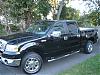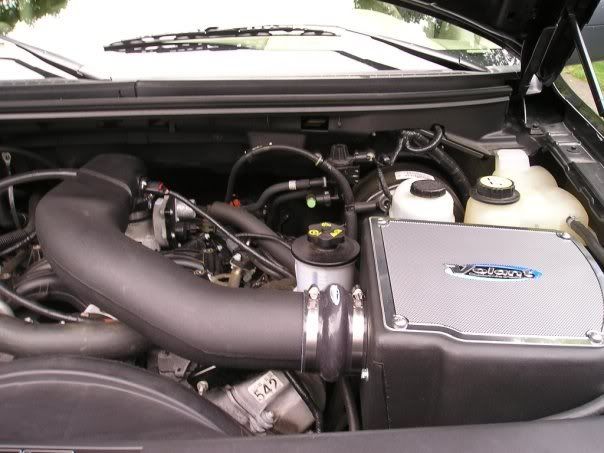

cold air intake
Senior User
Joined: Dec 2007
Posts: 256
Likes: 0
From: Sudbury, Ontario
does the Volant have a dry filter? (no oil) what about the s&b?
anyone have any experance with the AEM brute force or the roush?
what i've read: the AEM is garented to provide the most hp, tq and flow or money back, the dry synethic materal does not flow as well as the cotten gaze but they design the systems to proived 4 times the amount of air needed. the system also has a heat sheild that when the hood is closed it's sealed so that it only draws air in from the fender. they have designed thier systems to keep the proper air/fuel mixture unlike some that create a lean a/f


AEM - Brute Force Air Induction System
edit:
the roush is pretty much identical for roughly the same amount of money only major difference is the tube.

ROUSH Performance: 5.4L Cold Air Intake Kit Detail
anyone have any experance with the AEM brute force or the roush?
what i've read: the AEM is garented to provide the most hp, tq and flow or money back, the dry synethic materal does not flow as well as the cotten gaze but they design the systems to proived 4 times the amount of air needed. the system also has a heat sheild that when the hood is closed it's sealed so that it only draws air in from the fender. they have designed thier systems to keep the proper air/fuel mixture unlike some that create a lean a/f
AEM - Brute Force Air Induction System
edit:
the roush is pretty much identical for roughly the same amount of money only major difference is the tube.
ROUSH Performance: 5.4L Cold Air Intake Kit Detail
Last edited by 98greensi; Sep 15, 2008 at 11:07 AM. Reason: more info

MMNC (SS)(Ret)


Joined: Mar 2004
Posts: 11,606
Likes: 151
From: SE Georgia

this is a sealed box. It didn't have the lid installed yet...that's why you can see the filter
it sucks are from the OEM hole in your fender...and then there is a 4"x3" (roughly) scoop on the bottom side directly behind the headlight that scoops fresh air as well.
Volant is very well designed, and problem free. The 04's initially had CEL's...well with pretty much every CAI...but that was due to their ECU fuel maps. The 05+ have a better ECU fuel map and the CEL's are pretty non-existant with 99% of the CAI's out there.
Trending Topics
Senior User
Joined: Mar 2008
Posts: 444
Likes: 1
From: Vermont
FTE Stories
Ford Trucks for Ford Truck Enthusiasts

Top 10 Fords at 2026 Carlisle Ford Nationals
Joe Kucinski
3 Best / 3 Worst Parts of Modern Ford Ownership
Brett Foote
10 Amazing Upgrades That Solve Common Ford Truck Owner Headaches
Pouria Savadkouei
Every 2026 Ford Engine Explained
Brett Foote
10 Ugly Ford Trucks That We Still Kinda Love
Joe Kucinski
10 Things Every Truck Owner NEEDS (2026 Edition)
Michael S. Palmer
Rezvani's Latest Post-Apocalyptic Monster Is a Ford F-150 Raptor Underneath
Verdad Gallardo
Top 10 Most Expensive Ford Trucks Ever Sold on Bring a Trailer
Joe Kucinski
2027 Ford Super Duty Buyer's Guide (Every Model, Engine, & Package)
Brett Foote

Senior User
Joined: May 2008
Posts: 121
Likes: 0
From: South, AR
Yeah I have trouble keeping my foot out of it too since I installed mine sounds great!!!

Moderator


Joined: Aug 2002
Posts: 6,104
Likes: 384
From: Southern California

I have looked at every design out (IMHO), and while all share the same objective, fit, finish and the use of a dry filter (required IMHO) varies. Some produce a check engine light because of the air sensor location in the new unit. Given the cost, I built my own using existing OEM parts.
Based on my own flow testing and docs received from Ford & Wix, I concluded the following:
1. Flat panel filters can actually flow more cfm than cone style units if you analyze the turbulance or flow characteristics created after the entrance into the filter. I run a Wix HP series oem replacement unit (same series used in NASCAR).
2. The oem air intake manifold (the box located directly to the TB intake) is well designed with little gain to be had on a stock or lightly modified engine not turning over 5,500 rpm.
3. The pipe that feeds the air into the unit does have air flow restriction, most is seen at or below 35 mph and by design does not take advantage of potential gains from 35-70 mph.
4. Coldest air is located at a max height of 6 inches from the ground (from my old racing days) but is not a good location for street cars due to potential water and intake.
5. Ram air is still ram air.....
So I built a 1960's style ram air duct into the OEM manifold that replaces the intake hose. MPG gains are 16 mpg city, 13 mpg very heavy stop/go traffic, 21 mpg hwy (Lincoln Mark LT 4x2).
Throttle response is improved at idle and at 70 mph you can really feel a difference in terms of engine response.
Since I don't have time to go the track, we compared my truck to my cousins GMC which is the same year, but 4x4 and has the 8 liter in 0-60 accel test.
OEM to OEM air intake system: GMC beat the LT by 1/2 fender
My system to $600 GMC aftermarket CAI: Mark LT beat GMC by 6"
There are only a few of the CAI systems that are actually "engineered"- most are put together by what will install and how it looks- the do it yourself kits are probably just as efficient as 90% of what you can buy IMHO.
Based on my own flow testing and docs received from Ford & Wix, I concluded the following:
1. Flat panel filters can actually flow more cfm than cone style units if you analyze the turbulance or flow characteristics created after the entrance into the filter. I run a Wix HP series oem replacement unit (same series used in NASCAR).
2. The oem air intake manifold (the box located directly to the TB intake) is well designed with little gain to be had on a stock or lightly modified engine not turning over 5,500 rpm.
3. The pipe that feeds the air into the unit does have air flow restriction, most is seen at or below 35 mph and by design does not take advantage of potential gains from 35-70 mph.
4. Coldest air is located at a max height of 6 inches from the ground (from my old racing days) but is not a good location for street cars due to potential water and intake.
5. Ram air is still ram air.....
So I built a 1960's style ram air duct into the OEM manifold that replaces the intake hose. MPG gains are 16 mpg city, 13 mpg very heavy stop/go traffic, 21 mpg hwy (Lincoln Mark LT 4x2).
Throttle response is improved at idle and at 70 mph you can really feel a difference in terms of engine response.
Since I don't have time to go the track, we compared my truck to my cousins GMC which is the same year, but 4x4 and has the 8 liter in 0-60 accel test.
OEM to OEM air intake system: GMC beat the LT by 1/2 fender
My system to $600 GMC aftermarket CAI: Mark LT beat GMC by 6"
There are only a few of the CAI systems that are actually "engineered"- most are put together by what will install and how it looks- the do it yourself kits are probably just as efficient as 90% of what you can buy IMHO.