




Next years fuel........

Thread Starter
|
FTE Remembers


Joined: Jan 2005
Posts: 26,337
Likes: 12
From: Paradise Found!
Next years fuel........
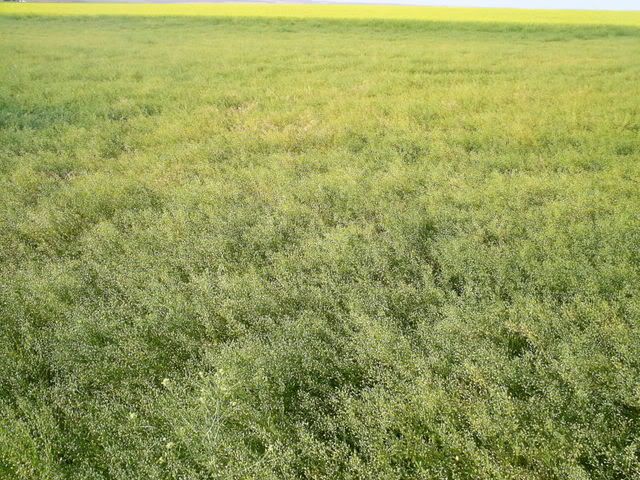
Here is a picture of my Camelina test plot (25 acres ) :
The seed pods have already formed, and the crop is about 1 foot tall.
I don't think the yeald will be as much as the Canola field in the background.
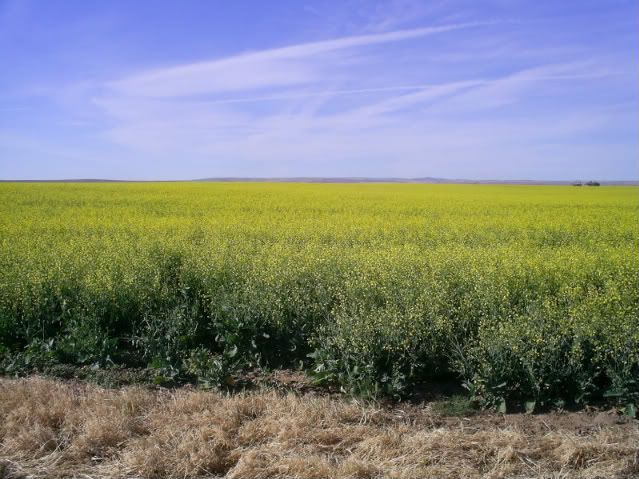
And this is the Canola field, 100 acres that should produce 20,000 gallons this year!
The seed pods have already formed, and the crop is about 1 foot tall.
I don't think the yeald will be as much as the Canola field in the background.
And this is the Canola field, 100 acres that should produce 20,000 gallons this year!
Thread Starter
|
FTE Remembers
Joined: Jan 2005
Posts: 26,337
Likes: 12
From: Paradise Found!
I've got about $1,000 in direct costs in the 100 acres of Canola at this point. After harvest I'll have a better Idea of the total cost of production.
I've already pre-sold the feedmeal @ $200/ton to a local dairy. At an average yeald of 4,000 lbs/acre that should be approx 120 tons X $200 = $24,000 just for the feedmeal.
I've already pre-sold the feedmeal @ $200/ton to a local dairy. At an average yeald of 4,000 lbs/acre that should be approx 120 tons X $200 = $24,000 just for the feedmeal.
Thread Starter
|
FTE Remembers
Joined: Jan 2005
Posts: 26,337
Likes: 12
From: Paradise Found!
About 1/2 of what the Canola fields cost, but with only 1/2 the yeald of Canola I probably will only plant Camelina as a spring rotation about every 4-5 years.
Trending Topics
Thread Starter
|
FTE Remembers
Joined: Jan 2005
Posts: 26,337
Likes: 12
From: Paradise Found!
Thanks, I take great pride in my stewardship of our land!
FTE Stories
Ford Trucks for Ford Truck Enthusiasts

Top 6 Best Deals Available on New Fords & Lincolns Right Now
Brett Foote
This Hennessey Takes the Expedition Tremor's Off-Roading Capability to the Next Level
Verdad Gallardo
Top 10 Fords at 2026 Carlisle Ford Nationals
Joe Kucinski
3 Best / 3 Worst Parts of Modern Ford Ownership
Brett Foote
10 Amazing Upgrades That Solve Common Ford Truck Owner Headaches
Pouria Savadkouei
Every 2026 Ford Engine Explained
Brett Foote
10 Ugly Ford Trucks That We Still Kinda Love
Joe Kucinski
10 Things Every Truck Owner NEEDS (2026 Edition)
Michael S. Palmer
Rezvani's Latest Post-Apocalyptic Monster Is a Ford F-150 Raptor Underneath
Verdad Gallardo
Senior User
Joined: Jul 2007
Posts: 118
Likes: 1
From: Winthrop, Minnesota
fabmandelux, why do you think the camelina yield will be so much lower per acre than the canola? I am not a farmer, but I am interested in learning about possible feedstock sources for making biodiesel. I have been doing a lot of reading on the internet about possible feedstocks but I find it hard to weed through all the hype and unfounded speculation. I would really appreciate some fact based information from someone that has been there and done real world farming and production of biodiesel feedstock.
Thanks for all you have done on this forum.
Jim
Thanks for all you have done on this forum.
Jim
Thread Starter
|
FTE Remembers
Joined: Jan 2005
Posts: 26,337
Likes: 12
From: Paradise Found!
From my experance with Canola I know I can produce around 4,000 lbs/acre. The seed pods on the Camelina are much smaller and less of them per plant. I think it's because the Canola is a fall seeded crop, and therefore has a longer time to grow. Camelina is a spring seeded crop only, and has less time to produce a crop. I won't know untill after harvest, just my observation of the fields. All my crops are dryland, no irrigation. The costs of growing Camelina is about half of that required for Canola. I will still use Camelina as a spring rotation to help control cheat grass, and goat grass in some years just as a way to control spring weeds. I have used spring seeded wheat in the past for this control, but the yealds are much smaller, and growing Camelina will give me a better ROI.
Senior User
Joined: Jul 2007
Posts: 118
Likes: 1
From: Winthrop, Minnesota
fabmandelux, Thanks for the information. I didn't know there was such a difference between the two crops. I came across this website today while doing some research and though I don't understand half of what it says I thought an experienced farmer such as your self might find it informative. Camelina: A Promising Low-Input Oilseed
Jim
Jim
Thread Starter
|
FTE Remembers
Joined: Jan 2005
Posts: 26,337
Likes: 12
From: Paradise Found!
fabmandelux, Thanks for the information. I didn't know there was such a difference between the two crops. I came across this website today while doing some research and though I don't understand half of what it says I thought an experienced farmer such as your self might find it informative. Camelina: A Promising Low-Input Oilseed
Jim
Jim
 Most of the info on Camelina is outdated or not applicable to my area. I've got a friend of mine that was so pumped about Camelina that he planted 1,000 acres of it. We had 2 days of below freezing weather in mid April that killed off his planting! Nobody told him that it's susceptible to late spring frosts.............It may be a viable crop for some areas, but Canola is still a better crop for this area.
Senior User
Joined: Jul 2007
Posts: 118
Likes: 1
From: Winthrop, Minnesota
A little OT: Yeah late spring frost is a real killer of crops, even down here in the Sacramento Valley area they somtimes wipe out the farmers whole season. Although in our area it is usually late spring rains and winds that wipe out the blossoms on the new crops for the year. I sometimes wonder how farmers are able to stay in business what with all that mother nature throws at them and then all of the government interference on top of everything else.
Jim
Jim

Thread
Thread Starter
Forum
Replies
Last Post
fabmandelux
General NON-Automotive Conversation
33
Mar 1, 2009 01:36 PM