



Carb Jets
Thread Starter
|
Senior User
Joined: Jan 2008
Posts: 246
Likes: 0
From: Cincinnati, OH
Carb Jets
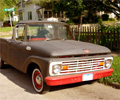
I rebuilt the Carb on my 64 292. It is the original carb, an auto-lite. I have been having some trouble getting it dialed in. My carb guru buddy came over the other night to help me get it right, and one of the first things we noticed is that when you "gun" it, the motor falls on it's face, He figured it just wasn't getting enough gas. So he pulled out the jets and said "holy *****! I've never seen jets that small before". The jets appear to say 48 on them. so to test the theory, we drilled them out to .062 (that was my smallest bit) and lo and behold you can now gun it without it dying out...but now it is too rich. I'm going to get a jet kit, and try a little smaller size and see how that works. I did a little research, and the elevation of Deadwood, SD (where the truck was originally purchased and remained for 43 years) is at 4531 ft. I am in Cincinnati, OH where the elevation is only 482 ft. Would that explain why I need bigger jets??
Thread Starter
|
Senior User
Joined: Jan 2008
Posts: 246
Likes: 0
From: Cincinnati, OH
The tag on my carb reads:
C3TF H
B 4CC
On the side of the carb is a marking that looks like a 5 year old's drawing of sunshine and inside it has:
1.02
292
Does it sound like this is the correct carb on this truck?
C3TF H
B 4CC
On the side of the carb is a marking that looks like a 5 year old's drawing of sunshine and inside it has:
1.02
292
Does it sound like this is the correct carb on this truck?
Ford Parts Specialist
Joined: Nov 2006
Posts: 88,826
Likes: 787
From: Simi Valley, CA

C3TF-H = C3TZ-9510-U .. Carburetor (Motorcraft CA-271)
1957/63 & 1964/72 Ford Truck Parts Catalogs / Carburetor Parts List #14A
Original application: 1963/64 F100/700 292.
D4AZ-9A586-A .. Carb Kit (Motorcraft CT-499-D)
78-9533-B .. Carb Jet ~ #48: 0-5,000 ft. (Motorcraft CJ-55)
C1AZ-9533-B .. Carb Jet ~ #46: 5,000-10,000 ft. (Motorcraft CJ-20)
C1AZ-9533-F .. Carb Jet ~ #44: 10,000-15,000 ft. (Motorcraft CJ-24)

Senior User
Joined: Apr 2007
Posts: 281
Likes: 0
From: Bloomfield, Iowa
If it falls on it's face immediately when you reve it, that's the accelerator pump and/or pump shot.
If it starts to accelerate then falls on it's face, that probably pump shot and jet.
You should have several choices for the pivot point of the arm going to the accelerator pump. Try another hole. See if that has any effect.
My guess is you should be in the 54-58 range for jets. You can't buy a jet kit for an Autolite carb that I have ever found. They are not the same as a Holley jet.
Drilling jets is a little different. The "48" on them is close to a size but it is actually a flow rating associated with the cross section of the hole. A 48 bit may or may not not pass through a 48 jet. You need to get a complete set of iwre gauge drills, start around #50 and sneak up on it. Jets can have an effect at idle if too large. Otherwise they are wide open throttle.
SPark
If it starts to accelerate then falls on it's face, that probably pump shot and jet.
You should have several choices for the pivot point of the arm going to the accelerator pump. Try another hole. See if that has any effect.
My guess is you should be in the 54-58 range for jets. You can't buy a jet kit for an Autolite carb that I have ever found. They are not the same as a Holley jet.
Drilling jets is a little different. The "48" on them is close to a size but it is actually a flow rating associated with the cross section of the hole. A 48 bit may or may not not pass through a 48 jet. You need to get a complete set of iwre gauge drills, start around #50 and sneak up on it. Jets can have an effect at idle if too large. Otherwise they are wide open throttle.
SPark
Thread Starter
|
Senior User
Joined: Jan 2008
Posts: 246
Likes: 0
From: Cincinnati, OH
Thanks for the info. It was falling on its face immediately. I suspected the accellerator pump, but I put in a new one when I rebuilt the carb so I decided that it should be OK. You are right about the pivot point - Right now the arm is in the hole closes to the carb. Maybe I can try the other hole.
My buddy said the jets he took out looked like standard Holley jets; I'll find out tonight when I bring it over his place. He has a Holley jet kit so I was going to try a couple sizes. Would Holley jets not work correctly in this carb?
My buddy said the jets he took out looked like standard Holley jets; I'll find out tonight when I bring it over his place. He has a Holley jet kit so I was going to try a couple sizes. Would Holley jets not work correctly in this carb?
Trending Topics
Senior User
Joined: Feb 2008
Posts: 316
Likes: 0
FTE Stories
Ford Trucks for Ford Truck Enthusiasts

3 Best / 3 Worst Parts of Modern Ford Ownership
Brett Foote
10 Amazing Upgrades That Solve Common Ford Truck Owner Headaches
Pouria Savadkouei
Every 2026 Ford Engine Explained
Brett Foote
10 Ugly Ford Trucks That We Still Kinda Love
Joe Kucinski
10 Things Every Truck Owner NEEDS (2026 Edition)
Michael S. Palmer
Rezvani's Latest Post-Apocalyptic Monster Is a Ford F-150 Raptor Underneath
Verdad Gallardo
Top 10 Most Expensive Ford Trucks Ever Sold on Bring a Trailer
Joe Kucinski
2027 Ford Super Duty Buyer's Guide (Every Model, Engine, & Package)
Brett Foote
Top 10 Ford Truck Tragedies
Joe Kucinski
Thread Starter
|
Senior User
Joined: Jan 2008
Posts: 246
Likes: 0
From: Cincinnati, OH
I went through great pains to make sure timing was set properly, point gap and spark plug gaps are set properly, balancer has not slipped, etc...I'm hoping that I am near the end of this frustrating trail!
Thanks
Thanks
Ford Parts Specialist
Joined: Nov 2006
Posts: 88,826
Likes: 787
From: Simi Valley, CA
Did you replace the check valve? It comes in the Motorcraft carb kit, dunno about other kits.
The check valve fits behind the acc. pump diaphragm, and has a small tit on it that wears/breaks off.
C4AZ-9B559-A .. Acc. Pump Diaphragm (Motorcraft CM-463)
C4AZ-9576-A .. Check Valve (Motorcraft CM-825)
Both these parts come with the kit.
D4AZ-9A586-A .. Carb Kit (Motorcraft CT-499-D)
btw: The pump diaphragm on Ford 2V carbs is notorious for being a total POS.
Did you see my post #5 with the info on the jets?
Thread Starter
|
Senior User
Joined: Jan 2008
Posts: 246
Likes: 0
From: Cincinnati, OH
I'm pretty sure I installed a new check valve along with a new pump diaphragm...I think I'll take the diaphragm and check valve out and do an inspection. I used a the kit that Carquest sold me - at first they gave me the wrong one (I think it was for a holley), then once I got the right one I couldn't find the carb's tag number on any of the documentation. So I ended up having to screw around with the float setting until I go it right (or close anyway). What a PITA this carb has been!
If I wanted to buy a new holley, how can I tell if it will fit? Is the 292 intake manifold fairly standard?
If I wanted to buy a new holley, how can I tell if it will fit? Is the 292 intake manifold fairly standard?
Ford Parts Specialist
Joined: Nov 2006
Posts: 88,826
Likes: 787
From: Simi Valley, CA
I'm pretty sure I installed a new check valve along with a new pump diaphragm...I think I'll take the diaphragm and check valve out and do an inspection. I used a the kit that Carquest sold me - at first they gave me the wrong one (I think it was for a holley), then once I got the right one I couldn't find the carb's tag number on any of the documentation. So I ended up having to screw around with the float setting until I go it right (or close anyway). What a PITA this carb has been!
If I wanted to buy a new holley, how can I tell if it will fit? Is the 292 intake manifold fairly standard?
If I wanted to buy a new holley, how can I tell if it will fit? Is the 292 intake manifold fairly standard?
Ford used the same 2V carb kit from 1962 thru 1974 on everything from 221 cid Fairlanes thru 460's on 74 LTD's, and that covered prolly 2,000 different carb ID tag numbers!
Now you know why there's no carb ID number in the documentation!

Thread Starter
|
Senior User
Joined: Jan 2008
Posts: 246
Likes: 0
From: Cincinnati, OH
Well, I have finally had enough of this P.O.S. carb. I have been screwing around this this pile for a month now when I should have been enjoying my slick...I just can't figure out what the heck is wrong. I have only driven it about 20 miles since I bought it, back in January...
I'm going to get a holley for it.
I'm going to get a holley for it.

Thread
Thread Starter
Forum
Replies
Last Post
kel1306
FE & FT Big Block V8 (332, 352, 360, 390, 406, 410, 427, 428)
1
Oct 17, 2016 02:19 PM
wallysF100
1973 - 1979 F-100 & Larger F-Series Trucks
3
Jan 8, 2016 08:48 AM
wallysF100
1973 - 1979 F-100 & Larger F-Series Trucks
1
Jan 4, 2016 06:44 PM
reverendxlt
1973 - 1979 F-100 & Larger F-Series Trucks
9
Dec 10, 2011 07:04 PM
newrider3
Ford Inline Six, 200, 250, 4.9L / 300
12
Aug 4, 2010 10:36 PM
