


What Heads Do I Have?

Thread Starter
|
Cargo Master

Joined: Dec 2004
Posts: 3,362
Likes: 22
From: Florence, SC
What Heads Do I Have?
What heads do I have on my stock 1985 carbureted 302 F150 with AOD? What are the cc figures? Are these heads as bad as I have heard? What would be my compression ratio?
What would be a good, solid upgrade to these heads?
Thanks!
What would be a good, solid upgrade to these heads?
Thanks!

Posting Guru
Joined: Mar 2007
Posts: 1,649
Likes: 2
A couple of us have gotten different info regarding what cc these year heads are. 2 years either way and there would be less doubt. Do you have the heads off, so you can turn them over and get the casting #'s? I'm going to say these were the 69 cc or so heads. I'm also going to say your compression was 8.3:1. Supposedly there are some kind of hi-output heads made in 85, but I've never seen them. If they are what I think they are, you would be better off with E7TE heads for a simple stock upgrade. Then there are GT-40's, early 351w heads and many different aftermarket heads. I'm not 100% sure on what you have, but the E7's alone should boost your compression close to a point, (I would think), but there are so many variables that determine CR: bore size, gasket thickness, whether the heads or block have been decked, that no one can tell you what CR you will get with any head until the other variables are established.
FTE Legend


Joined: Jun 2006
Posts: 31,930
Likes: 1,499
From: Ottawa, Ontario
You should have E5TE heads on that motor, and if so they are nearly identical to the E7TE's.. 64cc combustion chamber, 1.78"/1.45" valves. To get an upgrade over these heads you need to go to GT40 or the aftermarket, but if the cam in this motor is stock you are nowhere near the full potential of the existing heads.
Thread Starter
|
Cargo Master
Joined: Dec 2004
Posts: 3,362
Likes: 22
From: Florence, SC
You should have E5TE heads on that motor, and if so they are nearly identical to the E7TE's.. 64cc combustion chamber, 1.78"/1.45" valves.
[QUOTE[To get an upgrade over these heads you need to go to GT40 or the aftermarket, but if the cam in this motor is stock you are nowhere near the full potential of the existing heads.[/QUOTE]
I do have the stock cam. What cam would you reccomend to reach the full potential of the existing heads?
FTE Legend
Joined: Jun 2006
Posts: 31,930
Likes: 1,499
From: Ottawa, Ontario
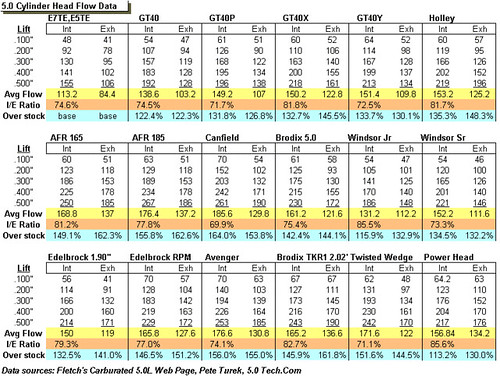
Here's a chart with some popular head flow numbers for comparison. The stock heads are a pretty good match for a 302 in a truck, larger volume heads tend to weaken the low end power even more. The Comp cams 31-255-5 is a healthy upgrade over the stock cam, there are lots more that would work as well with a carb, but in general a short duration-high lift cam like this will deliver best low rpm to mid range power.
Thread Starter
|
Cargo Master
Joined: Dec 2004
Posts: 3,362
Likes: 22
From: Florence, SC
Here's a chart with some popular head flow numbers for comparison. The stock heads are a pretty good match for a 302 in a truck, larger volume heads tend to weaken the low end power even more.
The Comp cams 31-255-5 is a healthy upgrade over the stock cam, there are lots more that would work as well with a carb, but in general a short duration-high lift cam like this will deliver best low rpm to mid range power.
FTE Legend
Joined: Jun 2006
Posts: 31,930
Likes: 1,499
From: Ottawa, Ontario
Is this the best choice for a cam upgrade, considering my EGR is removed along with all other emissions equipment? (I heard once that the stock cam is for use with a working EGR and the emissions equipment) I also plan to run a good set of ceramic Tri-Y headers for even more low to mid-range power, and my engine overhaul will finally be complete. Please tell me more about this Comp cam. I can't seem to find this particular cam in my Summit or Jeg's catalogs.
Cam selection is independent of emissions equipment since this gear just rides on the motor and should have no beneficial or detrimental effect on performance when it is operating properly. It was common to use cams with more valve overlap before EFI, but this style cam profile doesn't provide sufficient vacuum signal at idle speeds for the EFI control system, so cams with wider lobe seperation were developed. An additional benefit of this is it builds more cylinder pressure and as a result more low rpm TQ, so these EFI grinds also make good RV style cams for a carburated motor. For comparison the base 5.0 cam has lift of 0.379/395" and 244/256 duration at the valve.
Trending Topics
Thread Starter
|
Cargo Master
Joined: Dec 2004
Posts: 3,362
Likes: 22
From: Florence, SC
Thanks again, Conanski! You are a big help! Last thing...what about the timing set? If I were to change that while my motor is out, (which I probably will) is the stock efficient, or is there a "healthy upgrade" that would be better to use now that the engine is without all emissions equipment and modified with a better cam? Seems like I heard there was difference if I went with a "pre-smog" timing chain. Any truth to this, or any recommendations?
FTE Stories
Ford Trucks for Ford Truck Enthusiasts

Top 6 Best Deals Available on New Fords & Lincolns Right Now
Brett Foote
This Hennessey Takes the Expedition Tremor's Off-Roading Capability to the Next Level
Verdad Gallardo
Top 10 Fords at 2026 Carlisle Ford Nationals
Joe Kucinski
3 Best / 3 Worst Parts of Modern Ford Ownership
Brett Foote
10 Amazing Upgrades That Solve Common Ford Truck Owner Headaches
Pouria Savadkouei
Every 2026 Ford Engine Explained
Brett Foote
10 Ugly Ford Trucks That We Still Kinda Love
Joe Kucinski
10 Things Every Truck Owner NEEDS (2026 Edition)
Michael S. Palmer
Rezvani's Latest Post-Apocalyptic Monster Is a Ford F-150 Raptor Underneath
Verdad Gallardo
Thread Starter
|
Cargo Master
Joined: Dec 2004
Posts: 3,362
Likes: 22
From: Florence, SC
Conanski, how does this cam sound? Is it smooth, more like the factory cam, or is it very choppy? I mean, will you be able to tell from HEARING it that it is not a stock cam?
FTE Legend
Joined: Jun 2006
Posts: 31,930
Likes: 1,499
From: Ottawa, Ontario
This cam should idle smoothly, the same characteristics that make it good at producing low rpm power also mean it should have near stock idle quality. If you want the motor to sound like it has a cam in it you will sacrifice low rpm power, there's always a tradeoff.
Thread Starter
|
Cargo Master
Joined: Dec 2004
Posts: 3,362
Likes: 22
From: Florence, SC
Conanski, will you look over this for me and tell me what you think? Unlike me, who is still learning, you seem to have respectable knowledge and experience with engine building and fundamentals:
What I have right now:
A 2wd 1985 Ford F150 with a rebuilt, healthy stock carbureted 302 engine, 3:55 gears, AOD transmission, Edelbrock Performer (non-EGR) aluminum intake manifold, and Holley 570 cfm 4-V carburetor. I removed the computer and TFI/EEC-IV ignition system for the Duraspark II ignition system, re-curved the distributor with the lighter advance springs while I was doing that (to make full advance come in by 2000 rpm) and removed all other emissions, since most of it wasn't working anyway, except for the PCV system.
What I want to accomplish:
Good, solid, and simple upgrades while my engine is out to keep this engine dependable and gain a little on low-rpm and mid-range power. I am NOT looking to race the truck or anything like that. The only other thing I plan on doing is to replace my exhaust system that is rusting off the truck with a set of Thorley Tri-Y long tube headers and true dual exhaust.
Conanski, if I were to use the cam you recommended, along with the matching Comp timing set, will I see a noticeable improvement? Do all of these parts seem to MATCH to achieve this goal? Do you think my stock heads will still be a good match? Am I missing anything? Thanks so much.
What I have right now:
A 2wd 1985 Ford F150 with a rebuilt, healthy stock carbureted 302 engine, 3:55 gears, AOD transmission, Edelbrock Performer (non-EGR) aluminum intake manifold, and Holley 570 cfm 4-V carburetor. I removed the computer and TFI/EEC-IV ignition system for the Duraspark II ignition system, re-curved the distributor with the lighter advance springs while I was doing that (to make full advance come in by 2000 rpm) and removed all other emissions, since most of it wasn't working anyway, except for the PCV system.
What I want to accomplish:
Good, solid, and simple upgrades while my engine is out to keep this engine dependable and gain a little on low-rpm and mid-range power. I am NOT looking to race the truck or anything like that. The only other thing I plan on doing is to replace my exhaust system that is rusting off the truck with a set of Thorley Tri-Y long tube headers and true dual exhaust.
Conanski, if I were to use the cam you recommended, along with the matching Comp timing set, will I see a noticeable improvement? Do all of these parts seem to MATCH to achieve this goal? Do you think my stock heads will still be a good match? Am I missing anything? Thanks so much.
FTE Legend
Joined: Jun 2006
Posts: 31,930
Likes: 1,499
From: Ottawa, Ontario
The cam change will certainly make a noticable improvement in power, the cam is what determines the shape and size of the powerband after all for any given motor. The stock cam in this motor really does leave a lot on the table, it's so small in fact it's nearly impossible to get less power with any aftermarket cam. The stock heads are also fine for truck applications(emphasis on low rpm power), you can certainly get lots more peak HP with bigger heads and a different cam, but all that extra power will be at higher rpms and at the expense of low rpm power. This is a good commbo for the intended application IMO. Others here have been down this road before and the results speak for themselves. Several members here have added a complete GT40 top end to the stock truck motor or a HO bottom end(which is the same except for the cam). In all cases they got lots more HP at 5000rpm, but complained that motor seemed even weaker than stock below 3000rpm. If you had 50 more cubic inches then the situation changes because the stock heads are really too restrictive for a 5.8 and hurt power output everywhere, but that's not the case so don't worry about the heads.
Posting Guru
Joined: Mar 2007
Posts: 1,649
Likes: 2
[quote=LARIAT 85;6131468]Conanski, will you look over this for me and tell me what you think? Unlike me, who is still learning, you seem to have respectable knowledge and experience with engine building and fundamentals:
.
. The only other thing I plan on doing is to replace my exhaust system that is rusting off the truck with a set of Thorley Tri-Y long tube headers and true dual exhaust.
quote] Perhaps Paul has an opinion on this as well: From what I've read, "true dual" exhaust is not the best option in exhaust piping, as the "X" or "H" pipes actually improve airflow over "true" duals as they help contribute to exhaust scavenging by the flow of the other banks cylinders helping to pull some extra exhaust out and keep the flow more even overall. Of the 2, I think "H" pipe is probably better , as most "Y's" are at least potentially restrictive. Keeping with the "smaller is better" for your motor theme, (which I agree with), I would keep pipe size at 2 1/2" . Just M.O. The better your mufflers flow, the better your results there. It's all about velocity, not volume, with your motor.
.
. The only other thing I plan on doing is to replace my exhaust system that is rusting off the truck with a set of Thorley Tri-Y long tube headers and true dual exhaust.
quote] Perhaps Paul has an opinion on this as well: From what I've read, "true dual" exhaust is not the best option in exhaust piping, as the "X" or "H" pipes actually improve airflow over "true" duals as they help contribute to exhaust scavenging by the flow of the other banks cylinders helping to pull some extra exhaust out and keep the flow more even overall. Of the 2, I think "H" pipe is probably better , as most "Y's" are at least potentially restrictive. Keeping with the "smaller is better" for your motor theme, (which I agree with), I would keep pipe size at 2 1/2" . Just M.O. The better your mufflers flow, the better your results there. It's all about velocity, not volume, with your motor.
Thread Starter
|
Cargo Master
Joined: Dec 2004
Posts: 3,362
Likes: 22
From: Florence, SC
Conanski, with all the engine modifications I listed above, would a low-rise or high-rise dual plane intake manifold be a better choice for low end power for a truck application? Could I, or should use a 4-hole phenoleic spacer with the low-rse or high-rise intake manifold? Any recommendations? Thanks!