


Rear end question.

Thread Starter
|
Posting Guru
Joined: Dec 2007
Posts: 2,386
Likes: 0
From: North Van BC, Canada. EH!
Rear end question.
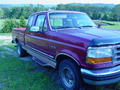
My 150 had its box removed and a flat deck installed. I spin the tires alot, because of the loss of that extra weight. What would be the stock numbers for a rear end for a 1994 F150 i6 auto. Or where would I find this information on the truck?
Reason I ask, is a buddy of mine suggested I buy his Dually rear end and install it. He says the rear end is out of a F250, but should bolt straight into my 150.
I dont know...
My truck

Reason I ask, is a buddy of mine suggested I buy his Dually rear end and install it. He says the rear end is out of a F250, but should bolt straight into my 150.
I dont know...
My truck

Posting Guru
Joined: Mar 2007
Posts: 1,757
Likes: 2
From: Florida
Check the driver's door jamb where it says axle code and post it up here for some of us to decode it.....really need to get some weight on that thing.......not sure about the dually rear end though.......
JR
JR

Joined: Jul 2006
Posts: 1,328
Likes: 0
From: Capac MI
Hmmm thats interesting. If you dont want to spin the tires add weight or get bigger beefier tires. A couple hundred lbs of sandbags just make sure you strap em down they do alot of damage. Are you thinking about putting a regular box back on it? The stock rear end codes are either 18- which is 3.08 Non LS (Limited Slip) 19- 3.55 NON LS B6- 3.73 LS H9- 3.55 LS. The tag is on the drivers side door jam. To be fully honest i wouldnt deal with the heavy duty dually axle unless your planning on hauling alot of stuff. If so go for it but your going to have to beef up the springs as well.
Thread Starter
|
Posting Guru
Joined: Dec 2007
Posts: 2,386
Likes: 0
From: North Van BC, Canada. EH!
I dont plan on hauling anything, I dont want to load the deck down with a few hundred pounds of crap either. Right now I'm paying $1.10p/liter for fuel (about $5 p/gallon), and the more weight the lower my gas mileage. I was hoping duallies would just fix the spinning tire issue.
Fleet Owner


Joined: Aug 2005
Posts: 23,668
Likes: 301
From: Easton,Ks
Originally Posted by Secret Agent 069
I dont plan on hauling anything, I dont want to load the deck down with a few hundred pounds of crap either. Right now I'm paying $1.10p/liter for fuel (about $5 p/gallon), and the more weight the lower my gas mileage. I was hoping duallies would just fix the spinning tire issue.
Not a hard job to do and you do not need any special tools, you do not even have to drop the drive shaft. Just pull the axles and center carrier and put all the shims back in on the same side they came out of.
I have done about four 8.8" rear ends this way in the last two years with very good results.
Take the cover off the salvage yard rear end before you buy it and make sure the LS part looks good.
Last edited by subford; Dec 22, 2007 at 07:13 AM.
Thread Starter
|
Posting Guru
Joined: Dec 2007
Posts: 2,386
Likes: 0
From: North Van BC, Canada. EH!
Originally Posted by subford
Just convert your rear end to LS and it should solve your problem. Just buy a core return LS rear end at a salvage yard for $50 and take the LS stuff out of it and put it in yours. Use your ring gear and carrier and you will not have to set it up and you can use your old bearings.
Not a hard job to do and you do not need any special tools, you do not even have to drop the drive shaft. Just pull the axles and center carrier and put all the shims back in on the same side they came out of.
I have done about four 8.8" rear ends this way in the last two years with very good results.
Take the cover off the salvage yard rear end before you buy it and make sure the LS part looks good.
Not a hard job to do and you do not need any special tools, you do not even have to drop the drive shaft. Just pull the axles and center carrier and put all the shims back in on the same side they came out of.
I have done about four 8.8" rear ends this way in the last two years with very good results.
Take the cover off the salvage yard rear end before you buy it and make sure the LS part looks good.
Trending Topics
Fleet Owner
Joined: Aug 2005
Posts: 23,668
Likes: 301
From: Easton,Ks
Originally Posted by Secret Agent 069
Ok now for the stupid question.... what the hell is an LS... I know basics, your now way over my head.... How do I find out what a LS is, is there specific markings to look for?
Operation
The pressure between differential clutch packs opposes differential action at all times. When the vehicle turns a corner, the differential clutch pack slips, allowing normal differential action to take place. Under adverse weather conditions, where one or both wheels may be on a low-traction surface such as snow, ice or mud, the friction between the clutch plates will transfer a portion of the usable torque to the wheel with the most traction. Thus, the wheel that is on ice or snow will have a tendency to operate with the opposite wheel in a combined driving effort.
CAUTION:
Extended use of other than matching size spare tires on a Traction-Lok® rear axle could result in reduction in effectiveness (bias torque). This loss of effectiveness does not affect normal driving and should not be noticeable to the driver. However, extended usage will reduce the ability of the rear axle to provide added traction on slippery surfaces.
The limited-slip axle assembly is identical to the conventional rear axle (4001) except for the differential case (4204).
The limited-slip differential (4026) employs two sets of differential clutch packs (4947) to control differential action. The mounting distance of the differential side gear (4236) is controlled by seven plates on each side: four steel, three friction, and one steel rear axle differential clutch shim (4A324). This steel rear axle differential clutch shim is of the selective type to control the position of the differential side gear.
The plates are stacked on the side gear hub and are housed in the differential case. Also located in the differential case, between the differential side gears, is a differential clutch spring (4214), which applies an initial force to the differential clutch pack. Additional clutch capacity is delivered from the thrust loads of the differential side gear. Splined plates are splined to the side gear hubs which, in turn, are splined to the axle shaft (4234). The friction plate ears are keyed to the case so the differential clutch packs are always engaged.

/
FTE Stories
Ford Trucks for Ford Truck Enthusiasts

Top 6 Best Deals Available on New Fords & Lincolns Right Now
Brett Foote
This Hennessey Takes the Expedition Tremor's Off-Roading Capability to the Next Level
Verdad Gallardo
Top 10 Fords at 2026 Carlisle Ford Nationals
Joe Kucinski
3 Best / 3 Worst Parts of Modern Ford Ownership
Brett Foote
10 Amazing Upgrades That Solve Common Ford Truck Owner Headaches
Pouria Savadkouei
Every 2026 Ford Engine Explained
Brett Foote
10 Ugly Ford Trucks That We Still Kinda Love
Joe Kucinski
10 Things Every Truck Owner NEEDS (2026 Edition)
Michael S. Palmer
Rezvani's Latest Post-Apocalyptic Monster Is a Ford F-150 Raptor Underneath
Verdad Gallardo
Fleet Owner
Joined: Aug 2005
Posts: 23,668
Likes: 301
From: Easton,Ks
Originally Posted by subford
Use your ring gear and carrier and you will not have to set it up and you can use your old bearings.
That should have read:
"Use your ring gear and the carrier from the salvage yard rear end and you will not have to set it up and you can use your old bearings."
If you use another ring gear and pinion then you will have to do the setup.
Last edited by subford; Dec 22, 2007 at 02:05 PM.

Lead Driver


Joined: Aug 2006
Posts: 5,670
Likes: 13
From: Sand Lake, MI
Also keep in mind that ring and pinion gears are a matched "set" and are marked as such.
Do not use mismatched gear sets, if you use the ring gear from a donor truck be sure to use it's pinion gear with it.
Do not use mismatched gear sets, if you use the ring gear from a donor truck be sure to use it's pinion gear with it.
Thread Starter
|
Posting Guru
Joined: Dec 2007
Posts: 2,386
Likes: 0
From: North Van BC, Canada. EH!
Can I just swap the entire rear end from the donor vehicle? Wouldn't that be easier? I dont have access to a shop, and my carport at my Apt they would rather I be very quick about any repairs i do.