



 but good luck!


Diesel swap (not what you're thinking)

Thread Starter
|
Fleet Mechanic
Joined: Feb 2006
Posts: 1,776
Likes: 5
From: Lorain County, Ohio

Diesel swap (not what you're thinking)
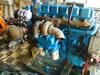
I'm trying to help a friend who's bound and determined to swap a 4-71 Detroit Diesel into his 1979 F-250 SC. (Kids and their bright ideas )
)
He's got the 4-71 mounted in the chassis with an AT 540 trans. We've figured out the plumbing, exhaust, driveline, oil pan mods, etc. The snag he's hit is connecting the flywheel to the torque converter. (The engine and trans weren't a unit, the engine was from a payloader and the trans from came from something else).
There needs to be some sort of "adapter" plate betweem the flywheel and converter but I'm coming up empty handed in my search. The DDA dealer wasn't much help. Any thoughts?
)He's got the 4-71 mounted in the chassis with an AT 540 trans. We've figured out the plumbing, exhaust, driveline, oil pan mods, etc. The snag he's hit is connecting the flywheel to the torque converter. (The engine and trans weren't a unit, the engine was from a payloader and the trans from came from something else).
There needs to be some sort of "adapter" plate betweem the flywheel and converter but I'm coming up empty handed in my search. The DDA dealer wasn't much help. Any thoughts?

Postmaster
Joined: Jul 2003
Posts: 2,711
Likes: 2
From: Pittsburgh
Did the 4-71 come in anything mated to the 540? If so that's be the easiest way to do it.
Either that or take the flexplate and have it drilled to mount the converter to and then have it rebalanced.
Justin
Either that or take the flexplate and have it drilled to mount the converter to and then have it rebalanced.
Justin
Cargo Master

Joined: Feb 2003
Posts: 2,341
Likes: 5
From: Sacramento
An Allison shop, or a truck wrecking yard should be able to help. The AT should have an SAE#3 bellhousing, and you need the adapter for a Detroit to a #3. That's close to what I'm doing. Mine is a Kornbinder DT466, and will be mated to an AT545 Allison.
Thread Starter
|
Fleet Mechanic
Joined: Feb 2006
Posts: 1,776
Likes: 5
From: Lorain County, Ohio
The AT has a #3 bell housing and mates to the flywhel housing on the engine via an adaptor. The problem is connecting the flywheel to the torque converter. He needs a flywheel/flex plate combo. He has a flywheel that is half of the coupling to the hydraulic drive unit from the payloader. (It looks like a normal Detroit flywheel with an internal ring gear).
The only truck junkyard in the area isn't willing to help him figure out what he needs, and I'm out of my league as far as knowing what to look for.
The only truck junkyard in the area isn't willing to help him figure out what he needs, and I'm out of my league as far as knowing what to look for.

Fleet Mechanic
Joined: Mar 2004
Posts: 1,529
Likes: 35
From: Kansas
Originally Posted by lsrx101
The snag he's hit is connecting the flywheel to the torque converter. (The engine and trans weren't a unit, the engine was from a payloader and the trans from came from something else).
There needs to be some sort of "adapter" plate betweem the flywheel and converter but I'm coming up empty handed in my search. The DDA dealer wasn't much help. Any thoughts?
There needs to be some sort of "adapter" plate betweem the flywheel and converter but I'm coming up empty handed in my search. The DDA dealer wasn't much help. Any thoughts?
At a previous place of employment, we swapped a Cummins diesel in place of what previously used to be a Perkins LP engine in a Cat forklift. The dealer that sold us the Cummins actually made the flywheel that we needed. Except for some plumbing issues, this worked out great as is still being used 5+ years after we did it.
You may need a shop like this to make your adapter.
Trending Topics
Thread Starter
|
Fleet Mechanic
Joined: Feb 2006
Posts: 1,776
Likes: 5
From: Lorain County, Ohio
Originally Posted by darrin1999
maybe he has a flywheel (for a manual) instead of a flexplate (for an automatic)? thatd cause the issues youre talking about.
What I'm unsure about are the parts needed between the crankshaft and torque converter.
I always thought (on larger Diesels with Auto Trans) that it should be:
Crankshaft---Flywheel---Flexplate---Torque Converter
Instead of the: Crankshaft---Flexplate---Torque Converter setup found on gassers and smaller diesels.
FTE Stories
Ford Trucks for Ford Truck Enthusiasts

10 Best Ford Truck Engines We Miss the Most!
Joe Kucinski
2026 Shelby F-150 Off-Road: Better Than a Raptor R?
Brett Foote
2027 Super Duty Carhartt Package First Look: 12 Things You NEED to Know!
Michael S. Palmer
10 Most Surprising 2026 Ford Truck Features!
Joe Kucinski
Top 10 Ford Trucks Coming to Mecum Indy 2026
Brett Foote
5 Best / 5 Worst Ford Truck Wheels of All Time
Joe Kucinski
Ford Super Duty: 5 Things Owners LOVE, 5 Things They LOATHE!
Joe Kucinski
Every 2026 Ford Truck Engine RANKED from WORST to FIRST!
Michael S. Palmer
The Best F-150 Deal of Every Trim Level (XL through Raptor)
Joe Kucinski
Senior User
Joined: Mar 2007
Posts: 201
Likes: 0
He's NUTS! He'll never be able to suppress the noise generated by that overgrown Lawn Boy, but at least it's not a 53 series. Here's another problem: 71 series engines only turned 2150 RPM in a no-load situation, so what about the gearing? If he cranks it up to 2500 RPM, he's tempting fate.
Thread Starter
|
Fleet Mechanic
Joined: Feb 2006
Posts: 1,776
Likes: 5
From: Lorain County, Ohio
Originally Posted by 69-highboy
He's NUTS! He'll never be able to suppress the noise generated by that overgrown Lawn Boy, but at least it's not a 53 series. Here's another problem: 71 series engines only turned 2150 RPM in a no-load situation, so what about the gearing? If he cranks it up to 2500 RPM, he's tempting fate.
 I'm too old for that silliness.

Senior User
Joined: May 2005
Posts: 150
Likes: 0
From: Green Valley, AZ
Originally Posted by 69-highboy
He's NUTS! He'll never be able to suppress the noise generated by that overgrown Lawn Boy, but at least it's not a 53 series. Here's another problem: 71 series engines only turned 2150 RPM in a no-load situation, so what about the gearing? If he cranks it up to 2500 RPM, he's tempting fate.
Senior User
Joined: Mar 2007
Posts: 201
Likes: 0
Originally Posted by fordmtnman
71 series detroits turned upwards of 3400 rpm in marine applications, and didn't make power at all until 2200 rpm in truck applications. He'll be fine.
Senior User
Joined: May 2005
Posts: 150
Likes: 0
From: Green Valley, AZ
I've put hundreds of thousands of miles on several different 671's, and I have a fair amount of experience with the silver series 8v92 @ 475 hp. Our 8v92 turned 2400, most of our 671's turned 2450, except for one that didn't run right - it turned 2100, but it wasn't ours, we leased it from another guy who didn't have it set up well at all.
I've never driven a 671 that made over 250 hp. The 425 hp engine you were talking about was a 92 series?
The newer 60 series engines are low rpm diesels, but the older two strokes were called "screaming jimmies" for a reason.
I've never driven a 671 that made over 250 hp. The 425 hp engine you were talking about was a 92 series?
The newer 60 series engines are low rpm diesels, but the older two strokes were called "screaming jimmies" for a reason.
Thread Starter
|
Fleet Mechanic
Joined: Feb 2006
Posts: 1,776
Likes: 5
From: Lorain County, Ohio
I can't speak from any real experience on the HP ratings. Although I went to school for Diesel engine/HD Truck repair repair in the 80s, I never did much with it and have forgotten more than I remember. I'm guessing that 4-71 NA makes right around 100HP. The 2300-2400 max speed sounds about right. The kid plans on getting the engine mounted and running, then removing it for rebuild and a turbo, so that should add a bit more oomph.
He's found a flexplate for it. I guess the flexplate and torque converter together act as a "flywheel" like in an automotive application. He now has to locate the 1" spacer that goes between the flexplate and crankshaft to get the fore/aft alignment of the parts correct inside the bell housing. It seems the 4-71\AT 540 combo was actually wsed in some MD truck applications.
I met a fellow many years ago who put a 4-71 into a 26 or 28' motorhome after wearing out the original 440 Chrysler engine. It was no powerhouse off the line, but he claimed a constant 60mph top speed and 13-15mpg. I don't know what the rear gearing was, but he said it was the original. I saw the rig in use but never drove it to actually see how it performed. I "think" he used the original 727 trans, but I don't remember for certain.
Thanks for all of the input guys. It's helped awaken some long dormant brain cells.
He's found a flexplate for it. I guess the flexplate and torque converter together act as a "flywheel" like in an automotive application. He now has to locate the 1" spacer that goes between the flexplate and crankshaft to get the fore/aft alignment of the parts correct inside the bell housing. It seems the 4-71\AT 540 combo was actually wsed in some MD truck applications.
I met a fellow many years ago who put a 4-71 into a 26 or 28' motorhome after wearing out the original 440 Chrysler engine. It was no powerhouse off the line, but he claimed a constant 60mph top speed and 13-15mpg. I don't know what the rear gearing was, but he said it was the original. I saw the rig in use but never drove it to actually see how it performed. I "think" he used the original 727 trans, but I don't remember for certain.
Thanks for all of the input guys. It's helped awaken some long dormant brain cells.
Last edited by lsrx101; Aug 19, 2007 at 08:43 AM.