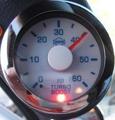
Turbo questions.


Thread Starter
|
Posting Guru
Joined: May 2006
Posts: 2,274
Likes: 1
From: Milroy, PA
Turbo questions.
So this weekend, I took everything out of my bed, took the cap off, and starting monday I will be redoing the crossmembers on my short bed, due to the rust yall saw. So since all the weight was off, (over 1k, I weighed it, empty at 7500) I put the evo on its high setting, wow. Its pretty impressive. Something I noticed, is when mashed, and the turbo is on, theres still quite a bit of smoke, and it made me wonder. Since black smoke is essentially unburnt fuel, is it possible a larger turbo would be worthwhile on stock sticks, and hpop? All the smoke when the turbo is on, makes me assume theres enough fuel, just not enough air to balance it out? Does that make sense? Not that I plan on running the evo on the high setting all the time, but I can only imagine it would be the same concept with dp, or anyone else, on the higher settings, and the turbo is lit, its still dark back there. Which is really cool, I had a grin as wide as the mirrors, but it also makes me think theres potential for more air, ie larger turbo? Thoughts would be appreciated.
Oh and I have to say, Im very jealous of the people who get to run empty everyday, not that 1k is all that much, but the quick factor is greatly increased!
Oh and I have to say, Im very jealous of the people who get to run empty everyday, not that 1k is all that much, but the quick factor is greatly increased!

Post Fiend
Joined: Jun 2004
Posts: 9,293
Likes: 10
From: Parker, CO
There are both sides to what you are thinking here.
Yes more air can reduce smoke. However a larger turbo that flows more air can at the same time be laggy down low, causing even more smoke in low RPM ranges. Stick with a turbo that can run effectively on stock injectors. Most prefer either the TN drop in replacement turbo, or the Garrett ball bearing for something like this. The TN unit comes with a 1.00 turbine housing same as the Garrett ball bearing, but Beans sells a .84 housing (same size as stock) for quicker spool down low. Both these turbos will flow more air and be able to handle higher boost levels than the stock turbo. I personally run the Garrett ball bearing turbo in my truck, and it works great.
Now something else that I have personally experienced with my truck. A few weeks ago I dropped in the Terminator high pressure oil system, and had Jody at DP-Tuner reflash my chip for the big oil setup and also new transmission. Before the reflash, the highest setting on my chip was the 120 race tune, now the highest one is the 140 extreme. I get less smoke now with the 140 extreme than I did in the 120 race. I also get less smoke in the econo tune as well. The reason is that higher oil pressure can better atomize the fuel, allowing for a more complete burn. The injectors are HEUI and require oil pressure to work. If your HPOP can't keep up with what the chip or tuner demands, then lower oil pressure means in the end you'll have more smoke.
Right now when I get on my truck hard, I'll throw out a cloud of black smoke right off idle, but as soon as the turbo spools, it's nothing more than a light grey haze all the way to 100 mph on the 140 tune. If I had to compare what was more effective at reducing smoke, I would have to say the Terminator setup. Swapping from the stock turbo to the ball bearing didn't reduce smoke as much as big oil did.
Anyway, that's my observations on my own truck. Take it as you will.
Yes more air can reduce smoke. However a larger turbo that flows more air can at the same time be laggy down low, causing even more smoke in low RPM ranges. Stick with a turbo that can run effectively on stock injectors. Most prefer either the TN drop in replacement turbo, or the Garrett ball bearing for something like this. The TN unit comes with a 1.00 turbine housing same as the Garrett ball bearing, but Beans sells a .84 housing (same size as stock) for quicker spool down low. Both these turbos will flow more air and be able to handle higher boost levels than the stock turbo. I personally run the Garrett ball bearing turbo in my truck, and it works great.
Now something else that I have personally experienced with my truck. A few weeks ago I dropped in the Terminator high pressure oil system, and had Jody at DP-Tuner reflash my chip for the big oil setup and also new transmission. Before the reflash, the highest setting on my chip was the 120 race tune, now the highest one is the 140 extreme. I get less smoke now with the 140 extreme than I did in the 120 race. I also get less smoke in the econo tune as well. The reason is that higher oil pressure can better atomize the fuel, allowing for a more complete burn. The injectors are HEUI and require oil pressure to work. If your HPOP can't keep up with what the chip or tuner demands, then lower oil pressure means in the end you'll have more smoke.
Right now when I get on my truck hard, I'll throw out a cloud of black smoke right off idle, but as soon as the turbo spools, it's nothing more than a light grey haze all the way to 100 mph on the 140 tune. If I had to compare what was more effective at reducing smoke, I would have to say the Terminator setup. Swapping from the stock turbo to the ball bearing didn't reduce smoke as much as big oil did.
Anyway, that's my observations on my own truck. Take it as you will.
Thread Starter
|
Posting Guru
Joined: May 2006
Posts: 2,274
Likes: 1
From: Milroy, PA
So now, with the oil work, and better atomization, what did you notice as far as engine performance? Im assuming that big oil doesnt do anything, or much of anything at the bottom of the engine curve, and mostly benifits mid to top range. Does it do anything to fuel economy, or just mainly performance?
Post Fiend
Joined: Jun 2004
Posts: 9,293
Likes: 10
From: Parker, CO
It does a TON for top end performance. Before big oil my truck would lose power on the top end as the HPOP couldn't keep up with what the chip wanted (setting off the P1211 code). Now it's strong all the way up the RPM band. As for mileage, I have no clue yet, too busy playing. Others have reported bit better mileage, but I'll find out sooner or later.