


Power Add-on's

Post Fiend
Joined: Nov 2001
Posts: 14,947
Likes: 6
From: Topsfield, MA

Originally Posted by Conanski
Yes, I've heard of and seen all those. You need to go look at that 5.0 truck intake again... and bring a good measuring device. The 5.0 truck runner cross section and volume is substantially larger than anything else, including the aftermarket.
Originally Posted by Conanski
None of the 5.0 trucks I have driven make any power beyond 3500rpm.. good luck even making an automatic equipped truck go past this.
Mine was a 5 spd. This is subjective...but consider the fact that the 5.0 truck engine makes it's max tq at 3000 rpm...and the max horsepower at 4000 RPM. What you're saying makes no sense to me and by me saying that power drops off significantly after 4500 is about right according to what I've got for information.
We've also got to consider the terminology and wording being used. You're saying "building power past 3500" in disagreeance with my statement off "power dropping off after 4500". What you said makes no sense to me. What I mean is when you look at a dyno graph of the non-HO 302's tq/hp curve...at around 4500 rpm you see it significantly drop off as the airflow begins to choke out the motor.
When you say "build power past 3500" you're making a conflicting statement. Since the max tq is at 3000 it technically starts dropping off after 3000. The hp maxes at 4000 and it starts dropping off after that. You're saying it's "not building power" inbetween that. How so?? It sure is if max HP is at 4000...nevermind the fact that you said "power" and there are two considerations here, tq and hp (reason for me saying confliction).
It's after around 4500 that both hp and tq dive off the deep end and you can consider it out of the engine's powerband. The engine will pull to about 4500ish before it's not making enough power to continue and you should shift. The dyno graphs make this pretty clear. It's where the hp/tq significantly start to drop that one would say such a statement. Technically it drops off right after the max...but it drops at a slow rate until the engine starts to choke out and where it significantly drops....is where I as well as most...consider it to be the ending point of the powerband. In the 5.0 truck motor's case....4500ish RPM.
With an automatic - you can't easily feel the powerband of the engine like you can with a manual trans. I was very hindered by the 5.0's lack of low end tq because I had a 5 spd and could easily feel it. The automatic tends to hide this as it doesn't force the engine to work at low RPMs because of slippage.
Originally Posted by Conanski
A stock mustang 5.0 drops off after 4500rpm. It'll rev more but it doesn't make any more HP.
Originally Posted by Conanski
From the factory the 5.0 truck makes less HP and torque than the 5.0 HO.
Originally Posted by Conanski
I'm sorry but this a case of "been there, done that". I have done the full exhaust on a 5.0 truck.. longtubes, hi-flow cat and muffler, 2.5" plumbing throughout. You gain substantial low RPM torque, but the motor still does not build any power past 3500rpm. The next most substantial restriction to airflow is the cam. The factory truck cam is a pathetic little thing with something on the order of .360" total lift and 180 deg duration. You can't buy an aftermarket cam this small unless you order the OEM replacement. Drop anything else in there and it'll unleash the beast.
You might even be able to run 1.7rr's to increase the stock cam's duration and lift and make it close to a mustang cam...I'm not sure as I havn't done the math...
You want solid data....go do the changes and dyno before/after....then you can safely make statements like you've made. The rest is speculation....
Last edited by MustangGT221; Jul 26, 2006 at 02:20 PM.
FTE Legend


Joined: Jun 2006
Posts: 31,930
Likes: 1,499
From: Ottawa, Ontario
Originally Posted by MustangGT221
I don't see how...esp with the 5.0 truck intake...but I'd have to do research to go further with this. I've seen people mention truck lowers on mustang forums but nothing significant mentioned about it. I'm going to throw up a post on corral and see what I can find out, I'm curious.
Originally Posted by MustangGT221
We've also got to consider the terminology and wording being used. You're saying "building power past 3500" in disagreeance with my statement off "power dropping off after 4500". What I mean is when you look at a dyno graph of the non-HO 302's tq/hp curve...at around 4500 rpm you see it significantly drop off as the airflow begins to choke out the motor.
With an automatic - you can't easily feel the powerband of the engine like you can with a manual trans. I was very hindered by the 5.0's lack of low end tq because I had a 5 spd and could easily feel it. The automatic tends to hide this as it doesn't force the engine to work at low RPMs because of slippage
With an automatic - you can't easily feel the powerband of the engine like you can with a manual trans. I was very hindered by the 5.0's lack of low end tq because I had a 5 spd and could easily feel it. The automatic tends to hide this as it doesn't force the engine to work at low RPMs because of slippage
I agree a chassis dyno is the best way to document power increases, but you don't need one to know you have made substantial changes. The exhaust on my 5.0 truck changed it from something that could barely break the tires loose and would loose speed on modeate grades and in a headwind on the highway, to a vehicle that could easily spin the back tires and maintain highway speeds. Putting numbers on it is guessing.. but there's real inprovements there nonetheless.
Last edited by Conanski; Jul 26, 2006 at 03:57 PM.
Post Fiend
Joined: Nov 2001
Posts: 14,947
Likes: 6
From: Topsfield, MA
Originally Posted by Conanski
I hope I'm not being to confrontational about this.. that's not my intention. I'll get some pics of my truck intake and post them if time permits. I have to say it was a real "WTF!!" moment the first time I pulled one of these apart. Here's a pic of the intake spacers for the car vs truck... http://ca.pg.photos.yahoo.com/ph/conan@rogers.com/detail?.dir=/2c2cre2&.dnm=6fc7re2.jpg&.src=ph

Originally Posted by Conanski
My experience is that the factory power graphs don't quite agree with real world expereince. It seems the area between 3500-4500rpm is pretty flat so the motor is not really building any more power.. just maintaining what it has.
According to dyno graphs and my experience that coincides with those dyno graphs...I've found it to be pretty flat between 3000-4000 but not between 3500-4500. That last 1000 RPM range covers the tip-over point in the engine's powercurve and I don't consider it to be flat. But...the 3000-4000 range is pretty flat in power output so you're on the right page.
It seems that you have an automatic and if you do than it can throw you off. With the slippage and indirect connection to the engine you won't accurately feel the powerband like you can with a manual.
Originally Posted by Conanski
I agree a chassis dyno is the best way to document power increases, but you don't need one to know you have made substantial changes. The exhaust on my 5.0 truck changed it from something that could barely break the tires loose and would loose speed on modeate grades and in a headwind on the highway, to a vehicle that could easily spin the back tires and maintain highway speeds. Putting numbers on it is guessing.. but there's real inprovements there nonetheless.
You can't simply state something like "putting a mustang cam in a 5.0 truck will get you 50hp" and not have the data to back it up. If you don't have significant dyno experience you wouldn't know a 20hp increase to a 50hp increase in the first place.
I can tell you from my experience that the 30hp I got between dyno runs felt like a $#^@#$%^$ load compaired to ANY exhaust modifications I've done to anything.
In the real world, it takes quite a bit to make a big HP increase. I've got a few mods on my otherwise stock 351 and it's no big hoss over a stock 351. That includes a full exhaust, ignition upgrades, larger intake manifold, MAF and tuning.
While I can relate to the power increases you noticed after doing the exhaust change...you've also got to think outside the box and consider other important factors. Mainly, the exhaust system you removed was probably old with a lot of miles on it. The cats might of been a bit clogged up, the muffler might of had some broken material or debris inside causing a restriction, etc. There could be other outside influences as to why you saw such an increase.
I know I've taken my exhaust completely off (running just manifolds, or headers, and about 3 feet of pipe) and not really noticed a power difference to when it was completely on. I ALMOST did it on the dyno to check but it was hot and didn't want to mess with it.
I guess all I'm saying is be careful what statements you make before other people read them and spread possibly false information. Because if people believe just throwing a cam in their truck is going to net them 50+ hp then they're being misled.
Last edited by MustangGT221; Jul 26, 2006 at 05:04 PM.
FTE Legend
Joined: Jun 2006
Posts: 31,930
Likes: 1,499
From: Ottawa, Ontario
Well... getting back to my statement that the 5.0 truck intake is no restriction to additional power, check out the pics I collected...
http://ca.pg.photos.yahoo.com/ph/conan@rogers.com/detail?.dir=2c2cre2&.dnm=84a3re2.jpg&.src=ph
http://ca.pg.photos.yahoo.com/ph/conan@rogers.com/detail?.dir=2c2cre2&.dnm=84a3re2.jpg&.src=ph
Post Fiend
Joined: Nov 2001
Posts: 14,947
Likes: 6
From: Topsfield, MA
Those pictures say what? They don't say anything....
They do not show that they are necessarily larger it's just a visual guess. It does not indicate that the volume of the ports are larger...and it does not indicate that it can flow more air...
Testing will tell you that. Put it on a flow bench and check it's volume.
They do not show that they are necessarily larger it's just a visual guess. It does not indicate that the volume of the ports are larger...and it does not indicate that it can flow more air...
Testing will tell you that. Put it on a flow bench and check it's volume.

Thread Starter
|
Senior User
Joined: Oct 2004
Posts: 123
Likes: 0
This thread has been interesting to read, I am glad I started it. After reading this and some other posts I found that I probably have the speed denisity system being that my truck is a 93. Can anyone tell me what to look for to tell if it hasnt be converted yet to MAF or maybe direct me to some pics? Thanks
After reading this and some other posts I found that I probably have the speed denisity system being that my truck is a 93. Can anyone tell me what to look for to tell if it hasnt be converted yet to MAF or maybe direct me to some pics? Thanks
FTE Legend
Joined: Jun 2006
Posts: 31,930
Likes: 1,499
From: Ottawa, Ontario
Originally Posted by MustangGT221
They do not show that they are necessarily larger it's just a visual guess. It does not indicate that the volume of the ports are larger...and it does not indicate that it can flow more air...
For Stangfan78. You'll know you have mass air if there is an aluminum piece with wires on it(MAF meter) plumbed into the intake near the airbox. If it's there you can't miss it. If there's just plumbing from your airbox to the throttle body, you have speed density.
FTE Stories
Ford Trucks for Ford Truck Enthusiasts

Top 10 Fords at 2026 Carlisle Ford Nationals
Joe Kucinski
3 Best / 3 Worst Parts of Modern Ford Ownership
Brett Foote
10 Amazing Upgrades That Solve Common Ford Truck Owner Headaches
Pouria Savadkouei
Every 2026 Ford Engine Explained
Brett Foote
10 Ugly Ford Trucks That We Still Kinda Love
Joe Kucinski
10 Things Every Truck Owner NEEDS (2026 Edition)
Michael S. Palmer
Rezvani's Latest Post-Apocalyptic Monster Is a Ford F-150 Raptor Underneath
Verdad Gallardo
Top 10 Most Expensive Ford Trucks Ever Sold on Bring a Trailer
Joe Kucinski
2027 Ford Super Duty Buyer's Guide (Every Model, Engine, & Package)
Brett Foote
Junior User
Joined: Dec 2005
Posts: 60
Likes: 0
From: Scottsdale, AZ
One simple way to tell speed density is the two air intake tubes running from the air box to the throttle body.
Here's what the K&N air intake kit looks like on my truck with speed density, replacing the stock air box:
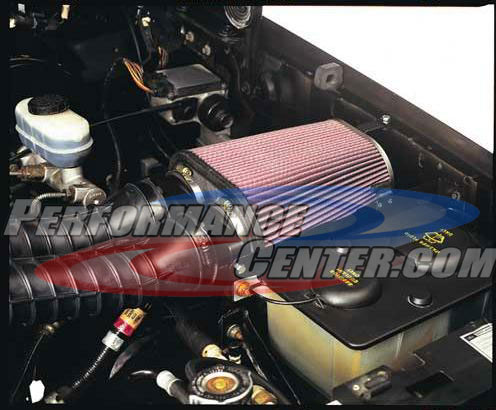
Here's what the K&N air intake kit looks like on my truck with speed density, replacing the stock air box:

Moderator

Joined: Jun 2003
Posts: 3,550
Likes: 72
From: Calhoun GA
Guys, one of the main things that has yet to be mentioned is the program in the ECU's; late 80's to mid 90's trucks and stangs. The way final spark and fuel is calculated is completely different. There's a boat load of program settings that make the truck feel slow, and that's because these settings are geared towards towing and hauling situations, not fast acceleration and top speed.
I will agree about the cam though; GEN 1 L owners have picked up about 15-20hp when going from the stock flat tappet to a stock stang roller.
I will agree about the cam though; GEN 1 L owners have picked up about 15-20hp when going from the stock flat tappet to a stock stang roller.
Post Fiend
Joined: Nov 2001
Posts: 14,947
Likes: 6
From: Topsfield, MA
Originally Posted by Conanski
Aww come on!! Now you are just in denial. I'll get some more pics, but it would seem I can't convince you anyway. No biggie.. matters not to me.. others will draw their own conclusions.
My GT-40Y heads in the garage are only 170cc on the intake...same as the Twisted Wedge heads but those TW's will easily outflow my Y's even though they're the same size.
I'm trying to get intouch with Tom Moss who is an intake porting expert to find out some factual data.
It's not that I don't or won't believe YOU...it's just that the evidence needs to be solid.
In my experiences I've found there are more and more misled people than ever and solid informaton needs to be presented in order to totally convince me of something. There have been pleanty of situations where someone thinks something is true when it is not...and don't find out until afterwards...
Originally Posted by Blurry94
I will agree about the cam though; GEN 1 L owners have picked up about 15-20hp when going from the stock flat tappet to a stock stang roller.
Last edited by MustangGT221; Jul 27, 2006 at 04:27 PM.
Moderator
Joined: Jun 2003
Posts: 3,550
Likes: 72
From: Calhoun GA
Correct, nowhere near 50...I have yet to see a 40-50 gain in hp with just a cam swap on a stock motor.
Without writing a book, an EEC-4 truck ECU is programmed to maximize torque for towing/hauling to an extent that the transmission doesn't burn up. Yes, mechanics play a roll in performance, but as I read, I keep seeing comparisons made with an orange (Mustang) when we're talking about apples (trucks)....they are different breeds built for different purposes.
To support that, I have a stock database for a 94 F-150 4x4. You people would laugh if you saw the stock spark and fuel tables for it. And, at tip-in, the ECU can pull a max of 16 degrees of timing away from the total advance, depending on the conditions.
Without writing a book, an EEC-4 truck ECU is programmed to maximize torque for towing/hauling to an extent that the transmission doesn't burn up. Yes, mechanics play a roll in performance, but as I read, I keep seeing comparisons made with an orange (Mustang) when we're talking about apples (trucks)....they are different breeds built for different purposes.
To support that, I have a stock database for a 94 F-150 4x4. You people would laugh if you saw the stock spark and fuel tables for it. And, at tip-in, the ECU can pull a max of 16 degrees of timing away from the total advance, depending on the conditions.
Last edited by Blurry94; Jul 27, 2006 at 05:35 PM.
Post Fiend
Joined: Nov 2001
Posts: 14,947
Likes: 6
From: Topsfield, MA
Originally Posted by Blurry94
Correct, nowhere near 50...I have yet to see a 40-50 gain in hp with just a cam swap on a stock motor.
Without writing a book, an EEC-4 truck ECU is programmed to maximize torque for towing/hauling to an extent that the transmission doesn't burn up. Yes, mechanics play a roll in performance, but as I read, I keep seeing comparisons made with an orange (Mustang) when we're talking about apples (trucks)....they are different breeds built for different purposes.
To support that, I have a stock database for a 94 F-150 4x4. You people would laugh if you saw the stock spark and fuel tables for it. And, at tip-in, the ECU can pull a max of 16 degrees of timing away from the total advance, depending on the conditions.
Without writing a book, an EEC-4 truck ECU is programmed to maximize torque for towing/hauling to an extent that the transmission doesn't burn up. Yes, mechanics play a roll in performance, but as I read, I keep seeing comparisons made with an orange (Mustang) when we're talking about apples (trucks)....they are different breeds built for different purposes.
To support that, I have a stock database for a 94 F-150 4x4. You people would laugh if you saw the stock spark and fuel tables for it. And, at tip-in, the ECU can pull a max of 16 degrees of timing away from the total advance, depending on the conditions.
http://www.corral.net/forums/showthread.php?t=818720
Last edited by MustangGT221; Jul 27, 2006 at 06:38 PM.
FTE Legend
Joined: Jun 2006
Posts: 31,930
Likes: 1,499
From: Ottawa, Ontario
Originally Posted by Blurry94
I will agree about the cam though; GEN 1 L owners have picked up about 15-20hp when going from the stock flat tappet to a stock stang roller.
I have to agree with our moderators pessimistic stance, because believe it or not I'm usually the one to err on the conservative side. I'd also love to see some real flow bench numbers on the various stock intakes to see if this has real potential or is all just an optical illuson. I'm well aware that in a lot of cases less is more and bigger is not always better. There's a whole lot more to making an engine flow than giant ports and big valves. Still.. this one issue has always bugged me, and I'd love to be able to prove it one way or the other, but I don't have the tools at my disposal to do that right now. A few more pics..
http://ca.pg.photos.yahoo.com/ph/conan@rogers.com/detail?.dir=2c2cre2&.dnm=ab84re2.jpg&.src=ph
The intake ports measurements are with slight variations...
At upper to lower gasket surface..2.33" x 1.31"
At lower to head gasket surface.. 1.72" x 0.92"
The head itself at lower to head surface.. 1.87" x 1.0"
There is ample material for matching the dimensions at the lower to head gasket surface if one was so inclined.
Moderator
Joined: Jun 2003
Posts: 3,550
Likes: 72
From: Calhoun GA
Pessimistic, nah...realistic is more like it. 
Yes the GEN 1 Lighting motors are not your run of the mill 5.8's, however, a 15hp gain is moderate/realistic for that type of swap, and I doubt that the same type of swap on a F-150 302 will net more than that. Sure the Mustangs make more power, but it's not just the cam, which is why I think comparing motors and modifications between EEC-4 F-150's and Mustangs is pointless.
Yes the GEN 1 Lighting motors are not your run of the mill 5.8's, however, a 15hp gain is moderate/realistic for that type of swap, and I doubt that the same type of swap on a F-150 302 will net more than that. Sure the Mustangs make more power, but it's not just the cam, which is why I think comparing motors and modifications between EEC-4 F-150's and Mustangs is pointless.