


Drilled rotors?

Freshman User
Joined: Jun 2006
Posts: 36
Likes: 0
Originally Posted by Nightrider41
I did a search for brake rotors and did not find much other than not to buy slotted rotors. What about drilled rotors? Good source?
Why should one not use them?
Thanks
Why should one not use them?
Thanks

Junior User
Joined: Jan 2002
Posts: 84
Likes: 0
Originally Posted by RangerWilly
When you drill rotors you have less surface area. This results in less heat dissipitation. \.
For example, lets say the rotor is solid and 1/4" thick. What would happen if a series of 1/8" holes were drilled?
For each hole drilled you would lose the surface area of a 1/8" circle on both sides. The area of a 1/8" circle is Pi times the radius squared. The radius is half the diameter: .125 / 2 = .0625". Square that and multiply times Pi: (.0625 * .0625) * 3.1415 = .012271... Finally, double it for both sides of the rotor and you have .024543 sq inches lost.
The hole will replace that with a surface area equal to the area of the wall of the hole. So the new area created is the circumference of the hole times the thickness of the rotor. Circumference is Pi times diameter: 3.1415 * .125" = .3926875. Then multiply times the thickness of the rotor: .3926875 * .375" = .1475258 sq inches gained.
That means that the hole actually has created 6 times more surface area than before. Using a 1/2" hole and everything else being the same, you create about 1.5 times the previous surface area.

Last edited by hank_48; Jun 30, 2006 at 04:13 PM.
Freshman User
Joined: Jun 2006
Posts: 36
Likes: 0
Originally Posted by hank_48
Not always true. As long as the hole isn't too big, you actually increase the surface area.
For example, lets say the rotor is solid and 1/4" thick. What would happen if a series of 1/8" holes were drilled?
For each hole drilled you would lose the surface area of a 1/8" circle on both sides. The area of a 1/8" circle is Pi times the radius squared. The radius is half the diameter: .125 / 2 = .0625". Square that and multiply times Pi: (.0625 * .0625) * 3.1415 = .012271... Finally, double it for both sides of the rotor and you have .024543 sq inches lost.
The hole will replace that with a surface area equal to the area of the wall of the hole. So the new area created is the circumference of the hole times the thickness of the rotor. Circumference is Pi times diameter: 3.1415 * .125" = .3926875. Then multiply times the thickness of the rotor: .3926875 * .375" = .1475258 sq inches gained.
That means that the hole actually has created 6 times more surface area than before. Using a 1/2" hole and everything else being the same, you create about 1.5 times the previous surface area.
For example, lets say the rotor is solid and 1/4" thick. What would happen if a series of 1/8" holes were drilled?
For each hole drilled you would lose the surface area of a 1/8" circle on both sides. The area of a 1/8" circle is Pi times the radius squared. The radius is half the diameter: .125 / 2 = .0625". Square that and multiply times Pi: (.0625 * .0625) * 3.1415 = .012271... Finally, double it for both sides of the rotor and you have .024543 sq inches lost.
The hole will replace that with a surface area equal to the area of the wall of the hole. So the new area created is the circumference of the hole times the thickness of the rotor. Circumference is Pi times diameter: 3.1415 * .125" = .3926875. Then multiply times the thickness of the rotor: .3926875 * .375" = .1475258 sq inches gained.
That means that the hole actually has created 6 times more surface area than before. Using a 1/2" hole and everything else being the same, you create about 1.5 times the previous surface area.
Logistics Pro

Joined: Jan 2001
Posts: 4,123
Likes: 2
From: Fort Smith

Yes, they make them...
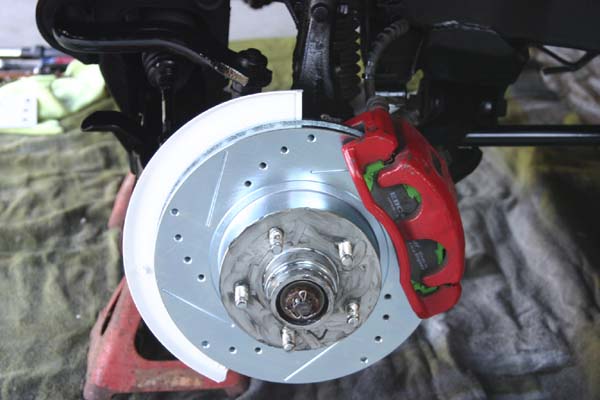
I've had mine on for 2 years now. I don't remember the name of the company I got them from (bought them in a group buy on another site). They are slotted and drilled, with zinc coating to prevent rust. I have had good luck with them so far. I actually wouldn't mind finding another set.
Let me see if I can get in touch with the guy I bought them from and get some info...
I've had mine on for 2 years now. I don't remember the name of the company I got them from (bought them in a group buy on another site). They are slotted and drilled, with zinc coating to prevent rust. I have had good luck with them so far. I actually wouldn't mind finding another set.
Let me see if I can get in touch with the guy I bought them from and get some info...

Fleet Owner


Joined: Mar 2003
Posts: 24,724
Likes: 74
From: Blue Hill Township
Your best bet would be to buy a set of brembo blanks from tirerack. They are fairly cheap and are some of hte best rotors out there.
Trending Topics
Thread Starter
|
Freshman User
Joined: Jun 2006
Posts: 40
Likes: 0
Fairly cheap?
$305.00
Thanks for the answers. I'm not sure I can spend that much for 2 rotors.
$305.00
Thanks for the answers. I'm not sure I can spend that much for 2 rotors.
FTE Stories
Ford Trucks for Ford Truck Enthusiasts

Top 10 Fords at 2026 Carlisle Ford Nationals
Joe Kucinski
3 Best / 3 Worst Parts of Modern Ford Ownership
Brett Foote
10 Amazing Upgrades That Solve Common Ford Truck Owner Headaches
Pouria Savadkouei
Every 2026 Ford Engine Explained
Brett Foote
10 Ugly Ford Trucks That We Still Kinda Love
Joe Kucinski
10 Things Every Truck Owner NEEDS (2026 Edition)
Michael S. Palmer
Rezvani's Latest Post-Apocalyptic Monster Is a Ford F-150 Raptor Underneath
Verdad Gallardo
Top 10 Most Expensive Ford Trucks Ever Sold on Bring a Trailer
Joe Kucinski
2027 Ford Super Duty Buyer's Guide (Every Model, Engine, & Package)
Brett Foote
Fleet Owner
Joined: Mar 2003
Posts: 24,724
Likes: 74
From: Blue Hill Township
http://www.tirerack.com/brakes/resul...ategory=Rotors
They are $44 a piece for the plain brembo rotors. The plain brembos are supposed to be some of the best rotors available, and for the price they are a good deal.
They are $44 a piece for the plain brembo rotors. The plain brembos are supposed to be some of the best rotors available, and for the price they are a good deal.

Elder User
Joined: May 2004
Posts: 508
Likes: 0
From: Webster, NY
Originally Posted by MisterCMK
http://www.tirerack.com/brakes/resul...ategory=Rotors
They are $44 a piece for the plain brembo rotors. The plain brembos are supposed to be some of the best rotors available, and for the price they are a good deal.
They are $44 a piece for the plain brembo rotors. The plain brembos are supposed to be some of the best rotors available, and for the price they are a good deal.
Front Fitment
Note: (Front) Drilled vented rotors. Not recommended for track use. Do not use with race compound brake pads. Drilled rotors are not warranted against warping or cracking.
Note: (Front) Drilled vented rotors. Not recommended for track use. Do not use with race compound brake pads. Drilled rotors are not warranted against warping or cracking.

New User
Joined: Aug 2006
Posts: 2
Likes: 0
My first post here, but thought I might comment on this topic.
Slotted and cross-drilled rotors are designed for performance applications. The slots and the cross-drilling is to vent gas built up from heat generated by extreme braking (allowing better pad to rotor contact). The vaned vents allow for better cooling for less fade.
If slotted and/or cross-drilled rotors are used then ceramic pads are recommended as others both deteriorate fast and can damage the rotors along with providing poor braking performance.
Also, to adequately obtain optimum braking performance, upgraded calipers and larger rotor diameters would be the proper path to follow.
I have the Baer Brake system (13" front/12" rear) slotted and cross-drilled on a 2000 turbocharged Mustang convertible. Appearance is great, but braking performance is even better.
95XLimited
Slotted and cross-drilled rotors are designed for performance applications. The slots and the cross-drilling is to vent gas built up from heat generated by extreme braking (allowing better pad to rotor contact). The vaned vents allow for better cooling for less fade.
If slotted and/or cross-drilled rotors are used then ceramic pads are recommended as others both deteriorate fast and can damage the rotors along with providing poor braking performance.
Also, to adequately obtain optimum braking performance, upgraded calipers and larger rotor diameters would be the proper path to follow.
I have the Baer Brake system (13" front/12" rear) slotted and cross-drilled on a 2000 turbocharged Mustang convertible. Appearance is great, but braking performance is even better.
95XLimited

New User
Joined: May 2006
Posts: 5
Likes: 0
I got my drilled brakes from www.autopartswarehouse.com back before i totaled my 2000 exploder. They were $178 for the set and I did them myself. Noticed an immediate difference in inclement weather especially. Definately worth it if you have the money. They give you free shipping on that site too I believe.
New User
Joined: Aug 2006
Posts: 2
Likes: 0
Glad you noticed the difference. Even with oem there should be better performance, just not optimal.
I am thinking of going with BaerClaw rotors and EBS pads, oem replacement size. Not sure what a complete system would cost, the Mustang was $3000 for both front and rear systems.
95XLimited
I am thinking of going with BaerClaw rotors and EBS pads, oem replacement size. Not sure what a complete system would cost, the Mustang was $3000 for both front and rear systems.
95XLimited