



511 initial timing, incredible!

Thread Starter
|
Posting Guru
Joined: Aug 2001
Posts: 2,117
Likes: 0
From: Evanston, WY

511 initial timing, incredible!
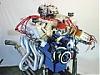
I decided that I was going to get my idle tuning done today. I have never taken the time to really set up the idle where it wants to be, including timing and A/F ratio, so the whole tamale was required. Since there is no timing spec on a custom engine like this, I figured I would do it the old fashioned way, by ear. In the past it has worked well. So today I start working the whole thing at once. I bring her up to operating temp and set the idle at 900. I loosen the dizzy so I can move it easily, and I start by retarding slightly. It instantly starts dropping rpm, so I advance it. It likes that, so I keep going until it starts to labor, this gives me a range to work with. I retard it again until it just barely starts to drop and then advance it just a little till it smooths out nice and lock it down. The idle is about 1100, so I drop the idle, lean out the A/F, and do the timing again. Finally repeating the process a few times, I get her purring like a kitten at 900, shuts off clean, starts instantly. So, I says to myself, "Self, let's get a timing reading. That way, in the future, I'll know exactly where to set the initial". Well I hook up the timing light at idle and just about crapped. 42 degrees! Anything under about 38 starts dropping RPM!
Well, that sucks, because even if I lock the advance so it's always 42 (it actually likes about 44 on the high end), it wont carry that much timing through the mid-range without pinging. So it looks like I'm going to have to back the idle timing down to the high twenties or early thirties and just tune it the best I can at that point.
Oh well, I guess these are the joys of Hot-Rodding.
-Scouder
Well, that sucks, because even if I lock the advance so it's always 42 (it actually likes about 44 on the high end), it wont carry that much timing through the mid-range without pinging. So it looks like I'm going to have to back the idle timing down to the high twenties or early thirties and just tune it the best I can at that point.
Oh well, I guess these are the joys of Hot-Rodding.
-Scouder
Thread Starter
|
Posting Guru
Joined: Aug 2001
Posts: 2,117
Likes: 0
From: Evanston, WY
That's a pretty cool suggestion. I don't think I'm up to it though.
I think the real solution will be an electronic engine management system with a programmable timing curve. On my engine the timing curve would look like the letter "U". I'm eventually headed that direction anyway, so I guess I'll do the best I can with what I've got until I can afford it.
-Scouder
I think the real solution will be an electronic engine management system with a programmable timing curve. On my engine the timing curve would look like the letter "U". I'm eventually headed that direction anyway, so I guess I'll do the best I can with what I've got until I can afford it.
-Scouder
Postmaster
Joined: Jul 2003
Posts: 3,934
Likes: 0
From: iowa
scouder, you got your dizzy a tooth advanced when you dropped it in. Theres roughly a 30 degree difference with each tooth. A engine will run with one tooth retarded and one tooth advanced.
I am 110% on this, as i have done it before myself.
I am 110% on this, as i have done it before myself.
Postmaster
Joined: Jul 2003
Posts: 3,934
Likes: 0
From: iowa
Scouder, I am willing to bet your idle screw is turned out about as much as possible. Increased inital timing causes the idle rpm to increase, and then you have to turn the screw out to get the idle down.
Maybe your trick carb has an extra long screw, and you will come you an make me "look" like an idiot. I use a primer to turn the shaft so the dizzy and oil pump shaft line up, can take anywhere from 5 minutes to hour.
My lastest method is look at the bottom of the dizzy, with the rotor set slighly advanced so it so it can rotate cw when the gears mesh. And then I look at the oil pump shaft and turn it so it will line up with the dizzy. If you are confused, just ignore this last paragraph.
Maybe your trick carb has an extra long screw, and you will come you an make me "look" like an idiot. I use a primer to turn the shaft so the dizzy and oil pump shaft line up, can take anywhere from 5 minutes to hour.
My lastest method is look at the bottom of the dizzy, with the rotor set slighly advanced so it so it can rotate cw when the gears mesh. And then I look at the oil pump shaft and turn it so it will line up with the dizzy. If you are confused, just ignore this last paragraph.

FTE Leadership Emeritus
Joined: Jul 2002
Posts: 42,561
Likes: 420
From: Long Island USA

You sure that damper ring didn't slip ? 
At 42 degress advance you're creating one HECK of a lot of vacuum. It's probably sucking air from anywhere it can.
Open up the throttle plates as you retard the timing, you should be able to get even a WILD cam down to 20 degrees or so and still have 11 inches of vacuum.
The manifold vacuum for vacuum advance trick worked VERY WELL for me.
It kept the idle timing up around 20 degrees (11 inches of vacuum at 950-1000RPM), dropped the timing down to 10 to keep it from pinging, and gave LOADS of low-end torque as a freebee.
Do this:
Get engine to OT.
Attach timing light.
Retard timing until idle drops.
Crank open throttle plates (idle adjust screw - not the mix, the throttle stop)
Retard.
Open throttle plates.
Retard.
Open throttle plates.
Keep doing this. I'm sure you can get that thing to idle at less than 20 degrees.
The problem is, with that much initial, did it start up fine? If so, there's DEFINITELY something wrong with that damper ring
Either that, or you're a Chevy guy and didn't get the timing light on #1 ...
At 42 degress advance you're creating one HECK of a lot of vacuum. It's probably sucking air from anywhere it can.
Open up the throttle plates as you retard the timing, you should be able to get even a WILD cam down to 20 degrees or so and still have 11 inches of vacuum.
The manifold vacuum for vacuum advance trick worked VERY WELL for me.
It kept the idle timing up around 20 degrees (11 inches of vacuum at 950-1000RPM), dropped the timing down to 10 to keep it from pinging, and gave LOADS of low-end torque as a freebee.
Do this:
Get engine to OT.
Attach timing light.
Retard timing until idle drops.
Crank open throttle plates (idle adjust screw - not the mix, the throttle stop)
Retard.
Open throttle plates.
Retard.
Open throttle plates.
Keep doing this. I'm sure you can get that thing to idle at less than 20 degrees.
The problem is, with that much initial, did it start up fine? If so, there's DEFINITELY something wrong with that damper ring
Either that, or you're a Chevy guy and didn't get the timing light on #1 ...
Trending Topics
Thread Starter
|
Posting Guru
Joined: Aug 2001
Posts: 2,117
Likes: 0
From: Evanston, WY
These are all great suggestions, let me address them individually.
As far as the dizzy being a tooth off, there really isn't a "proper" position in a custom application. If you think about it, as long as the timing light is attached to the number one wire, it is reading the spark in relation to the crank position. The dizzy position becomes largely irrelevant. I have, however, gotten the dizzy a tooth off on engines with a vacuum can, which limits the range of motion for advance and retard. THAT does cause issues.
Timing ring. When I changed cams this fall I used my big ol' 24" moroso timing wheel to set top dead center, then ground my timing pointer to show EXACTLY 0. It was about 3 degrees off out of the box.
Krewat. You have it 100% right. My throttle plates are nearly closed. I can definately reduce the timing and open the throttle blades. The only problem with this is that at shutdown it can cause run-on, or dieseling. In fact, I was seeing some slight run-on before I started. I will just have to start retarding the timing until I find run-on, then advance a couple of degrees and work from there.
Bear. Until recently, I might have agreed with you completely. It has been brought to my attention, though, that there are guys with big cammed FEs running locked out timing at 36+ degrees on the track and street. Some have issues with kickback during startup, and some don't. I think, in my case, that my extreme altitude, big cam, and big plenums are causing such a reduced cylinder pressure, and slow burn, that it is taking this kind of timing to make it happy at idle.
I sure can't think of anything else. If the timing light is on the number 1, and the timing ring on the damper is correct, then the indicated timing has to be correct. Doesn't it? BTW, it's a non-dial timing light.
-Scouder
As far as the dizzy being a tooth off, there really isn't a "proper" position in a custom application. If you think about it, as long as the timing light is attached to the number one wire, it is reading the spark in relation to the crank position. The dizzy position becomes largely irrelevant. I have, however, gotten the dizzy a tooth off on engines with a vacuum can, which limits the range of motion for advance and retard. THAT does cause issues.
Timing ring. When I changed cams this fall I used my big ol' 24" moroso timing wheel to set top dead center, then ground my timing pointer to show EXACTLY 0. It was about 3 degrees off out of the box.
Krewat. You have it 100% right. My throttle plates are nearly closed. I can definately reduce the timing and open the throttle blades. The only problem with this is that at shutdown it can cause run-on, or dieseling. In fact, I was seeing some slight run-on before I started. I will just have to start retarding the timing until I find run-on, then advance a couple of degrees and work from there.
Bear. Until recently, I might have agreed with you completely. It has been brought to my attention, though, that there are guys with big cammed FEs running locked out timing at 36+ degrees on the track and street. Some have issues with kickback during startup, and some don't. I think, in my case, that my extreme altitude, big cam, and big plenums are causing such a reduced cylinder pressure, and slow burn, that it is taking this kind of timing to make it happy at idle.
I sure can't think of anything else. If the timing light is on the number 1, and the timing ring on the damper is correct, then the indicated timing has to be correct. Doesn't it? BTW, it's a non-dial timing light.
-Scouder
FTE Stories
Ford Trucks for Ford Truck Enthusiasts

10 Best Ford Truck Engines We Miss the Most!
Joe Kucinski
2026 Shelby F-150 Off-Road: Better Than a Raptor R?
Brett Foote
2027 Super Duty Carhartt Package First Look: 12 Things You NEED to Know!
Michael S. Palmer
10 Most Surprising 2026 Ford Truck Features!
Joe Kucinski
Top 10 Ford Trucks Coming to Mecum Indy 2026
Brett Foote
5 Best / 5 Worst Ford Truck Wheels of All Time
Joe Kucinski
Ford Super Duty: 5 Things Owners LOVE, 5 Things They LOATHE!
Joe Kucinski
Every 2026 Ford Truck Engine RANKED from WORST to FIRST!
Michael S. Palmer
The Best F-150 Deal of Every Trim Level (XL through Raptor)
Joe Kucinski
FTE Leadership Emeritus
Joined: Jul 2002
Posts: 42,561
Likes: 420
From: Long Island USA
Originally Posted by Scouder
I sure can't think of anything else. If the timing light is on the number 1, and the timing ring on the damper is correct, then the indicated timing has to be correct. Doesn't it? BTW, it's a non-dial timing light.
Know what? I never bothered to care which one was #1 post on the distributor cap. Plop the thing in, rotate to TDC #1 on compression stroke, insert spark plug wires
The vacuum advance doesn't care if you're a tooth off either. The only problem is when you can't rotate the distributor far enough to get the timing right

That must be some slow burn if you're idling at 42 degrees...
Something's fishy...

Post Fiend
Joined: Jan 2003
Posts: 8,600
Likes: 4
From: Iowa
Well, the theory goes like this:
The thinner the air/fuel mixture, the slower it burns. At WOT it burns much faster than at cruise. At idle, it also burns slow. The increased timing simply allows it to develop peak pressure around TDC, thereby extracting the most power.
They developed vacuum advance to compensate for this. Essentially, intake manifold vacuum is a good indication of the amount of fuel and air going into the cylinder. The higher the vacuum, the less is going in. The thinner it is, the more timing it needs to obtain peak pressures near TDC.
Most people say vacuum advance was created for mileage. This is true, but I've just explained WHY it is true.
Since Scouder has a fairly large displacement engine with large cylinder bores, it is going to take a little extra time for the entire mixture to get burned. Combine that with the thin slow burning mixture at idle, and what do you get?
42 degrees.
It all makes perfect sense.
The thinner the air/fuel mixture, the slower it burns. At WOT it burns much faster than at cruise. At idle, it also burns slow. The increased timing simply allows it to develop peak pressure around TDC, thereby extracting the most power.
They developed vacuum advance to compensate for this. Essentially, intake manifold vacuum is a good indication of the amount of fuel and air going into the cylinder. The higher the vacuum, the less is going in. The thinner it is, the more timing it needs to obtain peak pressures near TDC.
Most people say vacuum advance was created for mileage. This is true, but I've just explained WHY it is true.
Since Scouder has a fairly large displacement engine with large cylinder bores, it is going to take a little extra time for the entire mixture to get burned. Combine that with the thin slow burning mixture at idle, and what do you get?
42 degrees.
It all makes perfect sense.

New User
Joined: Aug 2004
Posts: 21
Likes: 0
I would first of all check the compression... i know its new but i had a new 302 run like that ... turned out(i was young inexperienced etc) i had put in low compression dished pistons ... i could setthe timing at 30 degrees to get a nice idle but when i went to start it it would kick back.(collapsed two pistons doing this had to rebuild it again) well needless to say the 3rd time i pulled it apart i knew more ... stuffed in some 8 buck cast flat tops new rings and bearings and suddenly my timing was set at 10 degrees and i have power to burn. Also with all this screwing around i noticed many different advance curve weights and springs and also the top of the dist shaft (which comes off) had different max advance grinds on each ends... By the way NO motor should really need more than 40-45 degrees ign advance at 3000 rpm

Elder User

Joined: Jun 2001
Posts: 508
Likes: 0
From: Corpus Christi, Texas
Rusty makes good sense but 42 degrees is alot!! But I guess being up north in the thin air it will take alot more to get you engine to idle. My new 418FE has a pretty radical cam and is 12.5 to 1 compression and will idle at 0 degrees with no problem. But that would be the defference from being in Texas were the air is still thick!!

Posting Guru
Joined: Jul 2003
Posts: 1,268
Likes: 0
From: Eureka, Ca.
Originally Posted by Scouder
In my best Homer Simpson voice: "Mmmmmmmm. Aiiiirrrrr."
I can't imagine how nice it would be to have sea level pressure. Roughly 23% more HP for free. Dang.
-Scouder
I can't imagine how nice it would be to have sea level pressure. Roughly 23% more HP for free. Dang.
-Scouder
Postmaster
Joined: Jul 2003
Posts: 3,934
Likes: 0
From: iowa
I was telling why you have or need 42 degrees of timing. I don't care if you have vac advance pot or not. You are a tooth advanced, on the dizzy/cam timing. If you just want to swap wires around or twist the distributor to make you feel better, to each man his own.
This slow burn stuff, is a bunch of BS! The motor only needs 32-34 degrees of timing.
This slow burn stuff, is a bunch of BS! The motor only needs 32-34 degrees of timing.