When you click on links to various merchants on this site and make a purchase, this can result in this site earning a commission. Affiliate programs and affiliations include, but are not limited to, the eBay Partner Network.
NOTE: This is a repost of an earlier posting. I never got any replies to it although I did get 18 views. I suspect that no one knows the answer to my question either.
However, I decided to repost it under a different title so as to possibly get a different set of eyes looking at it. If I don't get any answers this time, I am going to strike out on my own and try to do the conversion. I don't mind doing that, and in fact had intended to go it alone anyway. But, I hate to reinvent the wheel, and wanted to see if anyone else had done it first.
If I get it to work, I will post how I did it here for the next guy.
J.
Folks, I have a 1966 F-600 Ford truck that has a single master cylinder on the firewall, and a Midland remote booster on the frame. It has 5/16 brake lines, dual wheel cylinders on the rear and single on the front. The master cylinder is the wide four bolt type, box shaped with 28825 molded on the side. Pedal hangs from the top with a single rod going into the cylinder. I am looking for some way to convert this to a dual master cylinder system with power brakes. It would be easier to go with a firewall mounted booster and dual master cylinder assembly if they make one that will fit and have enough volume. I have heard about a dual remote booster, and if that is all that is available, I'll go that way. I see ads for a kit to convert 66 model pickups to dual power systems, but I do not know if they will fit my larger truck.Also, I do not know if I need a master cylinder that has different sized chambers and pistons because of the different volume requirements between dual and single wheel cylinders per wheel front to rear.
Due to the size of the truck, a front disk conversion is not really in the cards.
As it stands now, I can lock up all six with no problem, but the master cylinder has flake rust coming off it, and the booster really looks bad. I could probably replace the master and the booster and make the brakes quite safe and reliable, but if I have to go to all that trouble, it would be easier to upgrade. WIth a firewall mounted booster, it would mean a lot less under the truck time. I have read here about the various different years and model setups that will bolt up, but again, I don't know if they will fit my bigger truck.
Thanks
J.
Anyone have access to a master ford parts list for the 60's? If you do please look up the master cylinder. Also J can you provide a picture of what you are refering to? They speak volumes for what you can't describe with words.
J.-The F100-F350 versions discussed will not bolt up to your F600 and function properly. You need to find the bore size of the present master cylinder and use a M/C with the same bore in a dual reservoir style. I have some A/M parts books, I will see what I can find this weekend.
I agree with Putt on this one, You need to make sure that you are appling the same volume of fluid for proper braking. If possible or if you have an old cylinder measure the bore and some of the online brake shops show bore size for cross referance.
I still have my drums on my 65 F100 and converted to a dual setup from a 70 F100. They work great had a car pull in front of me just this week and was able to lock up all four and miss the little import.
OK folks, not sure now which to reply to myself. I wonder if there is an easy way to combine the two threads. Wish I had thought about just bumping the original one up.
Anyway, I have been doing some research and have this to report. I went to this website: http://www.bscparts.com/index.php
I posted a message on the "ask the expert" button, but go no reply. However I suspect it just fell through the cracks. I called them and spoke to either Rich, or Rick. Not sure which. He knows his stuff. He was able to quote me part numbers for most of what I had, and tell me where to find the id numbers for the ones that might be one or the other. He said the same thing you have said, and what I suspected. That volume is the key. He did not quote any volumes, but it sounded like he could have found out fairly quickly. His ballpark guess as to the cost of custom building a unit that would have the correct volume and shaft length and would bolt up, was in the $500-600 range.
While that is high, one has to balance that against the cost of driving through a building when a brake line failed. Or a school bus....
NOTE: The one E-Mail and phone call are the sum total of my involvement with them. I do not work for them, nor do I have enough information give an accurate assessment of their business or abilities. My small amount of experience so far has been positive. Your mileage may vary..
I know that single line brake systems are reasonably safe, I drove a 60 model CJ-5 jeep for many years with only one line. Of course, due to the places I sometimes took it, I also got quite adept at picking the softest trees, dirt bank, and on one occasion, a stop sign. I only remember one time where I had what could be considered a "normal" failure. A rear wheel cylinder blew out. All the other times, limbs or stumps snagged brake lines. And all of those times, it was a steel line that failed. Eventually I replaced all the steel lines with thick wall copper. Never had one of them fail in use. I had several of them break when I tried to bend them back after they had been pulled and stretched out of shape. But that happened when the jeep was sitting still with me working on it. Of course, with todays higher brake pressures, plus the changes in the law, copper is out.
The thing about that jeep, was that a small tree would stop it without much danger or any damage if the brakes failed. To the jeep, that is. The tree often had a different opinion about the damage.
If I lose brakes in this F-600 with a 4000 pound boom attached to it, I better look for a darn Forrest! One tree ain't going to do it.
My plan now, is to order a new booster to replace the one I have. That should be in the $120 range. Along with a rebuilt Carb, that should make it road-worthy for short distances at reasonable speeds. 55 on an open highway with broad shoulders and not much traffic. 30 to 35 in town with the emergency brake ready.
This will let me drive it from my farm where it resides now, to a friend's house in town. There we will use the boom to pull the engines out of his inboard boat that we have on supports for an overhaul.
Then, after the engines are redone and reinstalled, I will make another cautious trip back to the farm, and then do a complete replacement on the brakes.
I will use the boom to set the flatbed body off the truck, so I can just stand or sit inside the frame and run new lines without crawling under. At the same time, I will order the conversion kit and convert it over to dual lines.
At which time, I will post my success or lack thereof here along with any lessons I have learned.
I will also keep you posted as to the repairs and replacement of the original booster.
Any suggestions or ideas welcome.
Thanks
According to the CarQuest brake books I have, there is no vacuum booster/dual outlet master cylinder system used thru '83. What is shown is a master cylinder with two outlets used with TWO Hydro-Vac boosters, one for the front and one for the rear.
Master cylinder-BPR 20-2246(15"x3" front brakes) or BPR 20-2262(all other sizes)
Hydro-Vac units-BBO 51-8030(front) and BBO 51-8007(rear)
Cost would likely be at or over your present quote. HTH
Another possiblity might be to track the brake systems on the B600 school bus chassis. Although cars and light trucks (under 10,000# GVW) had to be equipped with a dual system master cylinder in 1967, the larger trucks weren't required to do this for many years later. However, at least in New York state, school buses had to do this in the early 1970's. I remember seeing C***y chassis busses with a dual master cylinder and dual frame mounted hydrovac units. I never worked on any Ford busses at the time, but I'm pretty sure Ford had a similar setup on its "B" series chassis' that were meant for school bus service.
I have a '67 F750 fire truck that I am currently converting to a dual master cylinder set-up. I obtained a master cylinder and the two hydro-vac boosters from a B600 school bus. I just now came in from installing the master cylinder which was a direct bolt-on. Had to use my old brake pedal push rod because the one from the school bus was an 1-1/2" too long. I get full piston travel with my old push-rod with no problem.
I will be removing the current single hydro-vac unit and installing both of the ones from the school bus. It doesn't look like it will be a problem. I only have to drill a few holes for the second hydro-vac. I will use the existing brake line from the old system to supply the rear brakes and a new line to supply the front brakes. So far it seems as it will be a relatively easy conversion. I hope that I will have enough manifold vacuum for both hydro-vacs to work. I should since they worked on the old school bus and I didn't see anything to indicate differently when I removed the school bus brake system. By the way, the parts were obtained from a local scrap yard for $100.00.
Hi QuintCapt,
Yes, that's the system I remember from my school bus driver/mechanic days (mid 60's to early 70's). The busses also had a large vacuum storage tank (about two feet long and eight or ten inches in diameter). There was also a required low vacuum wig-wag over the windshield, by the sun visor. When the vacuum would get too low as a result of fanning the brake pedal, or system leakage, the red metal "flag" would drop down in the driver's field of view and swing from side to side as a warning.
I'm pretty sure if you get a good sized storage tank, you'll have no trouble getting sufficient vacuum for the hydrovacs.
Marmon
Hi, I have a ford F750 here in Scotland that i have rescued, and the rear brakes are not connected all although the front work great but I can’t in all honesty feel safe on the road without the fail safe of dual brakes, i wonder if you could please share with me some photos and details of what you managed to achieve with your dual conversion please. Kevin
Morning Kevin, welcome to FTE, I am a fellow member in Germany.
If you can, take a moment to post more info about your truck, and some photo's. That way other members can share in your enthusiasm, and it will help those folks with vast knowledge about these trucks better help you. In all likelihood, you will need to share what brakes are on the truck, as whatever dual master cylinder you need, will need to match with the appropriate fluid delivery volume to ensure that your breaks have enough stoping power, so if you can, post photos, especially if something is not original to the truck. Also, there should be a build plate on the drivers door, or maybe on the glove box door (not sure on the bigger rigs) and that info can be decoded and also will help folks know what your truck should have, and better direct you do what you might need.
Lastly, as this particular thread goes back 20 years, it might be a good idea to start a new thread with your questions about your truck.
Best of luck and look forward to seeing more about your truck.
Matt
Originally Posted by Kevin2511
Hi, I have a ford F750 here in Scotland that i have rescued, and the rear brakes are not connected all although the front work great but I can’t in all honesty feel safe on the road without the fail safe of dual brakes, i wonder if you could please share with me some photos and details of what you managed to achieve with your dual conversion please. Kevin
Last edited by The Dassler; Feb 1, 2026 at 01:09 AM.
Hi Matt and everyone who reads this, Thank you for the replay and please see below some info on the brakes and a few pics simply to add some flavour of the truck for you. I have purchased 4 x new brake cylinders for the rear brakes via a cousin in the USA and my plan is to try and find a dual master cylinder as i want to create the fail safe of having the ability to stop if front or rear brake fails. At the moment as you will see i have a single master cylinder and this serves only the front brakes as the rear leak badly when fluid is present. I plan to replace all 4 rear brake cylinders and the brake pipe front to rear. At the moment the truck does us the vac assistance under the cab also shown in the photos. I also put a photo of the plate that came with the truck and i would like to research its history but its hard to do from Scotland so i would appreciate any pointers if you guys are prepared to help. The main focus for the moment is getting the brakes to a dual system for safety. Thanks a lot in advance for your time to reply to me. I will also need some help getting water temperature and oil pressure gauges operational but thats for another post i guess. I am a welder and engineer and not a mechanic but doing my best. I have had to completely rebuild the truck myself as there are not many people prepared to be involved in this due to lack of knowledge but its been great fun. She has been completely re- modelled, new wiring etc etc as you can see and makes a beautiful noise through the big square stacks. she is a real head turner especially here in Scotland where she will be 100% one of a kind. Existing new single pot master cylinder Code from old cylinder View of engine bay The plate that came with the truck A view of the old cylinder How she arrived in December 2024 Engine bay before refurb Brakes on first strip down Engine out ready for cab off Vac for brake Refurbished Sandblasting 10 months later xmas in Scotland
What I'd recommend to you is you go to this link below which is the Large Truck forum here and start a New Thread. Tacking on to an older thread from 2006 year where they are talking about a few trucks that are not quite like yours doesn't make any sense and will make it hard for others to follow.
The forum we are in right now is for 1961-1966 F100 - and it says larger. What it should really say is F100-F350. Anything larger is generally discussed over in this Large Truck forum. And your truck doesn't appear to be a 1961-1966 either. I'm going to say your truck is older.
Kevin, Sadly, I have to agree with @TA455HO the large truck forum might give you access to more folks who will know your truck. But...Wow, and nice work. To have taken it as far as you have in only a year, is also impressive. All it needs now is a big generator and welder mounted on that diamond plate bed so you can weld anywhere.
My truck is still sitting in the United States, and I pray I will be able to ship her over this year. When I have that all sorted, I will reach out to those on this side of the pond and see if anyone needs anything added to the container.
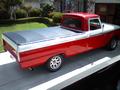
Thank you for the support and yes she is looking well. i have absolutely no patience and so when i start i need to finish, much to my wife's joy as she gets rid of me most nights and weekends good luck with the shipping
Rezvani's Latest Post-Apocalytic Monster Is a Ford F-150 Raptor Underneath
Slideshow: Called the Fortress, the 850-horsepower pickup combines Raptor underpinnings with military-inspired features, survival equipment, and a starting price of $285,000.


 Dual Master Cylinder?














 good luck with the shipping