


Oil Change Interval?

Elder User
Joined: Dec 2004
Posts: 718
Likes: 0
From: North Jersey, New Jersey
Yes that gauge was just to even out the dash it would look wierd with only 3 gauges in each corner  speaking of that I think I ended up replacing the sender for that gauge when my oil pan was leaking last year I originally traced the leak to the gasket I replaced it but there was still a little leak afterwards.
I open the engine cover and trace the leak to the sender switch it is a round plastic can with a metal threaded base that screws into the passenger side of the block and has a wire fastened on the top of it. Pulled it out bought a new one put some anti-sieze on it screwed it in no more black spots in my driveway. Well no more new ones anyway .
.
speaking of that I think I ended up replacing the sender for that gauge when my oil pan was leaking last year I originally traced the leak to the gasket I replaced it but there was still a little leak afterwards.I open the engine cover and trace the leak to the sender switch it is a round plastic can with a metal threaded base that screws into the passenger side of the block and has a wire fastened on the top of it. Pulled it out bought a new one put some anti-sieze on it screwed it in no more black spots in my driveway. Well no more new ones anyway
.

Posting Guru
Joined: Jul 2004
Posts: 2,416
Likes: 1
From: Mitchell, SD
Originally Posted by DaveMac2Vans
There was a post a while back about the oil gauge being a dummy gauge and not indicative of true pressure. It was more of an indication of having or not having oil pressure. Seems there was a link to a revision where you could change the sending unit, alter the PC Board on the dash, and have a real gauge. I couldn't find it in the search, but I'll bet one of these experts here could turn it up. If we can find it again, I'll make a copy and try it out.

Oh here is the link to fix it.
http://rogueperformance.com/oilsw.html

FTE Community Team


Joined: Nov 2001
Posts: 1,867
Likes: 275
From: Oak Harbor, Washington

Hmmph.
I have the digital dash, so I doubt that I have a nice, discrete resistor I can jumper, and I *know* that I have the same issue: the damned "gauge" has been stuck on four bars the entire time I've owned it.
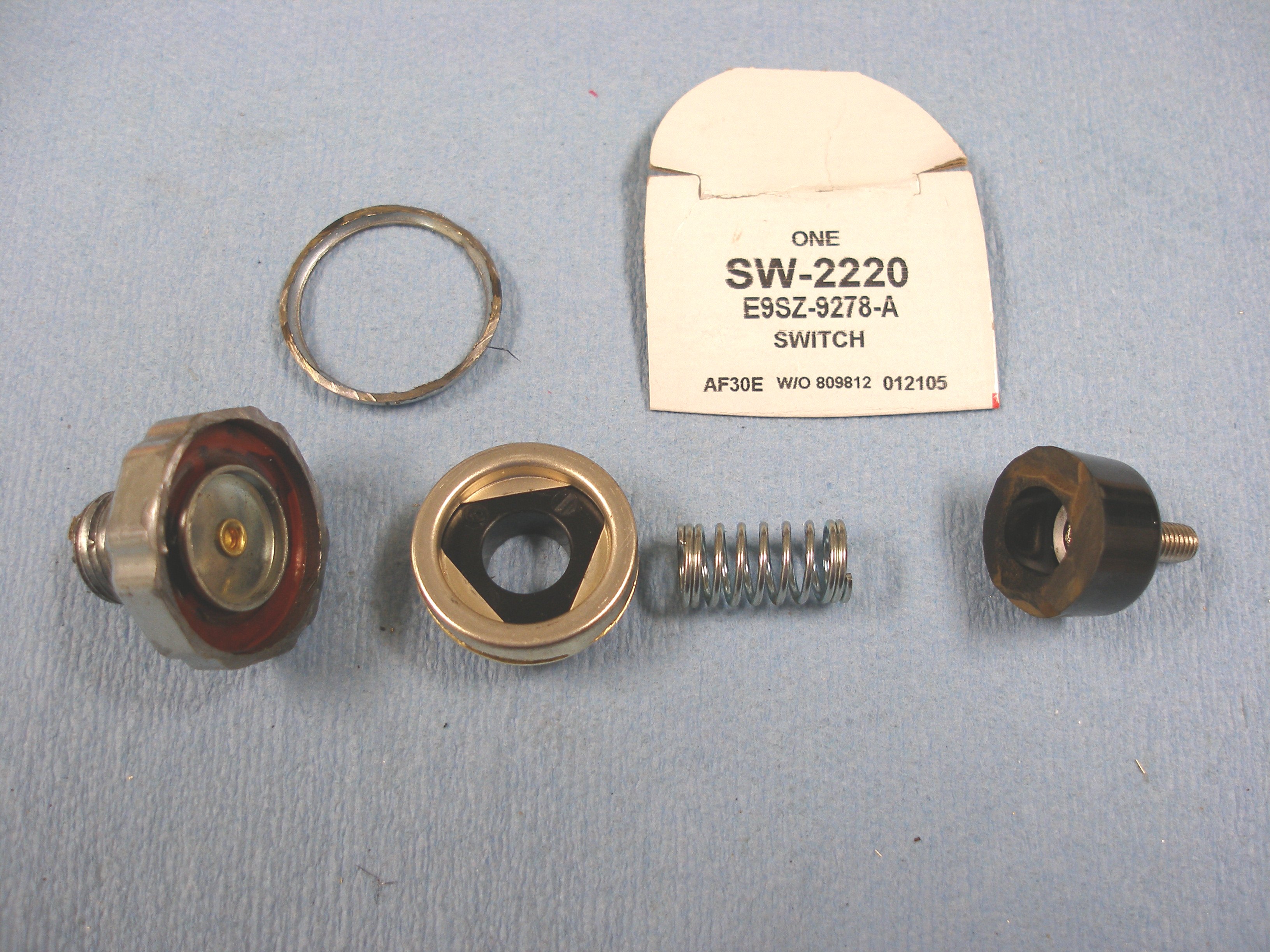
To add insult to injury: this system "bongs" every ten seconds if the pressure fails, and the gauge cluster automatically swaps to show you the oil "gauge". Fine, as far as it goes, but I've had to replace the sender (snap switch, really) four times in six years.
Symptom: I'm driving along and the "bong" will go off and scare the bejesus out of me, but no matter how carefully I listen, the engine sounds fine, it's full of oil, and I've had the pan off and there was no crud on the pickup, and I run synthetic oil and 3k changes even so.
The first time this happened, I did a real pressure test at the check port, and it was fine, so I swapped out the "sender" and the problem went away. For two years. Then it happened again. This time I just swapped the sender without checking, all was fine . . . for another 10 months, then AGAIN!
Last time, I bought a real Motorcraft switch (and now I have FIVE bars showing all the time!), but it's been a year and last week I heard a tell-tale "bong" (about three of them before it shut itself off) and I know that another switch is in my future.
I'd swear here if I could. If it annoys me just a little bit more, I'm going to unplug it and put in a mechanical gauge set.
Regards,
Al S.
I have the digital dash, so I doubt that I have a nice, discrete resistor I can jumper, and I *know* that I have the same issue: the damned "gauge" has been stuck on four bars the entire time I've owned it.
To add insult to injury: this system "bongs" every ten seconds if the pressure fails, and the gauge cluster automatically swaps to show you the oil "gauge". Fine, as far as it goes, but I've had to replace the sender (snap switch, really) four times in six years.
Symptom: I'm driving along and the "bong" will go off and scare the bejesus out of me, but no matter how carefully I listen, the engine sounds fine, it's full of oil, and I've had the pan off and there was no crud on the pickup, and I run synthetic oil and 3k changes even so.
The first time this happened, I did a real pressure test at the check port, and it was fine, so I swapped out the "sender" and the problem went away. For two years. Then it happened again. This time I just swapped the sender without checking, all was fine . . . for another 10 months, then AGAIN!
Last time, I bought a real Motorcraft switch (and now I have FIVE bars showing all the time!), but it's been a year and last week I heard a tell-tale "bong" (about three of them before it shut itself off) and I know that another switch is in my future.
I'd swear here if I could. If it annoys me just a little bit more, I'm going to unplug it and put in a mechanical gauge set.
Regards,
Al S.

Posting Guru

Joined: Jun 1999
Posts: 1,642
Likes: 6
From: Northern California
AL, I've had that happen before. Usually, it was when you least wanted it, like having important company on your van etc. What I hated was the contant "Ding Dong" or in your description, "bong"! There was no way to turn that mind numbing noise off! Okay, I can understand, it going off with a chime, once or twice, with the flashing oil symbol. That annoying chime, is very distracting, almost dangerous, in my opinion. Like you, I was alarmed, and had the oil pressure checked. It was perfectly fine and normal. However, the blinking oil symbol, one bar, and the chime, you would think the engine is about to seize at any moment. (digital dash too, I might add. I don't know if the regular Aerostar instrument panels had this problem) Then you go to Autozone. Their "help" behind the counter, have absolutely, no clue what a digital dash cluster is, as compared to a regular dash cluster. Then, the problem you and I just described, again, they have no idea what 1)the problem even is or 2) the correct part needed to fix the problem. "Get in the 'Zone. Auto Zone..." 9 times out of 10, Auto Zone's employees are "zoning" alright!!..  Ed
Ed
Ed

Hotshot


Joined: Jun 2003
Posts: 12,355
Likes: 4,390
From: SW VA
The other night, I went out camping with my friends to celebrate Graduation, and I had to drive through mudholes, creeks, hillclimbs, ect.... to get to where we were camping. Well, in the morning when I went to take off, the oil pressure guage (Digital, not analog) was down in the red and beeping at me. There was nothing I could do...I was 45 minutes away from home. So I babied it through the rough stuff and out to the trail-head. I checked the oil. That was fine. I look under the van for any leaks...yea right! Covered in mud and water from what I just went through.
I traced the problem back to where I parked the van. Facing up-hill on a very steep incline. Anyways, I got up the road about 5 miles and by that time, I had gotten used to the "dinging" of the guage. But I didnt hear it anymore...I looked down and the pressure was just below the 'H'. Whew....I was relieved!
I traced the problem back to where I parked the van. Facing up-hill on a very steep incline. Anyways, I got up the road about 5 miles and by that time, I had gotten used to the "dinging" of the guage. But I didnt hear it anymore...I looked down and the pressure was just below the 'H'. Whew....I was relieved!

Elder User
Joined: Jan 2003
Posts: 898
Likes: 0
Back when I started changing oil it was Every 1000 miles & filter every other oil change.
From there it went up in stages to every 12000 miles with filter change.
Since then I haven't seen ANY MFG. that calls for less then 5000 miles between changes & most are 6000 - 7500 miles.
Quicky Oil change stores & oil companies LOVE sheeple that will swallow their bilge that EVERY mile you drive is Heavy Duty Service.
Just think how much oil we could save if people would only read & follow their owners manuals.
I change mine between 6000 & 10000 miles & get over 200,000 miles on my vehicles before I give them to my kids. (And I average 80,000 miles a year on just my work vehicle
From there it went up in stages to every 12000 miles with filter change.
Since then I haven't seen ANY MFG. that calls for less then 5000 miles between changes & most are 6000 - 7500 miles.
Quicky Oil change stores & oil companies LOVE sheeple that will swallow their bilge that EVERY mile you drive is Heavy Duty Service.
Just think how much oil we could save if people would only read & follow their owners manuals.
I change mine between 6000 & 10000 miles & get over 200,000 miles on my vehicles before I give them to my kids. (And I average 80,000 miles a year on just my work vehicle

Junior User
Joined: Aug 2000
Posts: 78
Likes: 0
FTE Stories
Ford Trucks for Ford Truck Enthusiasts

Top 6 Best Deals Available on New Fords & Lincolns Right Now
Brett Foote
This Hennessey Takes the Expedition Tremor's Off-Roading Capability to the Next Level
Verdad Gallardo
Top 10 Fords at 2026 Carlisle Ford Nationals
Joe Kucinski
3 Best / 3 Worst Parts of Modern Ford Ownership
Brett Foote
10 Amazing Upgrades That Solve Common Ford Truck Owner Headaches
Pouria Savadkouei
Every 2026 Ford Engine Explained
Brett Foote
10 Ugly Ford Trucks That We Still Kinda Love
Joe Kucinski
10 Things Every Truck Owner NEEDS (2026 Edition)
Michael S. Palmer
Rezvani's Latest Post-Apocalyptic Monster Is a Ford F-150 Raptor Underneath
Verdad Gallardo
Former ******
Joined: Nov 2004
Posts: 4,901
Likes: 2
From: Salt Lake City, Utah
The longest safe oil change interval for normal driving is 5,000 miles. You can go 7500 if they are all highway miles, and even longer if you use high stock grade full synthetic (certain castrol, and redline, also know as 15,000 mile oil). If you use regualr motor oil, I would change the oil more often that with a synthetic.
FTE Community Team
Joined: Nov 2001
Posts: 1,867
Likes: 275
From: Oak Harbor, Washington
Castrol Syntec is not a "true" synthetic oil (ie it is not a API Group IV base stock), it's a severly hydrocracked and isodewaxed Group III base oil. So is Valvoline's, Chevron's, Pennzoil's, etc.
AFAIK, of the mass-market oil, only Mobil 1 is Group IV based. AMSoil, Redline, Royal Purple are other Group IV based oils.
Talking oil seems to be like talking religion, I try to stay out of it. But Syntec is a bug of mine, since they switched away from Group IV in about '99.
Regards,
Al S.
AFAIK, of the mass-market oil, only Mobil 1 is Group IV based. AMSoil, Redline, Royal Purple are other Group IV based oils.
Talking oil seems to be like talking religion, I try to stay out of it. But Syntec is a bug of mine, since they switched away from Group IV in about '99.
Regards,
Al S.
Former ******
Joined: Nov 2004
Posts: 4,901
Likes: 2
From: Salt Lake City, Utah
I wasn't referring to Castrol Sytec, though I should have been more specific. In my experience, high grade sythetics are better than regualar, but it depends of how you drive, and on how you maintain the vehicle, and upon what condition it is already in. For example, a engine with worn piston rings is a poor candidate for synthetic, because the oil still gets past the rings and burns, and the rate at which it is burned exceeds any cost effectiveness it may offer from superior lubrication and improved fuel economy. Any engine that leaks oil anywhere should be repaired before useing synthetic, since most synthetics will actually leak worse. But for all properly maintanied vehicles, synthetic seems to be worth it, if you get a good brand( the API I$ base stock above for example) Castrol is still good to, because it has special oxidizers in it, that improve its viscosity, and prevent it from breaking down. And everyone is going to have their own opinions about, and they should. If you only drive your car once a week, regular oil will be a better investment. If you do a lot of highway miles, it probably doesn't matter which you use. But for stop and go surface traffic, synthetics protect the engine much better.
FTE Community Team
Joined: Nov 2001
Posts: 1,867
Likes: 275
From: Oak Harbor, Washington
I wanted to stay out of this thread, really I did . . . but I'm an oil snob.
Synthetic lube oils are a waste of money for the average driver. Almost any engine built today will not wear out before 200k miles, but the rest of the car will be pretty ragged by then (that the target "end of life" mileage for the whole car), and unless the original owner decides that she's going to run it over 200k, then not enough is saved (in reduced wear, much improved startup lubrication, very slightly improved fuel mileage, and reduced oil consumption) to justify the expense of a synthetic lube.
(I use synthetic lubricants in EVERYTHING I own that uses a lubricant)
Oil doesn't breakdown. Over the very long haul, oil (the base oil, about 70-90% of total oil volume) does eventually form shorter chains, but the time it takes to accomplish this is way beyond anybody is using oil in their crankcase. The reason we have to change oil is twofold: additive depletion and crud-carrying-capacity saturation.
The additives in lube oil deplete. They oxidize themselves, they change to other chemical states, they vapourize and get pulled out the PCV system, they get "used up" as in the additives used to maintain the pH level in the slight alkaline range; the "detergent" additives that do not clean existing crud but instead prevent agglomerated crud from adhering to the metal parts. When the additives aren't there in sufficient concentration, Bad Things happen, such as crud adhering to the inside of the engine, reduced shear strength (that's what you need for areas that don't have a hydrodynamic cushion: pressurized areas at startup and cam followers all the time), sludge formation due to acidic water byproduct of combustion combining with agglomerated soot and crap and settling out; stuff like that.
The crud-carrying-capability is directly determined by the additive depletion level. When the additives deplete, crud that is the normal byproduct of combustion (and crud that is actually IN the fresh petro oil we put in our engine) and that makes it past rings and valve guides does not stay in suspension any longer and begins showing up on surfaces: Varnish/sludge.
But the base oil doesn't wear out. It doesn't suffer "thermal breakdown" or anything like that. "Detergent" oil doesn't "clean up" a dirty engine, it just keeps it from getting dirtier.
Synthetic oil in a leaky engine won't directly cause increased oil consumption, but it might indirectly. Part of what keeps oil in older engines is crud saturating porous seals (like the "rope" rear main seals in older domestic engines). Synthetic lubricants tend, by their composition, to not contain as much crud themselves and therefore to be able to maintain in suspension more crud in total; this translates to less crud being "replenished" in rope seals (or around the seal surface of elastomer seals) and in the normal course of events those seals will begin to contain less crud -- not due to any "detergent" cleansing action, but just because crud will tend to go back into suspension when put in contact with moving, cleaner oil.
("Oil detergents are NOT LIKE TIDE," one oil presenter -- Bob Nehren from Chevron told me at a oils technology presentation in 2002. It's called "tribology" and it's cool.)
In the 70's, there really was a problem with seals leaking more when you switched to synthetic. Why? Because seal materials at that time *depended* upon crud in the petro oil to do some of their work, and one of the petro oil's additives was a seal swell agent. Synth oil didn't have that, and automotive seals that depended upon this crutch did leak more on synth. That is a dead issue now: modern elastomers do not depend upon a seal swell additve in the lube oil to operate correctly as a seal, and the seal swell agent is present in "older engine/high miles engine" oils for those that do.
Viscosity Index improvers (STP, Hilton's Hyperlube, Lucas) aren't needed by synth lubes because they already have an improved VI due to their poly alpha olefin (PAO) structure. No point in adding a VI improver to them.
One reason why you can run a synth lube longer is that, because it starts off cleaner, it can hold more crud in suspension (new or old engine). Another is that a smaller percentage of a quart of synth lube is additive -- it doesn't need as many additives in order to perform superiour to petro oil. This affects the additive depletion curve, so you can run the synth longer.
If we could remove the larger crud from suspension in a filter, and then change the filter, and re-up the depleted additives, we could run either oil forever. Which is the point of bypass filtration (also popularly known as "toilet paper filters", though at least two commercial bypass filters use vapourization and centrifugal forces rather than media-based filtration). A typical full-flow filter today filters particles in the neighborhood of 25 microns -- that's about .001" which is a pretty darned large particle to be running around in your oil, but there you are: this is state-of-the-industry. Really.
Bypass filters only filter a small percentage of the total oil volume (typically about 10%) but they filter down to 1 micron or less. Some bypass filters remove some water, too, which is good because water + sulphur (present in most all available liquid fuels except biodiesel) = sulphuric acid which is Not Good for your engine or most other living things.
So the oil stays clean. But what about the additive depletion issue. Well, eventually you have to change the media in a bypass filter (if you're using the "toilet paper" type) and when you do that, you have to add about a quart of oil to bring the oil level back up. Bingo! Additive level restored!
Lastly, synth oil use and engines with worn rings etc. I purchased my '89 3.0l with 141k on it, and it had been used hard and put away wet. I've done a lot of work with it (heads rebuilt at 145k due to crack in exhaust seat, brgs in rods/mains at 185k just because I was re-sealing the pan, then didn't need it) but the rings are the same now (200k) as then. The flash point of synth oil is a lot higher than petro oil. When I run a quality (API SL/CI-4) 5W30 petro oil in this rig, it burns a quart in 600 miles. With synth (I run either Mobil 1 5W30 or very occasionally AMSOil 5W40), I obtain a usage rate of one quart to 750 miles. So it smokes less on synth. Why? Because the synth oil burns at a higher temp, which means an oil film on the cylinder wall and piston skirt/ring lands burns further down the piston or wall than the petro oil does. And if it doesn't burn, it gets scraped down for use in another cycle.
So I disagree that it's pointless to run synth in an old engine, there's at least that one clear benefit: reduced oil consumption (reduced visible smoke, reduced carbon formation in the combustion chamber, etc.)
However, if you only need the engine to last 200k miles, petro oil is just fine. For me, the cost of running synth oil and changing it short is a lot cheaper than anything else I can do to the engine, should it become worn to unserviceability. I'm not ready to trade off my '89 'star yet.
Regards,
Al S.
Synthetic lube oils are a waste of money for the average driver. Almost any engine built today will not wear out before 200k miles, but the rest of the car will be pretty ragged by then (that the target "end of life" mileage for the whole car), and unless the original owner decides that she's going to run it over 200k, then not enough is saved (in reduced wear, much improved startup lubrication, very slightly improved fuel mileage, and reduced oil consumption) to justify the expense of a synthetic lube.
(I use synthetic lubricants in EVERYTHING I own that uses a lubricant)
Oil doesn't breakdown. Over the very long haul, oil (the base oil, about 70-90% of total oil volume) does eventually form shorter chains, but the time it takes to accomplish this is way beyond anybody is using oil in their crankcase. The reason we have to change oil is twofold: additive depletion and crud-carrying-capacity saturation.
The additives in lube oil deplete. They oxidize themselves, they change to other chemical states, they vapourize and get pulled out the PCV system, they get "used up" as in the additives used to maintain the pH level in the slight alkaline range; the "detergent" additives that do not clean existing crud but instead prevent agglomerated crud from adhering to the metal parts. When the additives aren't there in sufficient concentration, Bad Things happen, such as crud adhering to the inside of the engine, reduced shear strength (that's what you need for areas that don't have a hydrodynamic cushion: pressurized areas at startup and cam followers all the time), sludge formation due to acidic water byproduct of combustion combining with agglomerated soot and crap and settling out; stuff like that.
The crud-carrying-capability is directly determined by the additive depletion level. When the additives deplete, crud that is the normal byproduct of combustion (and crud that is actually IN the fresh petro oil we put in our engine) and that makes it past rings and valve guides does not stay in suspension any longer and begins showing up on surfaces: Varnish/sludge.
But the base oil doesn't wear out. It doesn't suffer "thermal breakdown" or anything like that. "Detergent" oil doesn't "clean up" a dirty engine, it just keeps it from getting dirtier.
Synthetic oil in a leaky engine won't directly cause increased oil consumption, but it might indirectly. Part of what keeps oil in older engines is crud saturating porous seals (like the "rope" rear main seals in older domestic engines). Synthetic lubricants tend, by their composition, to not contain as much crud themselves and therefore to be able to maintain in suspension more crud in total; this translates to less crud being "replenished" in rope seals (or around the seal surface of elastomer seals) and in the normal course of events those seals will begin to contain less crud -- not due to any "detergent" cleansing action, but just because crud will tend to go back into suspension when put in contact with moving, cleaner oil.
("Oil detergents are NOT LIKE TIDE," one oil presenter -- Bob Nehren from Chevron told me at a oils technology presentation in 2002. It's called "tribology" and it's cool.)
In the 70's, there really was a problem with seals leaking more when you switched to synthetic. Why? Because seal materials at that time *depended* upon crud in the petro oil to do some of their work, and one of the petro oil's additives was a seal swell agent. Synth oil didn't have that, and automotive seals that depended upon this crutch did leak more on synth. That is a dead issue now: modern elastomers do not depend upon a seal swell additve in the lube oil to operate correctly as a seal, and the seal swell agent is present in "older engine/high miles engine" oils for those that do.
Viscosity Index improvers (STP, Hilton's Hyperlube, Lucas) aren't needed by synth lubes because they already have an improved VI due to their poly alpha olefin (PAO) structure. No point in adding a VI improver to them.
One reason why you can run a synth lube longer is that, because it starts off cleaner, it can hold more crud in suspension (new or old engine). Another is that a smaller percentage of a quart of synth lube is additive -- it doesn't need as many additives in order to perform superiour to petro oil. This affects the additive depletion curve, so you can run the synth longer.
If we could remove the larger crud from suspension in a filter, and then change the filter, and re-up the depleted additives, we could run either oil forever. Which is the point of bypass filtration (also popularly known as "toilet paper filters", though at least two commercial bypass filters use vapourization and centrifugal forces rather than media-based filtration). A typical full-flow filter today filters particles in the neighborhood of 25 microns -- that's about .001" which is a pretty darned large particle to be running around in your oil, but there you are: this is state-of-the-industry. Really.
Bypass filters only filter a small percentage of the total oil volume (typically about 10%) but they filter down to 1 micron or less. Some bypass filters remove some water, too, which is good because water + sulphur (present in most all available liquid fuels except biodiesel) = sulphuric acid which is Not Good for your engine or most other living things.
So the oil stays clean. But what about the additive depletion issue. Well, eventually you have to change the media in a bypass filter (if you're using the "toilet paper" type) and when you do that, you have to add about a quart of oil to bring the oil level back up. Bingo! Additive level restored!
Lastly, synth oil use and engines with worn rings etc. I purchased my '89 3.0l with 141k on it, and it had been used hard and put away wet. I've done a lot of work with it (heads rebuilt at 145k due to crack in exhaust seat, brgs in rods/mains at 185k just because I was re-sealing the pan, then didn't need it) but the rings are the same now (200k) as then. The flash point of synth oil is a lot higher than petro oil. When I run a quality (API SL/CI-4) 5W30 petro oil in this rig, it burns a quart in 600 miles. With synth (I run either Mobil 1 5W30 or very occasionally AMSOil 5W40), I obtain a usage rate of one quart to 750 miles. So it smokes less on synth. Why? Because the synth oil burns at a higher temp, which means an oil film on the cylinder wall and piston skirt/ring lands burns further down the piston or wall than the petro oil does. And if it doesn't burn, it gets scraped down for use in another cycle.
So I disagree that it's pointless to run synth in an old engine, there's at least that one clear benefit: reduced oil consumption (reduced visible smoke, reduced carbon formation in the combustion chamber, etc.)
However, if you only need the engine to last 200k miles, petro oil is just fine. For me, the cost of running synth oil and changing it short is a lot cheaper than anything else I can do to the engine, should it become worn to unserviceability. I'm not ready to trade off my '89 'star yet.
Regards,
Al S.
FTE Community Team
Joined: Nov 2001
Posts: 1,867
Likes: 275
From: Oak Harbor, Washington
Originally Posted by asavage
. . . I've had to replace the sender (snap switch, really) four times in six years.

Elder User
Joined: Dec 2006
Posts: 830
Likes: 0
From: Kitchener,Ontario,Canada
MBK , Ford says 7,500 miles for your vehicle. They dont want it to last forever ! What I'd say is this.......if money is not an issue, the newer your oil & filter the better for the engine. However if you just want 200,000 miles & will "dispose' of your vehicle to another party, go the 7,500 miles it is cheaper short term.
Aeroman59
Aeroman59
