When you click on links to various merchants on this site and make a purchase, this can result in this site earning a commission. Affiliate programs and affiliations include, but are not limited to, the eBay Partner Network.
Thank you for that awesome post chadstick! I would thumbs up more than once if I could. Helps clear up a lot. I'll have to re-think this now.
Regarding the "Exhaust back pressure," I was also curious about that one. Looks like you're getting around 17 psi at idle. With a little throttle it quickly climbs up to 30+ psi. It's kind of odd. At most, the boost pressure and exhaust back pressure should be 1.1, and it shouldn't exceed boost pressure. I used to run a mechanical boost and exhaust pressure gauge (no isolator), and if i recall correctly, they were similar with the exhaust pressure being slightly lower than boost pressure until the turbo maxed out.
Last edited by wcbcruzer; Nov 6, 2025 at 09:48 PM.
Thank you for that awesome post chadstick! I would thumbs up more than once if I could. Helps clear up a lot. I'll have to re-think this now.
Regarding the "Exhaust back pressure," I was also curious about that one. Looks like you're getting around 17 psi at idle. With a little throttle it quickly climbs up to 30+ psi. It's kind of odd. At most, the boost pressure and exhaust back pressure should be 1.1, and it shouldn't exceed boost pressure. I used to run a mechanical boost and exhaust pressure gauge (no isolator), and if i recall correctly, they were similar with the exhaust pressure being slightly lower than boost pressure until the turbo maxed out.
It's been a while since I have really watched that page, and again, I am not real certain on those. I remember reading something about the ambient air pressure being factored in, which is why I mentioned subtracting the AAP from the exhaust back pressure, which would render more of a 1:1 reading with the boost. Another way would be to subtract the boost from the exhaust back pressure to get a closer 1:1 MAP and exhaust pressure.
Also FWIW, in those pictures I had just ran out and cranked the truck to get the photos. And with as fast as the numbers move up and down, that photo may have caught them at a weird time. I'll have to pay ore attention to it next time I get out! lol...
That actually makes sense. So exhaust pressure is like MAP, but on the other side. I wonder if that's pre-turbo pressure, or pressure between the turbo and DPF.
That actually makes sense. So exhaust pressure is like MAP, but on the other side. I wonder if that's pre-turbo pressure, or pressure between the turbo and DPF.
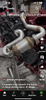
there are two pressure sensors in the exhuast system
the first is located on the exhaust manifold near the pax side firewall.
The second is on the dpf and it’s used to determine how full the dpf is
Oh that's a huge find! Good pic. It appears that it is pre-turbo, which would make sense given it's name and the readings we're seeing. Since it's pre-turbo, that makes it a much more useful sensor to monitor. This would also be a good spot to T in for a "real" EGT gauge.
Really pays off in the long run to know more about these engines. Keep 'em coming.
This Hennessey Takes the Expedition Tremor's Off-Roading Capability to the Next Level
Slideshow: The VelociRaptor Expedition gains a lift, upgraded suspension, Brembo brakes, and trail-ready equipment while retaining the stock 440-horsepower EcoBoost V6.
Rezvani's Latest Post-Apocalyptic Monster Is a Ford F-150 Raptor Underneath
Slideshow: Called the Fortress, the 850-horsepower pickup combines Raptor underpinnings with military-inspired features, survival equipment, and a starting price of $285,000.