When you click on links to various merchants on this site and make a purchase, this can result in this site earning a commission. Affiliate programs and affiliations include, but are not limited to, the eBay Partner Network.
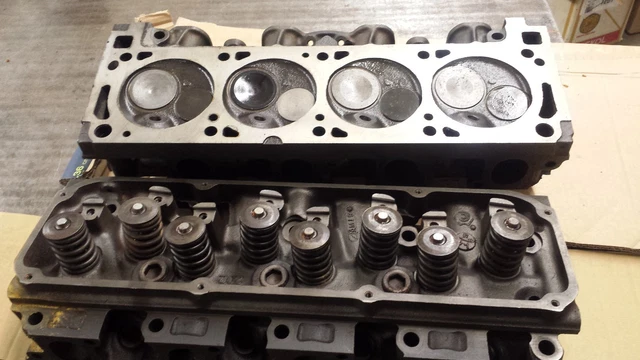
Hi all I'm trying to run on 87 octane as it ran fine but due to recent events the engine needed rebuilding. I got TMeyer KB Ford 400 pistons with a 9.8:1 CR at .000 Deck clearance. I'm aiming for a 8.7:1 or have any of you ran at 9:1 with 87 without detonation? I am also running the Summit racing 1792 camshaft so that might help with compression and bit. Any ideas preferably cheap would be great.
If I can could I get the pistons I got machined to lower CR or I's there a brand that makes stock pistons that are quality and can handle slightly under 400hp?
Thank you for any input.
CR using Summit Racing's CR calculator
link to pistons and cam everything else is getting machined or stock:
No I couldn’t say that is what is advertised but I am having the deck machined. From a feeler gauge with the smallest size we could not fit so it’s probably under 5thou if anything. It’s going to the machine shop hopefully this coming Wednesday so I’ll get a definitive answer.
I'm running about 9.8 with no problems, but I'm about a mile above sea level. If it's too much you use Snow Performance water/meth injection. It work really well.
Cool I'll look into that. I am about 700ft on average with a low of 600ft and peak of 900ft, I'm in the greater Pittsburgh area. Still open to ideas and out of curiosity are you running 87, if so that must be some pretty good stuff.
That’s pretty good, with that kind of compression I was not 100% expecting 91 to run that’s better than 93 at least. I’ll give her a run when I get it all back together on some 91 then. Thank you
It matters more what your dynamic compression is than your static compression when determining if you can burn regular gas or not. Get out your cam card and run the numbers on the calculator. A general rule of thumb is 8-1 max for pump gas.. Keep in mind that the calculator may be using 100% VE. In the real world a carburetor engine will probably be in the 80% range at best. Wallace Racing: Dynamic Compression Ratio Calculator
You've received some great advice from the community. With the stock 10.297" deck height and stock 6.585" connecting rods, you'd have .012" deck clearance with those pistons. Changing that value in our static compression calculator would net you 9.36:1, keeping your other specs.
@Crop Duster made a great point about dynamic compression when determining octane requirements. Our SUM-1792 camshaft closes the intake valve at 63* ABDC with the 276* advertised duration and 105 ICL. Using the Wallace Racing dynamic compression calculator, it comes out to 7.44:1 at your 700ft altitude for Yinzer land! That "should" be good for use with 87 Octane.
You could always "deck" the block to zero deck. That would be taking .012" off the 10.297", so you would be at 10.285" if everything checks out. That would bump static to 9.57:1. This would put you at 7.61 dynamic, so still within that target guideline for 87 octane. More importantly, you'd reduce the quench distance to .044", which would help produce a more efficient combustion cycle.
Piston to valve clearance is always something to check, especially when doing a cam swap, milling the deck or heads, or running a thinner head gasket.
Engines make more power with some deck height
Youi need that quench area
Zero deck height is not good, even when racing
Try using 85 octane on a 400 at 5000 feet
You can't get one to quit pinging or dieseling
You'll have hot spots on the pistons at zero deck
Open chamber heads still have a quench area (defined as piston to head area)
Zero deck height is a doable thing for a racing engine
Big problems in a street motor IMO with piston to valve clearance
Not so much of a problem with a Ford 400, and those motors sure do benefit with more compression
Ran stock steel shim head gaskets in my '69 302 Chev forever (came stock with steel shim head gaskets)
Sucked a few valves over the years (broken valve springs) mostly
Should have took a picture of the sucked valve in my 69 Z-28 when I put 2.05 turbo angle plug fuelie heads on it
Live and learn
Rezvani's Latest Post-Apocalyptic Monster Is a Ford F-150 Raptor Underneath
Slideshow: Called the Fortress, the 850-horsepower pickup combines Raptor underpinnings with military-inspired features, survival equipment, and a starting price of $285,000.




 Ford 400 Compression