


Vacuum gauge test


Thread Starter
|
Trailering
Joined: Apr 2025
Posts: 21
Likes: 4
Vacuum gauge test
Hi, I bought a vacuum gauge to set my idle mixture screws (learning). What port on the carb do I hook it it up to? When standing in front of it. There is a small one to the left that is empty. The center large for the PCV and on the right another small that leads to the distributor

Laughing Gas


Joined: Aug 2000
Posts: 1,005
Likes: 63
From: Eastern, Idaho
Anything that reads vacuum at idle will work, preferably directly from the intake manifold. One port on the carb will not have a reading at idle. Depending on what you have access to you might need to make a tee and connect into an existing system.
Thread Starter
|
Trailering
Joined: Apr 2025
Posts: 21
Likes: 4
okay I found it. So I adjusted the mixture screws but still no reading change. It bounces between 10-15, no matter the change of the screws. What would cause that.

Moderator & parts slinger


Joined: Feb 2007
Posts: 50,154
Likes: 5,785
From: S/W Missouri, Polk county

https://www.classiccarrestorationclub.com/post/engine-vacuum-troubleshooting
Common Vacuum Test Results:
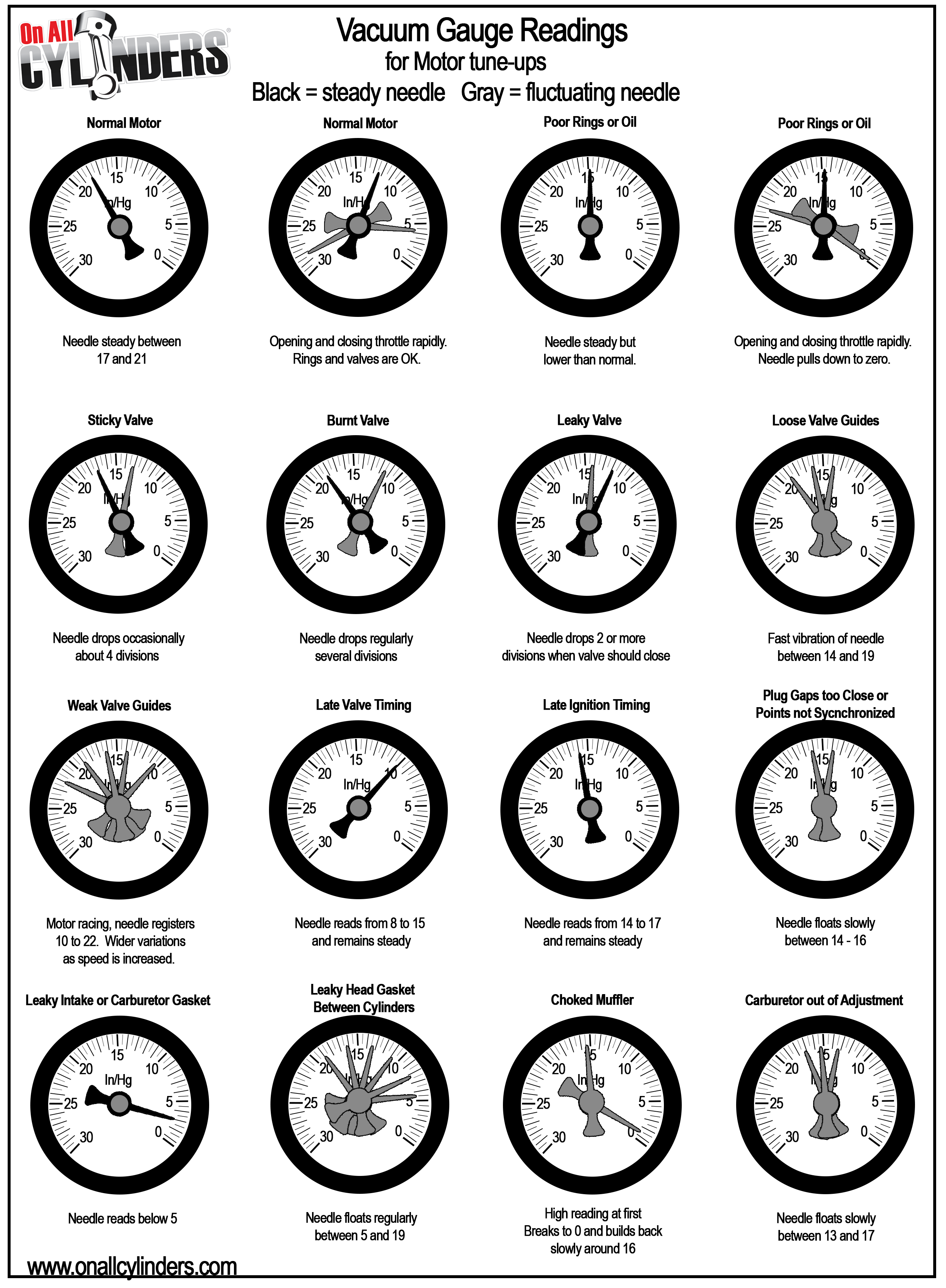
Normal Engine: On most engines, accelerate to around 2000 rpm and then quickly release the throttle. The engine should snap right back to a steady 17- 21″hg vacuum.Steady low between 5-10″hg vacuum: This indicates that the engine has a leak in the intake manifold or the intake gasket.
Steady low between 10-15″hg vacuum: This reading indicates late valve timing. There’s a chance the vehicle has jumped timing. Check the timing belt or chain depending on the application.
Steady low between 15-18″hg vacuum: This low reading indicates retarded ignition timing. Advance the timing on the distributor to correct this problem, and recheck vacuum.
Fluctuating Needle: A fluctuating needle indicates there’s a problem with a valve or a there’s an engine misfire.
Needle drops during acceleration: If the needle drops steady during acceleration there’s a restriction in the exhaust or intake. This is typically due to a clogged muffler or exhaust system.


Thread
Thread Starter
Forum
Replies
Last Post
JJFizzle
1973 - 1979 F-100 & Larger F-Series Trucks
7
Feb 14, 2023 05:27 PM
Dirk N
Small Block V8 (221, 260, 289, 5.0/302, 5.8/351W)
14
Aug 7, 2021 04:13 PM
Montag
1980 - 1986 Bullnose F100, F150 & Larger F-Series Trucks
7
Jan 12, 2018 07:20 AM
Fine250
Fuel Injection, Carburetion & Fuel System
2
Jul 17, 2005 05:01 PM






