When you click on links to various merchants on this site and make a purchase, this can result in this site earning a commission. Affiliate programs and affiliations include, but are not limited to, the eBay Partner Network.
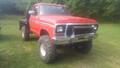
Added a 4 inch lift onto my 77 f150 4x4. Installed a drop pitman arm and trying to figure out the trac bar system
Am I better off to go with just a drop bar or do I need to buy an adjustable also?
I was looking at the drop bracket on wildhorses and it seems like it would be all I need but I dont know much about the subject. (https://www.wildhorses4x4.com/76-77-...r-drop-bracket)
Has anyone custom made one of these? Ive got lots of metal sitting around and the time to build it. Just wouldnt know how far to drop it down
Or get a trac bar riser bracket. That last one attaches to the top of the axle in place of where the bottom end of that trac bar normally attaches to the axle. Also know as a Kiser Riser. They have them for a full size bronco and F150 trucks. https://www.wildhorses4x4.com/78-79-...-riser-bracket
Bottom line you want the trac bar and the steering linkage as parallel to each other as much as possible. And if you get a trac bar drop bracket there are a couple of versions out there. A "stock" light weight but longer one. And there is heavy duty version the works with the stock one by attaching OVER it.
A cheap one when they break.
A harsh drop and snap it goes.
The ugliest trail fix out there, but it worked and we got to wheel the rest of the weekend.
Here is a way to gusset the trac bar to help solid it up. https://www.broncitisparts.com/produ...rac-bar-gusset
Or get a trac bar riser bracket. That last one attaches to the top of the axle in place of where the bottom end of that trac bar normally attaches to the axle. Also know as a Kiser Riser. They have them for a full size bronco and F150 trucks. https://www.wildhorses4x4.com/78-79-...-riser-bracket
Bottom line you want the trac bar and the steering linkage as parallel to each other as much as possible. And if you get a trac bar drop bracket there are a couple of versions out there. A "stock" light weight but longer one. And there is heavy duty version the works with the stock one by attaching OVER it.
Wonderful information thank you tons. Honestly that drop bracket looks easy enough to make myself. Seems all it’s doing is dropping 3 inches and using 2 bolt holes to secure it.
not doing any wheeling with this truck so gussets shouldn’t be needed but if I feel uncomfortable with my bracket I can always do this lol
If you use a drop, don’t just bolt it. Weld at least a little bit of it.
Bolting is certainly drivable, but welding takes that little bit more of flex out of it.
And that’s more for the street than trail, because the little flexing allows for a slight bit of wandering on the street.
Very tiny amount, and maybe not noticeable in a full-size truck or bronco. But very noticeable when daily driving a short wheelbase early bronco.
As Rich pointed out, if you’ve used a drop Pitman Arm, you don’t use only an adjustable track bar by itself, because that only changes the location of the axle. Does not correct the angle.
You must use a drop bracket (or riser) to correct the angle and bring the two bars back into their original relationship.
The adjustable track bar is only needed for two reasons. One is to fine tune the adjusting if the drop bracket doesn’t precisely center the axle. Usually not a big deal, because even the factory didn’t make them perfectly centered all the time.
But the other is a nice convenient way of reducing wear and tear on the upper bushing.
The adjustability allows you to twist the eye to better match the new angle of the track bar created by the lift.
If you look at the lower mounting bolt, as the suspension is lifted, it rotates down slightly. This puts a twist in the bar to align with the other mount.
With an adjustable bar, no more twist.
So while the drop bracket or riser are required, the adjustable track bar is a nice secondary option.
Risers are arguably stronger, but have their own set of rules and regulations and aspects that sometimes require tweaking of other things.
Well then give it a try making it and post up a pic when you do. My trac bar is still intact in this pic, you can see it under there. I think it broke further down the trail.
Imagine a straight line ...drawn from center of ball joint at pitman arm where drag link attaches ....&... through the ball joint at the far end where it attaches to the long side tie rod near the right front steering knuckle, Imagine a straight line ...drawn through the left side of frame attachment through bolt for the trac bar ...&... through the center of the big bolt where the trac bar attaches over on the right end of the front axle near C-bushing. The object is to keep those two lines parallel to each other. It helps if they are near the same length. Both bars swing the right most end through arcs, which because they are arcs, move that end right to left as they swing.
Bars with bends still have two ends, ignore the bends.
Tyler all the above is great information from very knowledgeable guys
Only input I have is if you do decide to build your own,, use good quality steel and GR.8 bolts and as mentioned above weld it also.
Jusk keep in mind at times depending on the conditions there can be tremendus strain on that bar and brackets.
Tyler all the above is great information from very knowledgeable guys
Only input I have is if you do decide to build your own,, use good quality steel and GR.8 bolts and as mentioned above weld it also.
Jusk keep in mind at times depending on the conditions there can be tremendus strain on that bar and brackets.
No kidding tons of good info.
Im off to the portland swap meet so I wont get to making it this week.
ill post some photos next week when I make it. Ive been using all grade 8 bolts. Will see if I can use some 1/4 flat stock to make the new bracket. Make sure its strong
Finally got around to building a bracket. Figured I’d upload some photos. Used some 3/8 flat bar I had lying around. Dropped it 2 inches which is what my pitman arm is. Added some cross pieces for extra strength.
Might redesign a little bit as I didn’t consider the flat platform I have build not. but this sucker is solid good enough for now
Took the advice and the steering and trac bar are pretty close to being parallel
Looks great. Very stout looking too!
It's always hard to define "parallel" when Ford made the trackbar's curved at the bottom! I always take into account the difference in height of the actual pivot points, rather than looking at just the bars, because of the curve. But I'm not sure if that's more correct or not. Just that it makes sense in my head.
Can't wait to hear how it drives. Especially with that custom ignition control module mount on the front tire! Haha!
Looks great. Very stout looking too!
It's always hard to define "parallel" when Ford made the trackbar's curved at the bottom! I always take into account the difference in height of the actual pivot points, rather than looking at just the bars, because of the curve. But I'm not sure if that's more correct or not. Just that it makes sense in my head. .... etc ....
It's an imaginary line through the pivot points. Curves in a bar to gain clearance do not change the imaginary line. You are correct in your thinking.
Looks great. Very stout looking too!
It's always hard to define "parallel" when Ford made the trackbar's curved at the bottom! I always take into account the difference in height of the actual pivot points, rather than looking at just the bars, because of the curve. But I'm not sure if that's more correct or not. Just that it makes sense in my head.
Can't wait to hear how it drives. Especially with that custom ignition control module mount on the front tire! Haha!
Paul
LOL yeah currently there’s no body parts on it. Driving me nuts as all the mechanical is pretty much finished and defined drivable.
with no cab I’ve got no brakes so I can’t even use a bucket.
Cross my fingers we are painting the cab in 2 weeks. Just finishing the last couple patches
I dropped the trac bar as much as my pitman arm was dropped. Figured that should pretty much line up. Frame is centered to the axle now which to me is a great start
Frame is centered to the axle now which to me is a great start
Unfortunately, that’s not always how it works.
You may get lucky, but you can’t truly center the axle, or consider it centered, until the full weight of the vehicle is on the suspension and it’s compressed to final basic ride height.
The on-center position is figured only at normal ride height. And from there it will move left and right during suspension cycling.
There are a few things having to do with the suspension and steering that you can’t fully dial in until the vehicle is either at its normal weight and ride height, or you compress the suspension manually to its expected level.
Unfortunately, that’s not always how it works.
You may get lucky, but you can’t truly center the axle, or consider it centered, until the full weight of the vehicle is on the suspension and it’s compressed to final basic ride height.
The on-center position is figured only at normal ride height. And from there it will move left and right during suspension cycling.
There are a few things having to do with the suspension and steering that you can’t fully dial in until the vehicle is either at its normal weight and ride height, or you compress the suspension manually to its expected level.
That bracket looks real stout..
When I make brackets, I always trim about a 1/4 in off the sharp corners then grind corners into a nice curved rounded corner.
When welding on the front, I grind a deep grove weld then grind flush .
Your truck is very nice and just thought that bracket would look nice detailed out to match all the other great work..
Again,, please do not take this as critism but just ideas..from an old guy...
Alex
This Hennessey Takes the Expedition Tremor's Off-Roading Capability to the Next Level
Slideshow: The VelociRaptor Expedition gains a lift, upgraded suspension, Brembo brakes, and trail-ready equipment while retaining the stock 440-horsepower EcoBoost V6.
Rezvani's Latest Post-Apocalyptic Monster Is a Ford F-150 Raptor Underneath
Slideshow: Called the Fortress, the 850-horsepower pickup combines Raptor underpinnings with military-inspired features, survival equipment, and a starting price of $285,000.