When you click on links to various merchants on this site and make a purchase, this can result in this site earning a commission. Affiliate programs and affiliations include, but are not limited to, the eBay Partner Network.
I’m pretty sure the radiator itself is fine . I’m also glad you mentioned that because it does it when I have it idling in the driveway when it gets up to operating range. And when it gets extremely hot the top radiator hose swells up and a loud humming noise starts coming from the radiator until it cools back down a little.
Just by looking at the picture that you posted, I would start by measuring the distance between the fan and radiator and by a spacer to move the fan as close as I could safely get it. Something like this they are made in several different sizes
This is only an example
You water hose is kinked, you need to shorten that loop around. What is the lbs pressure on the radiator cap? It sounds like you need to burp or get all the air out of the radiator. Park it nose high (car ramps) with the radiator cap loose and let it run until the T stat opens and it should purge the air. That noise could be water hammer. I agree that you need a shroud since you have a clutch fan. When was the last time you flushed the block?
IMO you also need to get ride of that GLASS fuel filter that threads together. A one piece plastic or metal one would be safer.
Are you aware of the thermostat issue with 335 series blocks? MUST run installed thermostat and must use correct thermostat that restricts internal bypass.
Yes clutch fans uses a shroud.
Non-clutch fans can get away not using a shroud but it needs to be 1 inch from the radiator.
I have a car with a v8 that the factory never had a shroud on and was 1 inch from the radiator and that worked as long as the block was not full of mudd
The fist think I saw was that glass fuel filter and then way to close to the fan!
Yes plastic or metal filter and get it away from that fan!
On the kinked hose is that needed for flow or dose the heating system stop flow when temp lever is to the cold side?
If it stops the flow then I dont think it is a big deal but would be nice if it did flow.
I also think the system needs to be burped.
Dave ----
Adding a shroud made a major difference to engine temps on my truck. Since I have no idea which version of radiator I have plus a maybe aftermarket fan spacer (or two!), I went with a shroud kit from
. It did require some thought and a lot of hammering to get it installed the way I wanted. I went from the gauge running up to and past the P in temp at idle in the McDonald's line to running between E and M almost all the time regardless of engine or vehicle speed. Really warm days will push it higher of course.
I’m pretty sure the radiator itself is fine . I’m also glad you mentioned that because it does it when I have it idling in the driveway when it gets up to operating range. And when it gets extremely hot the top radiator hose swells up and a loud humming noise starts coming from the radiator until it cools back down a little.
Good Googly Moogly! ..... I never seen a hose blow up like that, but I know it ain't good. It's compromised at best.
That glass filter is not a good thing either.
You need a shroud both for safety and to cool the engine at the stop lights or "Burger Doodle" drive through, no way that fan is gonna draw enough air through the radiator at idle & sitting still.
AutoKrafters, Dennis Carpenter, etc .... and other vendors have many different shrouds, understand that your fan is offset the right of the truck 1-1/2" from center so that it's 3" closer to that side than the left. You'll want to measure your fan diameter, shoot for an inch clearance around it, and try to get the fan in the shroud. You'll want height and width of the radiator core area too. D7TA-8146-AA was the number on my factory shroud, 1977 F-150 with 351M. Mine got broke so I replaced it.
351Ms (and 351Cs) and 400s take a special thermostat, it has a hat on the bottom that increasingly restricts the bypass in the engine block thus forcing more coolant flow through the radiator. Using a 351W type will lead to a very hot engine.
I'll add that I blew the upper hose twice before I figured out that radiator sealer can stick the cap shut, causing excess pressure in the cooling system. The third time it blew, it cracked the block and the thermostat housing plus blew out a freeze plug and blew the lower hose off the engine side. Don't be like Mike, don't use Barsleak!
Michael
PS; all of this was on a 390, I know nothing of the special requirements for the 335 series beyond what I've read here.
I have not read every comment so sorry for the repeats.
You need the correct shroud.
It looks like you upper radiator hose is about to burst.
I'm guessing your heater core leaks and it had been bypassed hence the kinked heater hose.
Rezvani's Latest Post-Apocalyptic Monster Is a Ford F-150 Raptor Underneath
Slideshow: Called the Fortress, the 850-horsepower pickup combines Raptor underpinnings with military-inspired features, survival equipment, and a starting price of $285,000.







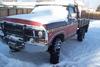















 Good Googly Moogly! ..... I never seen a hose blow up like that, but I know it ain't good. It's compromised at best.