



Sway bars

Tuned
Joined: Apr 2003
Posts: 394
Likes: 6
From: SEVA
Tim & Forest - Just to provide an alternate viewpoint, I had no hardware issues at all with my kit. Upon receipt, I compared the hardware to the packing list (all there, plus a couple extra nuts & washers), and each piece of hardware was used exactly as the instructions were written.
The emergency brake clip needs to be removed, and then reinstalled using the Hellwig-supplied bolt, washers, and nut. I had no difficulty with the instructions.
My only gripe are the drop links. They're a two-piece design that are bolted together. After I finalize the lift on my X, I'll weld those pieces together and do away with that portion of the hardware.
The emergency brake clip needs to be removed, and then reinstalled using the Hellwig-supplied bolt, washers, and nut. I had no difficulty with the instructions.
My only gripe are the drop links. They're a two-piece design that are bolted together. After I finalize the lift on my X, I'll weld those pieces together and do away with that portion of the hardware.

Thread Starter
|
FTE Leadership Emeritus


Joined: Jan 2003
Posts: 161,999
Likes: 75
From: 3rd Rock

Originally posted by LANDYOT
Tim & Forest - Upon receipt, I compared the hardware to the packing list (all there, plus a couple extra nuts & washers), and each piece of hardware was used exactly as the instructions were written.
Tim & Forest - Upon receipt, I compared the hardware to the packing list (all there, plus a couple extra nuts & washers), and each piece of hardware was used exactly as the instructions were written.
The main problem I had was with poor quality of hardware (bolts of wrong length, short on washers, etc.).
OK this makes since LANDYOT received Forests hardware.

Actually guy’s I have made up my mind, I am going to go with the Helwig unit and when LANDYOT sees his new bushings I’ll probably decide on doing all it once. The reason I want to wait on the bushings…. have known some folks that ended up haveing to cut and fit, and that is extremely difficult to do with those bushings. Therefore, hoeing LANDYOT has no problems with fit.
Thanks
Last edited by IB Tim; Dec 1, 2003 at 06:17 AM.
Posting Guru
Joined: Oct 2003
Posts: 1,198
Likes: 2
From: Tulsa, OK
Tim -
I stand by my comments on hardware. Landyot must just be better at following instructions than I am. However, I still would recommend the Hellwig addition. Just be prepared to make some allowances.
You may need to trim bolts that are too long and to add washers that may not be there. If you have to replace some bolts, be careful to use SAE-rated UNF (fine thread) hex bolts with Grade 5 or above. There should be at least 3 "hash marks" on the bolt heads.
Also, be sure that the crimped "lock nuts" are used wherever vibration loosening situations could occur. That is, everywhere! I found that not all of the nuts in the kit were self-locking.
All nuts should be self-locking. Replace those that are not. Do not rely on "split-type" lock washers--these break in service.
I stand by my comments on hardware. Landyot must just be better at following instructions than I am. However, I still would recommend the Hellwig addition. Just be prepared to make some allowances.
You may need to trim bolts that are too long and to add washers that may not be there. If you have to replace some bolts, be careful to use SAE-rated UNF (fine thread) hex bolts with Grade 5 or above. There should be at least 3 "hash marks" on the bolt heads.
Also, be sure that the crimped "lock nuts" are used wherever vibration loosening situations could occur. That is, everywhere! I found that not all of the nuts in the kit were self-locking.
All nuts should be self-locking. Replace those that are not. Do not rely on "split-type" lock washers--these break in service.
Tuned
Joined: Apr 2003
Posts: 394
Likes: 6
From: SEVA
Forest made some good points. I used a bit of LocTite on mine to prevent the nuts backing off. But regarding the grade of steel fasteners, Grade 5 is good, but I would avoid a "higher" grade. While a Grade 8 bolt may be stronger in a static condition, it is more brittle than a Grade 5, especially when subjected to all the jolts and vibrations an item receives in the suspension. I remember reading in a suspension book a few years back that Grade 5 should be the maximum for suspension components.
At our shipyard, I have seen HY80, HY100, and HY130 used in various applications. HY = High Yield, and the numerical designator is the thousands of pounds of tension the steel can withstand using just one square-inch of material. Most of your "run-of-the-mill" (pun intended) mild steel runs about 65,000 to 70,000 PSI in tension.
At our shipyard, I have seen HY80, HY100, and HY130 used in various applications. HY = High Yield, and the numerical designator is the thousands of pounds of tension the steel can withstand using just one square-inch of material. Most of your "run-of-the-mill" (pun intended) mild steel runs about 65,000 to 70,000 PSI in tension.
Thread Starter
|
FTE Leadership Emeritus
Joined: Jan 2003
Posts: 161,999
Likes: 75
From: 3rd Rock
This is great stuff………now I will through the proverbial stuff in the mix.
If the hardware is made outside, the U.S. is the same standard in effect.
i.e. is a grade five Chinese the same tinsel strength as the U.S. or a French one
(OK bad choice) then say a British grade 5? Or say Taiwanese since we do get tons of bolts from them
If the hardware is made outside, the U.S. is the same standard in effect.
i.e. is a grade five Chinese the same tinsel strength as the U.S. or a French one
(OK bad choice) then say a British grade 5? Or say Taiwanese since we do get tons of bolts from them
Tuned
Joined: Apr 2003
Posts: 394
Likes: 6
From: SEVA
I honestly do not know how the grading systems work in other countries. But if it's sold here in the good ol' US of A, and it's marked like a Grade-5 fastener, then it better be at least a US Grade-5 equivalent. Otherwise, should a mis-marked fastener fail, and that failure causes an injury or death, then I'd imagine the importer, distributor, and/or retailer would be coughing up a lot of dough. There are some very stringent rules and regulations governing the marking of graded fasteners in this country. My company has our own quality assurance instruction on this topic, and another tightly controlled procedure for when we manufacture our own fasteners. You wouldn't expect anything less from a company that builds nuclear-powered marine vessels, would you? We also service land-based nuclear power plants ... conventional fuel plants, too.

New User
Joined: Nov 2003
Posts: 1
Likes: 0
Were is a good place to pick up the Hellwig Sway bar??
Do I actually have to cut the traction bar to install it??
Do I actually have to cut the traction bar to install it??
FTE Stories
Ford Trucks for Ford Truck Enthusiasts

3 Best / 3 Worst Parts of Modern Ford Ownership
Brett Foote
10 Amazing Upgrades That Solve Common Ford Truck Owner Headaches
Pouria Savadkouei
Every 2026 Ford Engine Explained
Brett Foote
10 Ugly Ford Trucks That We Still Kinda Love
Joe Kucinski
10 Things Every Truck Owner NEEDS (2026 Edition)
Michael S. Palmer
Rezvani's Latest Post-Apocalyptic Monster Is a Ford F-150 Raptor Underneath
Verdad Gallardo
Top 10 Most Expensive Ford Trucks Ever Sold on Bring a Trailer
Joe Kucinski
2027 Ford Super Duty Buyer's Guide (Every Model, Engine, & Package)
Brett Foote
Top 10 Ford Truck Tragedies
Joe Kucinski
Posting Guru
Joined: Oct 2003
Posts: 1,198
Likes: 2
From: Tulsa, OK
No cutting or even drilling is required to install the sway bar. Traction bars are unaffected.
See http://www.hellwigproducts.com/dealers/index.html.
See http://www.hellwigproducts.com/dealers/index.html.
Tuned
Joined: Apr 2003
Posts: 394
Likes: 6
From: SEVA
Traction bars - Look at your rear leaf springs on the forward side of the rear axle. On the bottom of the "leaf stack" is a single 3" wide x 1/2" thick bar that extends forward ... it does not extend aft of the axle ... at the forward end of this bar is a rubber snubber. When you accelerate, the axle torques, and the snubber & bar find resistance when they're pressed against the "stack," and thus reduce the amount of spring wrap experienced by the leaf springs ... providing more forward thrust ... ie. traction.
The downfall of this design is it only works when you accelerate. It does nothing at all but add weight when you're just cruising along, or stopping. I built and installed my own set of radius-rods that replaced the OEM traction bars. They eliminate axle wrap, and smooth out the ride tremendously ... no more "bouncy feeling" from the rear of my X.
The downfall of this design is it only works when you accelerate. It does nothing at all but add weight when you're just cruising along, or stopping. I built and installed my own set of radius-rods that replaced the OEM traction bars. They eliminate axle wrap, and smooth out the ride tremendously ... no more "bouncy feeling" from the rear of my X.
Tuned
Joined: Apr 2003
Posts: 394
Likes: 6
From: SEVA
PS on traction bars - The other SuperDuty vehicles do not have any traction bars because those vehicles have leaf springs that are much stronger than the Excursion's. The X got Ford's weakest set of truck leaf springs because it wasn't designed to carry the payloads expected of the othe SD vehicles. Ford added the traction bar on the X because the leaves are weaker.

Elder User
Joined: Apr 2003
Posts: 536
Likes: 1
From: Cleveland, OH
Last edited by neilc88; Dec 5, 2003 at 06:52 AM.
Thread Starter
|
FTE Leadership Emeritus
Joined: Jan 2003
Posts: 161,999
Likes: 75
From: 3rd Rock
Originally posted by neilc88
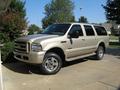
https://www.ford-trucks.com/user_gal...=28642&width=2 You asked for it, and you got it.
https://www.ford-trucks.com/user_gal...=28642&width=2 You asked for it, and you got it.
Or did you use all the Hellwig components?
