When you click on links to various merchants on this site and make a purchase, this can result in this site earning a commission. Affiliate programs and affiliations include, but are not limited to, the eBay Partner Network.
I traded my F150 King Ranch for my F-350 Platinum because towing my toy hauler was "uncomfortable". I don't think it was unsafe, just felt weird. Kind of a tail wagging the dog thing.
I recently took the toy hauler to pick up a new sofa bed I am gonna use to replace the "bed in the sky" that this old man no longer wants to climb into in the toy hauler.
Anyway I digress. Since I was only going like 5 miles, so I just hooked it up with just the hitch, and didn't put the weight equalizer arms on. The truck handled the toy hauler rock solidly.
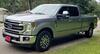
I took this pic at the furniture store because the trailer appears to sit level with maybe 2-3" of deflection when lowering the tongue on the hitch. With the F-150, it was like 6-7".
I get the F-350 has way more weight capacity, hence the little deflection. I did some research and the 10-15% of trailer weight on the tongue seems to be a loading thing and manufacturer build thing. Taking out the 300-500# Queen bed and structure from high in the rear behind the axles, will affect that some.
Info: Toy Hauler weighs about 6000# loaded to camp, and 7000# with my trike in there.
So, here's my questions.
1) Do I need to use the weight equalizing hitch? I ask because the F-350 has a 2.5" Receiver and I am thinking of eliminating the 2-2.5" sleeve and getting a 2"/2 5/16" ball drop hitch. (I have a 1000# utility trailer with a 2" ball).
2) Is it worth going to a weight scale and paying for two weighs to determine if I fall within the 10-15% rule. Or maybe three weighs as the trike will affect that a little although it sits right over the axles.
3) The hitches with a scale built in or the OBDII "tongue Weight Scales", Do they actually work?
Never had a WD hitch because I never have owned a travel trailer, use to rent them a few times a year and just pulled from the hitch.
Never hit any extreme wind.
If they have sway control and you don’t go offroad I would use one just for side wind sway. Set it up loaded? If its 2 inches black RTV a sleeve to it so it doesn’t rattle around in there.
On my 22 Ram 3500 HO Mega Cab SRW with the factory rear auto leveling air suspension the WDH made it ride worse. I quit using it and towed a few times with my Bulletproof hitch. It did great on the Ram. Getting ready to tow for the first time with the 23 F350 DRW this weekend Best hitch I have owned IMO.
For your trailer, I probably would not bother using WDH. I have tried with and without on my F350 with my 26ft travel trailer. When doing short hauls, I don't use the WDH. However, the ride is improved with the WDH. My tongue also weighs 1300lbs. Even with the WDH, it rides nose high unless I add air to my airbags. But the main reason is sway control. It handles wind with the WDH better.
Now my work trailer on the other hand has the same tongue weight, but I don't use a WDH. It handles just fine. It is lower profile compared to the travel trailer, so it gets less sway. Probably comparable
in size to your trailer.
I would say you don't need the weight distribution, but the sway could be an issue. If you want sway control you could go with an Andersen Sway control hitch. It does have some weight distribution but not a lot, and you can use it as a regular hitch as well. They have 2.5" shaft with either a 4, 6, or 8 inch drop. I have one for a 30' camper and it works really well. Just an option.
On my current TT, I use the WDH more for the reduced sway than the actual weigh movement. A 9500lb, 35' sail needs some help sometimes. I never have any short runs when towing it, so I can't say I've tried without it.
Do yourself a favor, and educate yourself on the purpose and benefits of weight distributing hitches. Forget the "opinions" offered here. These hitches are designed for more that just sway control - there are other safety considerations for you to consider. Then you can make your own decision. FWIW
For a trailer that size behind a 350, you don't 'need' a W/D setup. If you're comfortable with how it tows on a regular ball mount, you have more than enough truck to be able to manage that trailer, especially with the oil burner weighing down the front end. I'm towing a similar sized trailer as you, little longer but not a toy hauler so likely similar in weight. Short trips, I don't bother with the W/D and sway control setup. On the longer trips, I still don't need it, but the trailer handles better with weight distribution and sway control. I'd be perfectly fine without it, but it's a more comfortable ride with it so it's worth the extra couple minutes to connect.
I have a smaller 6000 lb trailer that I tow with my 250. However, my 250 has the same front and rear suspension at the 350. The tongue will still cause the rear end to sag, and with the heavier plow springs up front, it looks worse.
I do use a W/D hitch, but it’s the Anderson like mentioned above. It helps move some weight back to the front end and reduces the sag. It also does improve the ride. The trailer feels more connected to the truck, it cuts down on sway as well as porpoising.
I have no doubt my truck can handle this trailer without one, but I enjoy traveling with it with the W/D set up. It really doesn’t take but an extra minute or 2 to engage it.
I think the reason my curt WDH made my Ram ride worse is because mine had the auto leveling factory air suspension on the rear. Not sure though. The truck would level itself when I hooked up the trailer and I never researched if there was something special I needed to do with it. I did notice the auto level air I think made the trailer harder to get off the ball. There was a setting that I was supposed to turn on to make it stop auto leveling probably for that reason and I know you are supposed to turn it on when using a jack or getting an alignment or stuff like that. I just never used it and didn’t keep the truck long enough to play around with that setting.
I use a wdh/sway control when traveling on the interstate. The camper is only 6000 pounds but tall. The camper I have is designed for off road. I often tow over 12000 pounds hauling farm equipment with no wdh and no sway, I do experience some sway due to cross winds with the camper. and none towing equipment. Make sure you check the speed limit recommended by the camper manufacturer is often only 65 max. I did tow my camper to Alaska last year and spent he summer there and tried towing with and without the wdh and for me it towed better with. I have a 2022 f350 4x4 lariat with 7.3
I towed a 2022 Puma 27RBQC which is about 8,000 #,s when loaded with my 21 F150. I used a weight distribution hitch for long hauls. I didn't use it locally though. The F150 didn't sag a whole lot with or without the sway bars. It did sway on highways though, with the bars. The 150 could handle the weight, not the length. I would never go over 65MPH, didn't like the feel of the front end when a regular car passed me let alone a CMV . I have a 350 now and haven't towed the trailer yet. I am hoping not to hook up the bars, that is such a PITA. 4,189 for a payload.
Rezvani's Latest Post-Apocalyptic Monster Is a Ford F-150 Raptor Underneath
Slideshow: Called the Fortress, the 850-horsepower pickup combines Raptor underpinnings with military-inspired features, survival equipment, and a starting price of $285,000.