


Checking the steps
FTE Legend


Joined: Nov 2015
Posts: 30,935
Likes: 4,124
From: Angier, NC

Now to the carb. I see a non-feedback carb for sale that has the feedback solenoid port blocked off with a metal plate. This raised the question. If you plug up all the holes in a feedback carb, cap off tubes, that are not in a non-feedback carb, remove other hanger on things that also are not on the feedback, and keep the electric choke of course, will it work? Or are there hidden passage ways within the casting of the feedback model that keep it from ever being a non-feedback? Or just buy the darn 80 buck non-feedback carb?

When I went looking for a the other day I seen the same thing and wondered

Then I was what if my Ebay carb was like that as I had not open the box since I got it over a year ago.
Well mine did not have that plate but it also did not have the carb's bowl vent so I had to change some of the vacuum hoses around.
Once I got the carb on and road tested I found it ran really lean but with the Carter carbs you can change this with out to much trouble ..... once you know what tool it uses for adjusting. Factory uses a Torx thru a hole (got to remove a plug) but this knock off uses a slotted screw driver thru a smaller hole (after you remove a screw).
Back to your question I wonder if that is just a picture of a carb they post up or of the carb you get?
That is also why we said to change the dist. first as the carb you have looks new and you may find it will work fine with it unplugged.
Think DaveF ran his Bronco II that way for a bit?
Dave ----

Lead Driver


Joined: Nov 2013
Posts: 7,178
Likes: 1,174
Still researching the plan, and chasing the Duraspark wiring to see how they did it. But, does anyone one know why did they put the starter solenoid on the ignition coil side of the ignition resistor, basically sending the 12 volts the solenoid needs to pull in through the ignition resitor?...
https://www.garysgaragemahal.com/1985-evtm.html
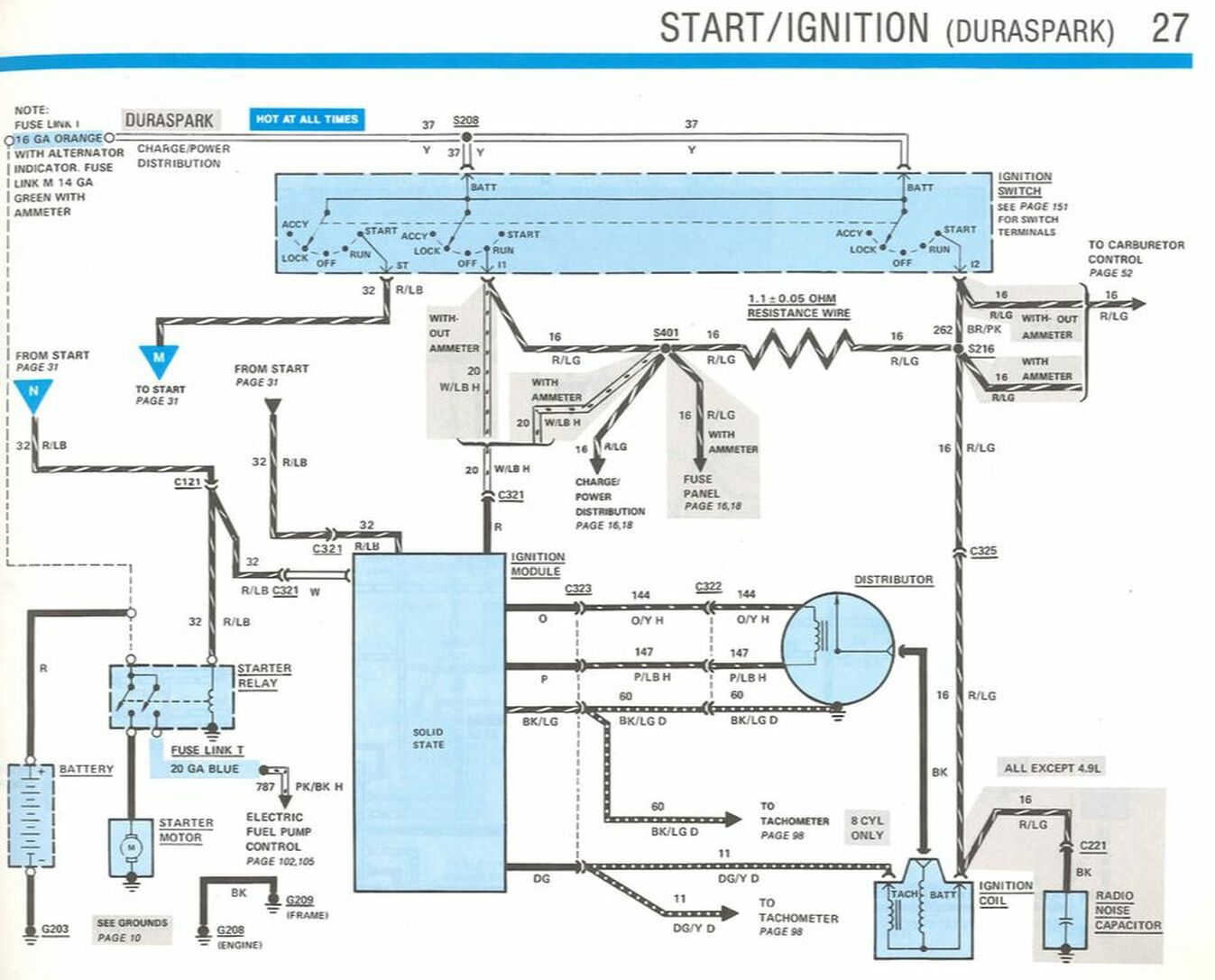
The ignition switch is illustrated across the top of that diagram. Only 3 of the 4 poles are shown. The pole at the far left is the one that sends battery voltage to energize the electromagnet inside the starter relay. See the two blue triangles, labeled M and N? That sends you off to page 31 for the clutch interlock (manual transmission) or NSS (automatic). When the transmission is in the correct configuration for engine start, you basically have a straight shot between triangles M and N. Hold the key to Start, and full battery power (via fuse link I) is sent to operate the starter relay.
The mystery resistance wire can be seen towards the right, below the ignition switch. This is part of the circuit that feeds power to the BATT terminal on the coil.
With the key in Start, look at the switch pole at the far right. It sends direct battery power (also via fusible link I) to the coil, bypassing the resistor wire. Momentarily applying full battery power provides a little hotter spark for starting, and also helps compensate for normal drop in voltage with the starter engaged.
With the key in Run, power to the coil passes through switch pole in the middle. Only now, power also passes through the resistance wire and reduces the voltage a little bit. The coil is not designed to run at full battery power for long periods.

Thread Starter
|
5th Wheeling
Joined: Oct 2023
Posts: 29
Likes: 1
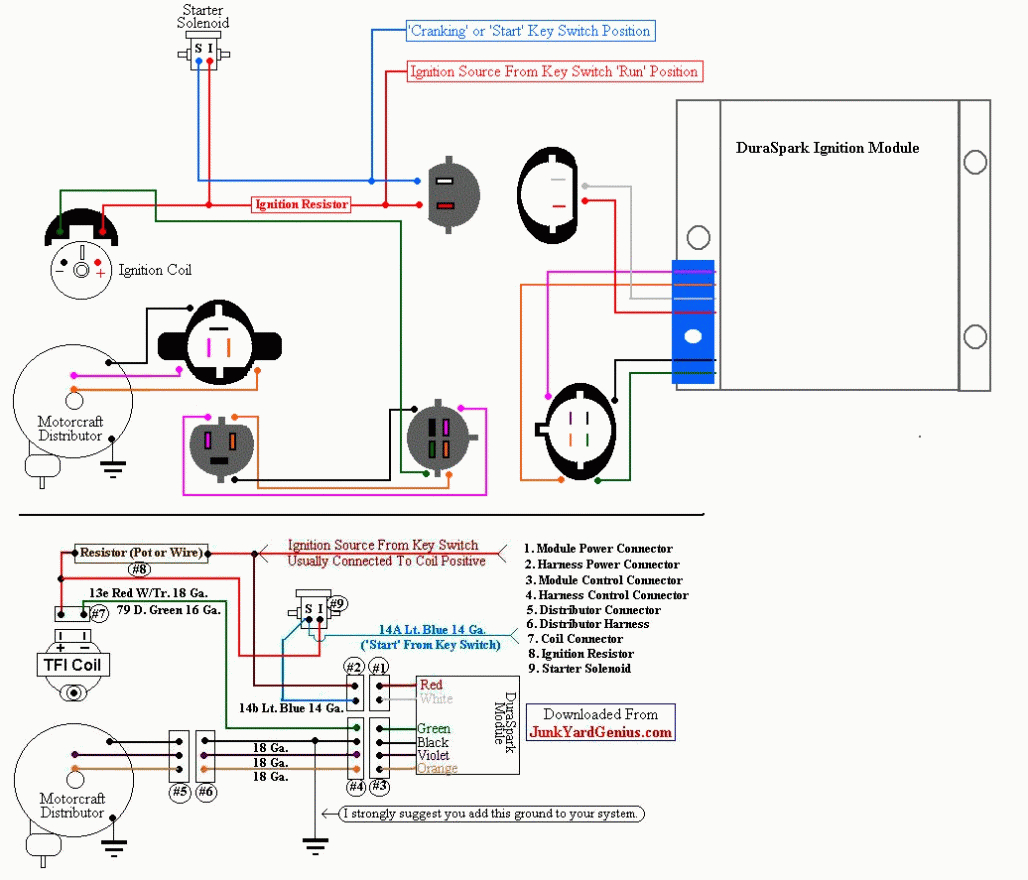
I think the 2 schematics I found were just wrong, here is one of them, note the starter relay coil on the ignition coil side of the resistor, and the fact the voltage across the resistor is being sampled and sent to the module. Your schematic is more of what I expected to see, and not the red herring here:
Last edited by CALNNC; Oct 17, 2023 at 08:53 AM.

Moderator


Joined: Jan 2001
Posts: 56,992
Likes: 2,741
From: Virginia
Still researching the plan, and chasing the Duraspark wiring to see how they did it. But, does anyone one know why did they put the starter solenoid on the ignition coil side of the ignition resistor, basically sending the 12 volts the solenoid needs to pull in through the ignition resitor? I do see a a pair of wires basically going into the control module, one on each side of that resistor, and if this was a radio transmitter, I would say they are measuring the amount of voltage drop across the ignition resistor to tell the module something. As Dave said, looks like the best plan is just go with the one wire HEI dist., a lot simpler.
The HEI system does not require a resistor. The Ford TFI system you have now also does not require a resistor. The resistor is still in the harness, but the way they use the plugs the duraspark II uses the resistor, the TFI does not. If you use the white/blue wire that was used on the original TFI square coil, it does not use the resistor and is what you want for the HEI.
Moderator
Joined: Jan 2001
Posts: 56,992
Likes: 2,741
From: Virginia
Now to the carb. I see a non-feedback carb for sale that has the feedback solenoid port blocked off with a metal plate. This raised the question. If you plug up all the holes in a feedback carb, cap off tubes, that are not in a non-feedback carb, remove other hanger on things that also are not on the feedback, and keep the electric choke of course, will it work? Or are there hidden passage ways within the casting of the feedback model that keep it from ever being a non-feedback? Or just buy the darn 80 buck non-feedback carb?
Moderator
Joined: Jan 2001
Posts: 56,992
Likes: 2,741
From: Virginia
I think the 2 schematics I found were just wrong, here is one of them, note the starter relay coil on the ignition coil side of the resistor, and the fact the voltage across the resistor is being sampled and sent to the module. Your schematic is more of what I expected to see, and not the red herring here:
Notice the blue wire from the solenoid to the ignition module. The "S" terminal is the coil for the solenoid. As long as there is 12v from the ignition switch, it activates the solenoid AND also sends a signal to the ignition module. A guy supposedly in the know said this changes the dwell time in the module during cranking.
FTE Legend
Joined: Nov 2015
Posts: 30,935
Likes: 4,124
From: Angier, NC
I tried this very thing. Yes, it will run fine. But your fuel mileage will be lousy. I ran mine for about year this way. I then got a China knock-off and my mileage jumped 3-4 mpg. On the feedback carb, they put larger main jets in it. The solenoid just controls a air bypass in the carb. They control the amount of fuel delivered by the carb by adding more or less air. When the solenoid is not hooked up or used, the larger jets give you lousy fuel mileage. I looked in both carbs and verified the china carb had smaller jets. But it ran fine and got better fuel mileage. Can you put smaller jets in a feedback carb and would it work? Not sure, didn't try it.
When you look up a carb for a 81 F100 300 six the pictures all show a carb that looks like a feed back with a plate screwed to the side where the solenoid would be.
He / me wonder if it is just the picture they used or if that is a feed back carb you could use as a replacement for the non-feed back carb?
Then it would be like yours before the swap and he would be right where he is now.
Dave ----
edit: my knock off did not have the plate looks just like the old non-feed back.
Hotshot
Joined: Jun 2015
Posts: 12,872
Likes: 2,445
Can you put a non-feedback/ regular carburetor on it and keep the rest or does the computer change the timing if it doesn’t see a response from the carb?
While not cheap, I would buy a Davis Unified Ignition (D.U.I) over some eBay HEI distributor.
While not cheap, I would buy a Davis Unified Ignition (D.U.I) over some eBay HEI distributor.
FTE Stories
Ford Trucks for Ford Truck Enthusiasts

3 Best / 3 Worst Parts of Modern Ford Ownership
Brett Foote
10 Amazing Upgrades That Solve Common Ford Truck Owner Headaches
Pouria Savadkouei
Every 2026 Ford Engine Explained
Brett Foote
10 Ugly Ford Trucks That We Still Kinda Love
Joe Kucinski
10 Things Every Truck Owner NEEDS (2026 Edition)
Michael S. Palmer
Rezvani's Latest Post-Apocalyptic Monster Is a Ford F-150 Raptor Underneath
Verdad Gallardo
Top 10 Most Expensive Ford Trucks Ever Sold on Bring a Trailer
Joe Kucinski
2027 Ford Super Duty Buyer's Guide (Every Model, Engine, & Package)
Brett Foote
Top 10 Ford Truck Tragedies
Joe Kucinski
FTE Legend
Joined: Nov 2015
Posts: 30,935
Likes: 4,124
From: Angier, NC
The biggest killer of power and MPG is when the timing gets locked at a retard setting.
So changing the carb for anon-feed back one will lock the timing and kill power.
That is why we say change the dist. first to a non-feed back one so the timing is not locked.
Then deal with the carb when you can as it will just run rich till then.
Dave ----
Thread Starter
|
5th Wheeling
Joined: Oct 2023
Posts: 29
Likes: 1
I ended up ordering an HEI dist from a fellow on ebay, not the cheapest and not the most expensive, plus plug wires, and due to my module failure paranoia, an extra module for it to carry in the truck. I will see how this one works and if it lasts. If it turns out to be failure prone will go with a higher end unit. I did the Duraspark II research, found everything I needed but the dist., which will not be available from anyone until 2024 for some reason. Did not try the junk yard, might be the only option for that. After reading the comments on the jet sizes in the feedback carburetor, will probably get a new non-feedback unit, but I bought a rebuild kit from NAPA for $22 and will try blocking off everything on this carb that is not part of the feedback, and see what happens. Why did they put a PCV valve on this engine when it also has a vent into the air cleaner that is basically open all the time? I saw a pic of a truck that has a basic breather in place of that line to the air cleaner, and an identical looking breather where the PCV valve went with a line to it from the carb. My first thought is why do you need a PCV valve when the crankcase is already free lunging it back through the air cleaner?
FTE Legend
Joined: Nov 2015
Posts: 30,935
Likes: 4,124
From: Angier, NC
If your carb works now do the dist. and wire swap first and see how it goes before doing the carb rebuild.
BTW it is always best to do 1 change at a time so you know what did not work as it should.
Say you did the dist. & carb at the same time and it now runs like crap.
Was the dist.or the carb the cause? If you did just the dist. and it ran like crap you know it was that.
Now the PCV system: It has to do with smog control.
All motors have blow by and before motors had a PCV they had road tubes that put that blow by out the bottom of the car / truck and caused smog.
The PCV now pulls the blow by into the intake track to burn it with the air / fuel mix and have less smog.
Now if you are pulling a vacuum on the crank case thru the PCV you need to let air into the motor.
This air should be filtered and why it is hooked to the air filter. If you look on the inside the housing there should be a little filter.
This filtered air goes into the motor mixes with the blow by and pulled out thru the PCV to be burned.
If you dont see a PCV then the blow by is just being pushed out into the engine bay making a mess and you may smell it inside the cab.
It can also cause seals to leak if the blow by is too much by building pressure inside the motor.
A PCV is a good thing
Dave ----
BTW it is always best to do 1 change at a time so you know what did not work as it should.
Say you did the dist. & carb at the same time and it now runs like crap.
Was the dist.or the carb the cause? If you did just the dist. and it ran like crap you know it was that.
Now the PCV system: It has to do with smog control.
All motors have blow by and before motors had a PCV they had road tubes that put that blow by out the bottom of the car / truck and caused smog.
The PCV now pulls the blow by into the intake track to burn it with the air / fuel mix and have less smog.
Now if you are pulling a vacuum on the crank case thru the PCV you need to let air into the motor.
This air should be filtered and why it is hooked to the air filter. If you look on the inside the housing there should be a little filter.
This filtered air goes into the motor mixes with the blow by and pulled out thru the PCV to be burned.
If you dont see a PCV then the blow by is just being pushed out into the engine bay making a mess and you may smell it inside the cab.
It can also cause seals to leak if the blow by is too much by building pressure inside the motor.
A PCV is a good thing
Dave ----
Thread Starter
|
5th Wheeling
Joined: Oct 2023
Posts: 29
Likes: 1
If I ask redundant questions, sorry, I am learning from you fellers and looking at this from all the angles I can find so I can fully understand. A couple comments have been made about leaving the feedback carb if it is working, and replacing only the distributor. But, doesn't the truck ECM take inputs from the engine sensors, the few that this year has, and adjust spark via the stock Ford ignition, and also make carb adjustments? If you remove the ignition system, any signal sent to it does nothing to control the engine via spark, so that would seem to make any signals sent to the carb as a useless thing, which by logic seems to say disable the feedback stuff or just put a plain old carb in its place.
Moderator
Joined: Jan 2001
Posts: 56,992
Likes: 2,741
From: Virginia
The main thing the ECM controlled was the timing. Swap the distributor out and the ECM doesn't have much of anything to do. Yes it did TRIM the fuel, but as was said the feedback carb will still work without the ECM, just the fuel mileage will be lousy. The whole ECM system was mainly for emissions. It also controlled the EGR, the smog pump and some other emissions pieces.
PCV stands for POSITIVE crankcase ventilation. That means the crankcase is ventilated by force with vacuum from the engine. This keeps the inside of the engine cleaner. This is the one good smog piece that adds to the longevity of every engine that has it.
PCV stands for POSITIVE crankcase ventilation. That means the crankcase is ventilated by force with vacuum from the engine. This keeps the inside of the engine cleaner. This is the one good smog piece that adds to the longevity of every engine that has it.
FTE Legend
Joined: Nov 2015
Posts: 30,935
Likes: 4,124
From: Angier, NC
There is no problems asking questions you may have already asked.
Sometimes with someone else answering the question a different way it will set off that light bulb and it will click.
DaveF is right on the ECM mainly controlling timing.
To add to that the older dist. have a "built in" timing adjustment 2 different ways.
1 is based on RPM. As the RPM goes up the timing advances by weights inside the dist. that are pulled back in by springs and the RPM goes down.
The other is load based on vacuum. The dist. is hooked to a port on the carb that only gets vacuum above idle and adds advance on top of the advance the weights add.
Now know the feed back carb dose not have this vacuum port but dont worry just the weight advance is still better than the feed back dist. not advancing at all.
Later when you replace the feed back carb it will have the needed port.
That light bulb just went off for me
You know them pictures on Ebay of the carb that look like the feed back with the plate on the side?
I never looked to see if it had a port for the dist. vacuum on it or not.
Then again that picture could just be a picture of any carb and not show it anyway.
Just something I thought of
Dave ----
Sometimes with someone else answering the question a different way it will set off that light bulb and it will click.
DaveF is right on the ECM mainly controlling timing.
To add to that the older dist. have a "built in" timing adjustment 2 different ways.
1 is based on RPM. As the RPM goes up the timing advances by weights inside the dist. that are pulled back in by springs and the RPM goes down.
The other is load based on vacuum. The dist. is hooked to a port on the carb that only gets vacuum above idle and adds advance on top of the advance the weights add.
Now know the feed back carb dose not have this vacuum port but dont worry just the weight advance is still better than the feed back dist. not advancing at all.
Later when you replace the feed back carb it will have the needed port.
That light bulb just went off for me
You know them pictures on Ebay of the carb that look like the feed back with the plate on the side?
I never looked to see if it had a port for the dist. vacuum on it or not.
Then again that picture could just be a picture of any carb and not show it anyway.
Just something I thought of
Dave ----
Thread Starter
|
5th Wheeling
Joined: Oct 2023
Posts: 29
Likes: 1
Thanks Dave's. I need to go look, but I thought there was a capped off vacuum looking tube on the bottom of the carb. In regards to PCV, I never thought about the ventilation going the other way, that is coming through the air filter into the crankcase and out the PCV valve, which now makes sense sending crankcase fumes back into the carb to be burned. Should have been obvious, but like Dave said, light bulb went on.
Charlie in NC
Charlie in NC
Last edited by CALNNC; Oct 19, 2023 at 08:12 AM.