



Transmission issues, 4spd AOD, HELP!

Thread Starter
|
Cross-Country
Joined: Sep 2023
Posts: 94
Likes: 2
Transmission issues, 4spd AOD, HELP!
Hey guys, I'm new to this forum. yesterday I (16) bought my first bullnose, a 86 single cab with the inline 6 and the 4 speed auto. I bought the truck for $900, and was told it may need a transmission rebuild in the future. the truck goes into every gear, but does not move. In drive, it will rev and move maybe an inch or so. In reverse, however, it works completely fine. Transmission fluid is fine, and the Parking brake is off. Any help is appreciated, Thanks!

Lead Driver
Joined: Jul 2011
Posts: 8,679
Likes: 191
From: On the Edge of the Desert
I am by no means going to call myself an expert, but I have owned, driven, and worked on several AOD's and know a little bit about them. It sounds like the transmission might already be roasted and you need to pull it out. At minimum, I would say the valves in the valve body are stuck, and it needs to be dropped, cleaned and inspected.
there should be a cable running from the throttle linkage on the carburetor down to the side of the transmission. This is called the TV cable and is absolutely critical to the life of the transmission. If it's unhooked or broken or missing, or even misadjusted, the transmission won't last A trip around the block.
If it's not absolutely stuck, (like on 4 flat tires with the brakes locked up) i'd say it's time to pull the transmission.
I had an AOD rebuilt about three years ago and it was $1500. I wouldn't be surprised if it's over 2000 now. If this isn't within your budget, you can look for a used one to swap in, but that's a gamble that could just put you deeper in the hole. A C4 or C6 would also bolt in place of the AOD, with minor changes. You'd lose overdrive, but it would get you on the road if that's what you can find.
if you've got the gumption, it is possible to rebuild it by yourself at home, but it's not for the faint of heart or inexperienced. And it's easy to get in over your head. So don't recommend trying it unless you know your skills are good enough and you're confident in your ability. (And you have the speciality tools) not many people are this good.
there should be a cable running from the throttle linkage on the carburetor down to the side of the transmission. This is called the TV cable and is absolutely critical to the life of the transmission. If it's unhooked or broken or missing, or even misadjusted, the transmission won't last A trip around the block.
If it's not absolutely stuck, (like on 4 flat tires with the brakes locked up) i'd say it's time to pull the transmission.
I had an AOD rebuilt about three years ago and it was $1500. I wouldn't be surprised if it's over 2000 now. If this isn't within your budget, you can look for a used one to swap in, but that's a gamble that could just put you deeper in the hole. A C4 or C6 would also bolt in place of the AOD, with minor changes. You'd lose overdrive, but it would get you on the road if that's what you can find.
if you've got the gumption, it is possible to rebuild it by yourself at home, but it's not for the faint of heart or inexperienced. And it's easy to get in over your head. So don't recommend trying it unless you know your skills are good enough and you're confident in your ability. (And you have the speciality tools) not many people are this good.
Thread Starter
|
Cross-Country
Joined: Sep 2023
Posts: 94
Likes: 2
hey, thanks a lot guys, and sorry for the late response. The truck doesn't move freely in neutral but yesterday I temporarily removed the e brake cables and while it did free up a bit, it still wouldn't move as I would want it to. I'm lead to think my transmission is grits. It moves, but you need to hold the throttle for it to slowly start moving. I'll look into buying an AOD, since luckily for me there's one for sale in my area pulled out from a 94' mustang. Swapping it in should be just plug and play, right? (excuse my inexperience lol, I'm still new to this)
Last edited by straighsixconvict; Sep 18, 2023 at 12:19 PM.
Lead Driver


Joined: Jun 2013
Posts: 5,667
Likes: 1,159
From: Tolland, CT
If it moves a bit after disconnecting the E-brake cable, you need to verify the brake shoes, are in fact, still not touching the drums. You need to make sure the cables at each wheel are not frozen. Can you remove the brake drums without an issue. If you can't just slide them off the hubs, the shoes may be dragging because of the rusty cables.

Lead Driver


Joined: Apr 2002
Posts: 5,317
Likes: 1,243
Or if on level ground and you have a group of friends put half the folks in front, half in the rear and rock it back and forth alternating each push. Might break free. Also can try rocking back and forth with the truck running, switching from D to R.
Trending Topics
Thread Starter
|
Cross-Country
Joined: Sep 2023
Posts: 94
Likes: 2
update as of 9/19, I've been taking the truck on some slow drives down my street with its somewhat drivability, and it definitely feels like its freeing up a bit. throttle response is far better and it doesn't stall as much with medium throttle, but rather accelerates a bit more. don't know if that's my brakes freeing up, who knows. but hey! she moves better now and that's what matters.
FTE Stories
Ford Trucks for Ford Truck Enthusiasts

Rezvani's Latest Post-Apocalytic Monster Is a Ford F-150 Raptor Underneath
Verdad Gallardo
Top 10 Most Expensive Ford Trucks Ever Sold on Bring a Trailer
Joe Kucinski
2027 Ford Super Duty Buyer's Guide (Every Model, Engine, & Package)
Brett Foote
Top 10 Ford Truck Tragedies
Joe Kucinski
AEV FXL Super Duty - the Super Duty Raptor Ford Doesn't Make
Brett Foote
Lobo Vs Lobo: Proof the F-150 Lobo Should Be Even Lower!
Michael S. Palmer
Ford's 2001 Explorer Sportsman Concept Looks For a New Home
Verdad Gallardo
10 Best Ford Truck Engines We Miss the Most!
Joe Kucinski
2026 Shelby F-150 Off-Road: Better Than a Raptor R?
Brett Foote
Lead Driver
Joined: Apr 2002
Posts: 5,317
Likes: 1,243
update as of 9/19, I've been taking the truck on some slow drives down my street with its somewhat drivability, and it definitely feels like its freeing up a bit. throttle response is far better and it doesn't stall as much with medium throttle, but rather accelerates a bit more. don't know if that's my brakes freeing up, who knows. but hey! she moves better now and that's what matters.

Cargo Master

Joined: Sep 2006
Posts: 2,120
Likes: 390
From: Evansville, Indiana

Thread Starter
|
Cross-Country
Joined: Sep 2023
Posts: 94
Likes: 2

4wd High
Joined: Apr 2017
Posts: 9
Likes: 2
From: Willis
i have a similar issue with a used aod i put it 2 weeks ago. Sorry to hijack your thread but nobody replied to mine. Does anyone know the forward or direct clutch pressures? i'd like to rule out a sticking valve before i take it back out for teardown and inspection.

Moderator


Joined: Jan 2001
Posts: 56,984
Likes: 2,738
From: Virginia

Adjustment At The Carburetor
TV control linkage may be adjusted at the carburetor using the following procedure:
- Check that engine idle speed is set at the specification.
- De-cam the fast idle cam on the carburetor so that the throttle lever is at its idle stop. Place shift lever in N (neutral), set park brake (engine off).
- Back out linkage lever adjusting screw all the way (screw end if flush with lever face).
- Turn in adjusting screw until a thin shim (0.005 inch; max.) or piece of writing paper fits snugly between end of screw and Throttle Lever. To eliminate effect of friction, push linkage lever forward (tending to close gap) and release before checking clearance between end of screw and throttle lever. Do not apply any load on levers with tools or hands while checking gap.
- Turn in adjusting screw an additional four turns. (Four turns are preferred. Two turns minimum is permissible if screw travel is limited).
- If it is not possible to turn in adjusting screw at least two addition turns or if there was sufficient screw adjusting capacity to obtain an initial gap in Step 2 above, refer to Linkage Adjustment at Transmission.Whenever it is required to adjust idle speed by more than 50 rpm, the adjustment screw on the linkage lever at the carburetor should also be readjusted as shown.
- If it is not possible to turn in adjusting screw at least two addition turns or if there was sufficient screw adjusting capacity to obtain an initial gap in Step 2 above, refer to Linkage Adjustment at Transmission.Whenever it is required to adjust idle speed by more than 50 rpm, the adjustment screw on the linkage lever at the carburetor should also be readjusted as shown.
- Turn in adjusting screw an additional four turns. (Four turns are preferred. Two turns minimum is permissible if screw travel is limited).
- Turn in adjusting screw until a thin shim (0.005 inch; max.) or piece of writing paper fits snugly between end of screw and Throttle Lever. To eliminate effect of friction, push linkage lever forward (tending to close gap) and release before checking clearance between end of screw and throttle lever. Do not apply any load on levers with tools or hands while checking gap.
- Back out linkage lever adjusting screw all the way (screw end if flush with lever face).
- De-cam the fast idle cam on the carburetor so that the throttle lever is at its idle stop. Place shift lever in N (neutral), set park brake (engine off).
Idle Speed Change/Turns on Linkage Lever Adjustment Screw
- Less than 50 rpm: No change required
- 50 to 100 rpm increase: 11/2 turns out
- 50 to 100 rpm decrease: 11/2 turns in
- 100 to 150 rpm increase: 21/2 turns out
- 100 to 150 rpm decrease: 21/2 turns in
- 100 to 150 rpm decrease: 21/2 turns in
- 100 to 150 rpm increase: 21/2 turns out
- 50 to 100 rpm decrease: 11/2 turns in
- 50 to 100 rpm increase: 11/2 turns out
After making any idle speed adjustments, always verify the linkage lever and throttle lever are in contact with the throttle lever at its idle stop and the shift lever is in N (neutral).
Moderator
Joined: Jan 2001
Posts: 56,984
Likes: 2,738
From: Virginia
Adjustment At Transmission
Automatic overdrive transmission linkage adjustment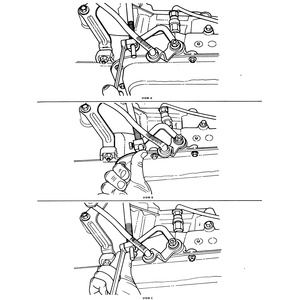 The linkage lever adjustment screw has limited adjustment capability. It is not possible to adjust the TV linkage using this screw, the length of the TV control rod assembly must be readjusted using the following procedure. This procedure must also be followed whenever a new TV control rod assembly is installed.
This procedure requires placing the vehicle on jackstands to give access to the linkage components at the transmission TV control lever.
- Set the engine curb idle speed to specification.
- With engine off, de-cam the fast idle cam on the carburetor so that the throttle lever is against the idle stop. Place shift lever in Neutral and set park brake (engine off).
- Set the linkage lever adjustment screw at its approximately mid-range.
- If a new TV control rod assembly is being installed, connect the rod to the linkage lever at the carburetor.
The following steps involve working in proximity to the exhaust system. Allow the exhaust system to cool before proceeding.
- Raise the vehicle on the hoist.
- Using a 13mm box end wrench, loosen the bolt on the sliding trunnion block on the TV control rod assembly. Remove any corrosion from the control rod and free-up the trunnion block so that it slides freely on the control rod. Insert pin into transmission lever grommet.
- Push up on the lower end of the control rod to insure that the linkage lever at carburetor is firmly against the throttle lever. Release force on rod. Rod must stay up.
- Push the TV control lever on the transmission up against its internal stop with a firm force (approximately 5 pounds) and tighten the bolt on the trunnion block. do not relax force on lever until nut is tightened.
- Lower the vehicle and verify that the throttle lever is still against the idle stop. If not, repeat steps 2 through 9.