When you click on links to various merchants on this site and make a purchase, this can result in this site earning a commission. Affiliate programs and affiliations include, but are not limited to, the eBay Partner Network.
Beginning to reassemble radius arm with new bushings and axle insulator. Have cleaned up bolt threads with wire wheel (my 1973 f100 4x4 has the clamshell design that has 4 big bolts with 2 fixtures that clamp with rubber insulators around axle then spring goes on top), and I’d like to clean threaded holes the four bolts go in. I have a tap and die kit but have never used it, and I want to “run the threads” with a tap. First thing is obvious; the bolt heads (13/16) don’t determine which tap to use in the holes.
Anyone know the bolt diameter and thread pitch to use? Any general idea of the procedure? Not worth destroying the hole threads. Thanks!
First follow this post and put this information in your signature. Year / model / 2wd or 4wd / engine / wheelbase / and transmission. It is needed to look up the correct information for your vehicle.
I just took that exact thing apart today. Well on a 79 Bronco and removed the complete axle for a swap out to another rig. I will go up to the shop in the AM and get you the bolt and tap size. Also make sure you put the new rubber C bushings in the correct side and a possible specific top and bottom to them too. If you put them on wrong I believe you can change the (caster?) and then it will never align. Early Bronco folks commonly change them out with a lift kit install and you can get the "Bronco lean", if installed wrong.
I just took that exact thing apart today. Well on a 79 Bronco and removed the complete axle for a swap out to another rig. I will go up to the shop in the AM and get you the bolt and tap size. Also make sure you put the new rubber C bushings in the correct side and a possible specific top and bottom to them too. If you put them on wrong I believe you can change the (caster?) and then it will never align. Early Bronco folks commonly change them out with a lift kit install and you can get the "Bronco lean", if installed wrong.
Appreciate it. The insulators and bushings have no orientation (I checked). I believe that is because they are stock (with no lift, or 0-2inches of lift), or because the book claims that the 1973 F100 4x4 doesn’t require alignment after radius arm bushing/insulator replacement because the caster is “built in”; true enough you see the metal casting angles on radius arm axle mount. We’ll see. Reality has no end to the process of details….
I just took that exact thing apart today. Well on a 79 Bronco and removed the complete axle for a swap out to another rig. I will go up to the shop in the AM and get you the bolt and tap size. Also make sure you put the new rubber C bushings in the correct side and a possible specific top and bottom to them too. If you put them on wrong I believe you can change the (caster?) and then it will never align. Early Bronco folks commonly change them out with a lift kit install and you can get the "Bronco lean", if installed wrong.
I have been parting out that ol rear-ended Bronco for years. It has breathed a lot of life into a number of FTE members rigs. In fact I pulled the motor for my red signature truck and the complete front clip and a/c box was some of the 1st things sold. It was setting still and got hit by a S-10 doing 45mph. The S10 died on the spot. If the fuel tank had not ruptured by the rear part of the frame (and all leaked out) the Bronco would of stayed running and been driven away. I test drove it in a field with a 2 gal gas can hanging from the open hood.
I have been parting out that ol rear-ended Bronco for years. It has breathed a lot of life into a number of FTE members rigs. In fact I pulled the motor for my red signature truck and the complete front clip and a/c box was some of the 1st things sold. It was setting still and got hit by a S-10 doing 45mph. The S10 died on the spot. If the fuel tank had not ruptured by the rear part of the frame (and all leaked out) the Bronco would of stayed running and been driven away. I test drove it in a field with a 2 gal gas can hanging from the open hood.
Well, I didn’t want to be rude and say it looked like a rusted parts truck. I mean, it could have been a ground up rebuild. : O P
Dont worry, I’ve been doing weld and body work to body and frame on mine for a year, and it’s about ready for paint, after I rebuild engine. But it’s MY rusted out junker near parts truck….
No worries I have thick Ford truck like skin. I have a few parts trucks and running projects. So I know how that is...
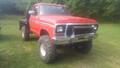
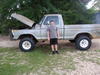
The ol blue beater at a local show.
Way back in its slicked up days, it is showing its age a bit now days.
I have been working on ol red for years. It is a Ford truck shop therapy program participant.
No worries I have thick Ford truck like skin. I have a few parts trucks and running projects. So I know how that is...
The ol blue beater at a local show.
Way back in its slicked up days, it is showing its age a bit now days.
I have been working on ol red for years. It is a Ford truck shop therapy program participant.
Uh. Yah. A few. Poor guy. Suffering for parts and all…
I'd just take a clean the threads some with a solvent or kroil or even kerosene on a rag wrapped around a rod, then maybe brush in some lube and use my impact or even a drill or "speed wrench" with socket and run the bolt in/out a few times, then blow out, call it good. Wire brush the bolt's threads clean. Unless threads are screwed up, wouldn't do more.
Ok so we know the bolt head is 13/16, my gauge says it is a 9/16 bolt and 9/16 bolt hole. And a Harbor Freight tap/die set 1/2 NC13 tap (thread chaser) threaded right in by hand. Of course I just removed the bolt yesterday. Best is to get it started straight and just clean out the threads, you do not want to start it crooked and cut NEW threads. Liberal amount of PB Blaster or WD to wash out the crud in side, before and while cleaning with the tap.
NC is None Course, meaning the thread. So do not use a fine course tap. Now I use the HF stuff when I am cleaning out threads, but it I was to have to cut good thread in that area and any other critical tapping needed, I would definitely use WAY higher QUALITY made tools. You DO NOT want to break that tap off in there.
I agree with tbear853's advice above also.
Ok so we know the bolt head is 13/16, my gauge says it is a 9/16 bolt and 9/16 bolt hole. And a Harbor Freight tap/die set 1/2 NC13 tap (thread chaser) threaded right in by hand. Of course I just removed the bolt yesterday. Best is to get it started straight and just clean out the threads, you do not want to start it crooked and cut NEW threads. Liberal amount of PB Blaster or WD to wash out the crud in side, before and while cleaning with the tap.
NC is None Course, meaning the thread. So do not use a fine course tap. Now I use the HF stuff when I am cleaning out threads, but it I was to have to cut good thread in that area and any other critical tapping needed, I would definitely use WAY higher QUALITY made tools. You DO NOT want to break that tap off in there.
I agree with tbear853's advice above also.
Appreciate it. You used a 1/2 “ tap to clean a 9/16 “ hole? Did the 1/2” tap clear it enough to run the 9/16 “ tap?
The biggest I had in the kit was 1/2", it fit sort of easy enough to run it in by hand, no T bar attached. Being that's all I had up size wise, that's all I could do. I was cleaning threads, NOT cutting new threads. Are your threads messed up or you just want to chase them?
And yes a 13/16 bolt head/wrench size, is a 9/16 bolt diameter and so yea you need a 9/16 tap to properly clean/cut new threads.
This Hennessey Takes the Expedition Tremor's Off-Roading Capability to the Next Level
Slideshow: The VelociRaptor Expedition gains a lift, upgraded suspension, Brembo brakes, and trail-ready equipment while retaining the stock 440-horsepower EcoBoost V6.