



Speedometer gears

Lead Driver


Joined: Jul 2017
Posts: 9,610
Likes: 1,181
From: San Jose, CA
Sorry for the delay. Was blessedly away from the computer almost all day today!
Price is each. They used to be something like $3.00 each, but that was then, this is now...
Are you seeing them for different prices out there? If so we may need to revisit some different suppliers.
Paul
Price is each. They used to be something like $3.00 each, but that was then, this is now...
Are you seeing them for different prices out there? If so we may need to revisit some different suppliers.
Paul
Lead Driver
Joined: Jul 2017
Posts: 9,610
Likes: 1,181
From: San Jose, CA
1. The driven gear that I had already in the TF was a yellow 18-tooth count that looks like this:
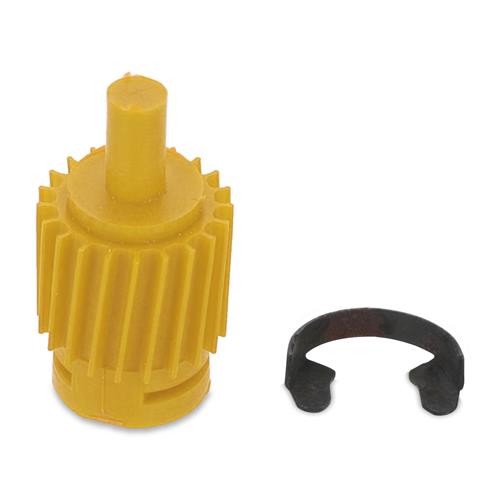
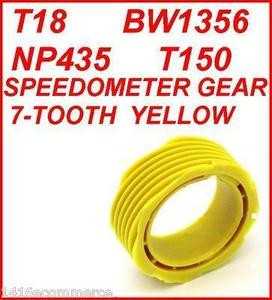
The driving gear is also yellow and based on my observation - the teeth also also slanted right (i.e. they look like this when looking in the hole: ///////) - I believe this is what I have:
Now I did some poking around in the event I'd have to replace the gear (gonna test drive tomorrow as it was getting late) and found out that apparently the "proper" driven gear is supposed to look like this:

Notice the teeth are slanted left instead of right and the bottom is not smooth like the yellow gear but instead has straight cut teeth. So - what is the correct driven gear for a 4 speed NP435 with a NP205? The left slant or right slant?
The driving gear is also yellow and based on my observation - the teeth also also slanted right (i.e. they look like this when looking in the hole: ///////) - I believe this is what I have:
Now I did some poking around in the event I'd have to replace the gear (gonna test drive tomorrow as it was getting late) and found out that apparently the "proper" driven gear is supposed to look like this:
Notice the teeth are slanted left instead of right and the bottom is not smooth like the yellow gear but instead has straight cut teeth. So - what is the correct driven gear for a 4 speed NP435 with a NP205? The left slant or right slant?
I've heard of both types of gears (and maybe one other?) that were used, but I've never actually run across one like in your second pic. All of the Fords that I've worked on in this area were using just the first one.
The video shows the clip oriented one way, and it's easy enough to try it both ways in a flash.
The gear should line up correctly and the clip install easily by hand. If it does not, flip it over and try the other way.
3. When I was installing the cable, I realized I could only install one end fully - either into the cluster or the TF. After digging and poking I realized that the inner cable inside the speedo cable was too long. If I was to snap the cable into the speedo, on the driven will not slide fully onto shaft because the inner cable gets stopped by the nub:
So what I ended up doing was snip the tip of my gear off to allow the cable to go through. That allows the inner cable to go through and then the driven gear can slide to its proper place and get locked by the clip. Is that right, though? Am I missing something simple that would allow everything to install correctly without modifying the gear?
It might be an installation error, but more likely than not it's a manufacturing defect that is so typical of today's new parts. The inner cable was probably misinterpreted by the Chinese factory worker from the original engineering drawings or the other cable that they reverse engineered and didn't think an extra milimeter here or there would make a difference. It's something we see constantly with parts these days. Hell, even brake pads and shoes and drums and bearing hubs are made wrong! Meat and potatoes stuff, and they're still made wrong.
Bottom line though, is if the speedo works properly (smooth and linear motion) then you're good to go.
I still think you got a bad cable. But clipping off the end of the gear was probably the better solution than jamming it on, unless the end of the cable is so long that it interferes with something inside the case. And because pushing it down hard to get the clip lined up can put enough tension on the inner cable that is unacceptable and will make the instrument read inaccurately. It will certainly skew the readings on the speedometer if it's tight enough. Some might get away with it (looks like some have already) but it's still not correct to my way of thinking.
Cutting the gear should just not be needed, but cutting the cable (the correct thing to do in my mind) is not always easy with normal hand tools. Your best bet is often a cut-off or grinding wheel on a die-grinder.
I've heard of people cutting cables successfully (cable cutters maybe?) but they're tough hombrés for sure!
So you need a gear with about a 15% smaller gear. Since there is no 15.3T gear (or whatever it would be, since my math is a little fuzzy anyway), you'll have to stick with 16t instead.
2. The speedo needle is wobbly despite it being a brand new speedo cable. It definitely wobbles a lot at lower space (under 10) and as speeds get higher it jiggles rapidly but not a wide wobble across many tick marks (the jiggle is basically like a +/- 1 MPH on the speedo). Any idea of what that could be? Old speedometer gauge? Worn gear (if so which one)? Could be cuz of the snipping I did because I couldn't get the driven gear all the way on the shaft?
You could put a drill motor on the lower end and spin it up slightly while you or someone watches the needle (is the cable long enough for one person to do both?) to see how it acts. If it's still wobbly then the issue is with the gauge or the cable. If it goes away and is smooth operating below 10mph, then it's something in the gear mesh itself.
If snipping off the end messed with the gear engagement, it's not for it being in the wrong position in and out, because it's still clipped to the cable in the normal spot. However, if that stud is supposed to align with a hole on the other side of the drive gear to hold the gears steady, and is now not capable of doing it's job, then yes that could effect the smooth meshing of the gears and the action at the speedo.
I have 3.73 rear end with 33". At 2500 RPM in 4th gear, I am at about 65 MPH (using GPS speedo) which based on online tools comes to be 3.73 gears. I don't think I will upgrade to 35"s - looks kinda ridiculous lol. I just realized the link to the calculator is provided in the posts below - so, if I am at 33", with 3.73 and a 7 tooth gear - the math shows I need a 16.5 tooth driven gear... so does that mean 16 or 17?
In other words, since you can't have a half tooth gear count, look at which way you need it to read. A little above or a little below. My money is on 16t.
But if you're going to us a calculator and factor in your tire size, then you need to measure your tire size exactly as the vehicle sits on the ground. So take a tape measure from the ground to the center of the axle/wheel/hub and double that. That is your "rolling diameter" and is what the speedometer is seeing. Not the writing on the sidewall of the tire, which is almost always inaccurate.
Here, just swapped mine out. I press the tip of the new gear on a solid piece of metal surface to really dig that gear in there, then, popped the clip on. It was tight, but I was able to press hard enough to get the clip to snap in. Make sure the square gear hole is lining up with the cable properly.
I just know that sometimes when you jam it up like that it can result in erratic reading at the speedo.
Smaller gear makes the cable spin faster, raising the numbers on the speedo.
Paul

Thread Starter
|
Mountain Pass
Joined: Mar 2014
Posts: 143
Likes: 4
Ive pulled the speedo head out of the cluster and carefully applied lube of choice to the moving parts. Using a square head screw bit in a drill to turn the speedometer, you can work the lube into the rotating parts and see if it steadys out. This is somewhat tedious work, and if it’s outside of a person’s confidence range I probably wouldn’t recommend it

More Turbo


Joined: Jun 2020
Posts: 648
Likes: 394
From: Montana
I have 3.73 rear end with 33". At 2500 RPM in 4th gear, I am at about 65 MPH (using GPS speedo) which based on online tools comes to be 3.73 gears. I don't think I will upgrade to 35"s - looks kinda ridiculous lol. I just realized the link to the calculator is provided in the posts below - so, if I am at 33", with 3.73 and a 7 tooth gear - the math shows I need a 16.5 tooth driven gear... so does that mean 16 or 17?
And - any ideas what could cause the jiggle?
And - any ideas what could cause the jiggle?
For the gear, like @1TonBasecamp said, you just pick which one is closer and which way you'd like your speedometer to be wrong. There are mechanical limits and you can only get so close to correct. From the factory automakers are allowed something like 10% error in speedometers, but pretty much always have the error in the "you're driving slower than you think" direction to save traffic tickets. Your 33" tires aren't actually 33" though. Mine come out to less than 32" diameter when I actually measure because they aren't manufactured at an exact 33" and then the weight of the truck squishes them down so the diameter they are rolling on is the smaller squished side from ground to hub doubled.
If you use the calculator to calculate the necessary gear using 3.73 gearing and 32" tires (probably closer to actual than 33") it says you need a 16.95 tooth driven gear so try an 17 tooth and it should be very close.

More Turbo
Joined: Feb 2021
Posts: 525
Likes: 84
Paul / 1TonBasecamp - thank you for the wealth of information!! I'll get a 16T gear and will give it a shot!!
I've taken the speed gear before - so that is not a big deal - just a pain in the butt now because of how tough the speedo cable makes dealing with the cluster... 
Ive pulled the speedo head out of the cluster and carefully applied lube of choice to the moving parts. Using a square head screw bit in a drill to turn the speedometer, you can work the lube into the rotating parts and see if it steadys out. This is somewhat tedious work, and if it’s outside of a person’s confidence range I probably wouldn’t recommend it
More Turbo
Joined: Feb 2021
Posts: 525
Likes: 84
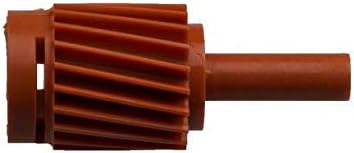
Btw - interesting observation but some of the driven gears for later Ford models (not just F100), come with a longer stud (is it a stud?) on the tip of the gear - example compared to a 16 tooth gear for our trucks:


Cross-Country
Joined: Apr 2021
Posts: 67
Likes: 11
From: Dayton, OH
Hah! I just "actually" checked my gear ratio by jacking it up and counting the revolutions; it appears my gear ratio is 3.50:1! Not 4.11 like I thought.
That would calculate to a 14 tooth gear, which ford doesn't make! Fun!
I guess I'll stick with the 16 and know that after 35, I'm about 10 over
That would calculate to a 14 tooth gear, which ford doesn't make! Fun!
I guess I'll stick with the 16 and know that after 35, I'm about 10 over
More Turbo
Joined: Feb 2021
Posts: 525
Likes: 84
So a bit of an update on my end: got the 16 tooth gear and as MeanBigGreen suggested, I had to just push the gear against something metal and then slip the clip on; sits and quite snug. However, before doing so, I hooked a drill the to speedo cable and when rotating at a steady speed, the needle in the speedo is ROCK solid; no wobble of any kind. With the cable inside the TF (and now it's within a couple of miles), the needle still jiggles. At lower speeds it wobbles a lot more and I've even seen it do crazy 10 mph jumps during acceleration (but that was always momentary). Another interesting observation is that once, at a red light, the needle was at 10 mph even though the truck was not moving. So - still likely the speed itself?
Also - let this be a lesson... when using a drill, you have to turn it CCW. I had it turned CW and cranked it up and noticed the needle was not moving; I then set the drill to CCW and it worked fine. Later as I was driving, I noticed that instead of the odo showing ~45XXX it was showing 044XX... I may have wiped 40K off the trucks odo (or maybe added 55K? I guess it's better to claim that lolol).
Also - let this be a lesson... when using a drill, you have to turn it CCW. I had it turned CW and cranked it up and noticed the needle was not moving; I then set the drill to CCW and it worked fine. Later as I was driving, I noticed that instead of the odo showing ~45XXX it was showing 044XX... I may have wiped 40K off the trucks odo (or maybe added 55K? I guess it's better to claim that lolol).
FTE Stories
Ford Trucks for Ford Truck Enthusiasts

Top 10 Fords at 2026 Carlisle Ford Nationals
Joe Kucinski
3 Best / 3 Worst Parts of Modern Ford Ownership
Brett Foote
10 Amazing Upgrades That Solve Common Ford Truck Owner Headaches
Pouria Savadkouei
Every 2026 Ford Engine Explained
Brett Foote
10 Ugly Ford Trucks That We Still Kinda Love
Joe Kucinski
10 Things Every Truck Owner NEEDS (2026 Edition)
Michael S. Palmer
Rezvani's Latest Post-Apocalyptic Monster Is a Ford F-150 Raptor Underneath
Verdad Gallardo
Top 10 Most Expensive Ford Trucks Ever Sold on Bring a Trailer
Joe Kucinski
2027 Ford Super Duty Buyer's Guide (Every Model, Engine, & Package)
Brett Foote
Lead Driver
Joined: Jul 2017
Posts: 9,610
Likes: 1,181
From: San Jose, CA
Couple of possibilities.
1. The speedo/odo is a bit loosey goosey inside because I've never seen a momentary running of a cable in reverse back up an odometer a tiny bit. Much less thousands of miles!
2. The wobbling could be due to the cable being jammed into the housing just to fit the gear on the other end. Remember that what happens at one end is directly connected to the other. So when you jam the gear up against something hard to push the clip in, you're also pushing the inner cable up into the speedo at the other end. If there is nowhere to go, it's got the potential to jam things up.
The steady needle when using a drill says that the speedo is working properly when not jammed tight, but once pushed tight with the gear, either the cable action is no longer smooth, or the speedo itself is a bit jammed up.
If you have a proper tool (like a grinder with cutoff wheel, or other kind of cable cutting tool) I would take the gear back off and nip a 1/16" or so off the end. However much you had to push to get the clip notch to line up, cut that amount off the tip of the inner cable. See if that smooths things back out.
Paul
1. The speedo/odo is a bit loosey goosey inside because I've never seen a momentary running of a cable in reverse back up an odometer a tiny bit. Much less thousands of miles!
2. The wobbling could be due to the cable being jammed into the housing just to fit the gear on the other end. Remember that what happens at one end is directly connected to the other. So when you jam the gear up against something hard to push the clip in, you're also pushing the inner cable up into the speedo at the other end. If there is nowhere to go, it's got the potential to jam things up.
The steady needle when using a drill says that the speedo is working properly when not jammed tight, but once pushed tight with the gear, either the cable action is no longer smooth, or the speedo itself is a bit jammed up.
If you have a proper tool (like a grinder with cutoff wheel, or other kind of cable cutting tool) I would take the gear back off and nip a 1/16" or so off the end. However much you had to push to get the clip notch to line up, cut that amount off the tip of the inner cable. See if that smooths things back out.
Paul
More Turbo
Joined: Feb 2021
Posts: 525
Likes: 84
Couple of possibilities.
1. The speedo/odo is a bit loosey goosey inside because I've never seen a momentary running of a cable in reverse back up an odometer a tiny bit. Much less thousands of miles!
2. The wobbling could be due to the cable being jammed into the housing just to fit the gear on the other end. Remember that what happens at one end is directly connected to the other. So when you jam the gear up against something hard to push the clip in, you're also pushing the inner cable up into the speedo at the other end. If there is nowhere to go, it's got the potential to jam things up.
The steady needle when using a drill says that the speedo is working properly when not jammed tight, but once pushed tight with the gear, either the cable action is no longer smooth, or the speedo itself is a bit jammed up.
If you have a proper tool (like a grinder with cutoff wheel, or other kind of cable cutting tool) I would take the gear back off and nip a 1/16" or so off the end. However much you had to push to get the clip notch to line up, cut that amount off the tip of the inner cable. See if that smooths things back out.
Paul
1. The speedo/odo is a bit loosey goosey inside because I've never seen a momentary running of a cable in reverse back up an odometer a tiny bit. Much less thousands of miles!
2. The wobbling could be due to the cable being jammed into the housing just to fit the gear on the other end. Remember that what happens at one end is directly connected to the other. So when you jam the gear up against something hard to push the clip in, you're also pushing the inner cable up into the speedo at the other end. If there is nowhere to go, it's got the potential to jam things up.
The steady needle when using a drill says that the speedo is working properly when not jammed tight, but once pushed tight with the gear, either the cable action is no longer smooth, or the speedo itself is a bit jammed up.
If you have a proper tool (like a grinder with cutoff wheel, or other kind of cable cutting tool) I would take the gear back off and nip a 1/16" or so off the end. However much you had to push to get the clip notch to line up, cut that amount off the tip of the inner cable. See if that smooths things back out.
Paul
Opinions?
Lead Driver
Joined: Jul 2017
Posts: 9,610
Likes: 1,181
From: San Jose, CA
Well my opinion is still the same.
Regarding the apparently correct working odometer, they are two separate mechanisms and the odo is not going to show oscillations like the speedo will.
The odo is mechanically coupled to the end of the cable via another set of gears. So as the cable spins the input shaft of the unit, the mechanism spins the odo along with it. The speedo head on the other hand is uncoupled and is driven by a spinning magnet at the end of the input mechanism. The cable is spinning the magnet directly and the needle is coupled to a metal "cup" for lack of a better term and is surrounding the magnet. The needle is sensitive enough to show the oscillations that the magnet is going through from the cable.
If the cable is catching then free-spinning to unwind itself, that would possibly explain the high speeds showing on the needle now and then. The sticking needle is potentially bad news if left unchecked though I would think. I could be way off base, but I still think that your cable being jammed up with nowhere to go is jamming up the speedo mechanism. Possibly pushing it off-center and making any "damage" require a little journey into the speedo to free things up again.
Sounds like for now you're not at that point of actual damage to the speedo head, but I would still remove some of the center cable tip (at either end in fact) so that the gear slides on with no force.
Work at whichever end is easier to reach. Which for me is always at the transfer case end because my neck hates twisting around under the dash!
Maybe a quick check is at the speedo end though. Does your cable have the metal threaded collar type of attachment at the speedo? Or the plastic clip thingy that slides over the end of the speedo and snaps into receivers? If it's the threaded collar type you should be able to loosen the threads to the point that the cable is free-floating again and see how the speedo acts then.
Paul
Regarding the apparently correct working odometer, they are two separate mechanisms and the odo is not going to show oscillations like the speedo will.
The odo is mechanically coupled to the end of the cable via another set of gears. So as the cable spins the input shaft of the unit, the mechanism spins the odo along with it. The speedo head on the other hand is uncoupled and is driven by a spinning magnet at the end of the input mechanism. The cable is spinning the magnet directly and the needle is coupled to a metal "cup" for lack of a better term and is surrounding the magnet. The needle is sensitive enough to show the oscillations that the magnet is going through from the cable.
If the cable is catching then free-spinning to unwind itself, that would possibly explain the high speeds showing on the needle now and then. The sticking needle is potentially bad news if left unchecked though I would think. I could be way off base, but I still think that your cable being jammed up with nowhere to go is jamming up the speedo mechanism. Possibly pushing it off-center and making any "damage" require a little journey into the speedo to free things up again.
Sounds like for now you're not at that point of actual damage to the speedo head, but I would still remove some of the center cable tip (at either end in fact) so that the gear slides on with no force.
Work at whichever end is easier to reach. Which for me is always at the transfer case end because my neck hates twisting around under the dash!
Maybe a quick check is at the speedo end though. Does your cable have the metal threaded collar type of attachment at the speedo? Or the plastic clip thingy that slides over the end of the speedo and snaps into receivers? If it's the threaded collar type you should be able to loosen the threads to the point that the cable is free-floating again and see how the speedo acts then.
Paul
More Turbo
Joined: Feb 2021
Posts: 525
Likes: 84
Well my opinion is still the same.
Regarding the apparently correct working odometer, they are two separate mechanisms and the odo is not going to show oscillations like the speedo will.
The odo is mechanically coupled to the end of the cable via another set of gears. So as the cable spins the input shaft of the unit, the mechanism spins the odo along with it. The speedo head on the other hand is uncoupled and is driven by a spinning magnet at the end of the input mechanism. The cable is spinning the magnet directly and the needle is coupled to a metal "cup" for lack of a better term and is surrounding the magnet. The needle is sensitive enough to show the oscillations that the magnet is going through from the cable.
If the cable is catching then free-spinning to unwind itself, that would possibly explain the high speeds showing on the needle now and then. The sticking needle is potentially bad news if left unchecked though I would think. I could be way off base, but I still think that your cable being jammed up with nowhere to go is jamming up the speedo mechanism. Possibly pushing it off-center and making any "damage" require a little journey into the speedo to free things up again.
Sounds like for now you're not at that point of actual damage to the speedo head, but I would still remove some of the center cable tip (at either end in fact) so that the gear slides on with no force.
Work at whichever end is easier to reach. Which for me is always at the transfer case end because my neck hates twisting around under the dash!
Maybe a quick check is at the speedo end though. Does your cable have the metal threaded collar type of attachment at the speedo? Or the plastic clip thingy that slides over the end of the speedo and snaps into receivers? If it's the threaded collar type you should be able to loosen the threads to the point that the cable is free-floating again and see how the speedo acts then.
Paul
Regarding the apparently correct working odometer, they are two separate mechanisms and the odo is not going to show oscillations like the speedo will.
The odo is mechanically coupled to the end of the cable via another set of gears. So as the cable spins the input shaft of the unit, the mechanism spins the odo along with it. The speedo head on the other hand is uncoupled and is driven by a spinning magnet at the end of the input mechanism. The cable is spinning the magnet directly and the needle is coupled to a metal "cup" for lack of a better term and is surrounding the magnet. The needle is sensitive enough to show the oscillations that the magnet is going through from the cable.
If the cable is catching then free-spinning to unwind itself, that would possibly explain the high speeds showing on the needle now and then. The sticking needle is potentially bad news if left unchecked though I would think. I could be way off base, but I still think that your cable being jammed up with nowhere to go is jamming up the speedo mechanism. Possibly pushing it off-center and making any "damage" require a little journey into the speedo to free things up again.
Sounds like for now you're not at that point of actual damage to the speedo head, but I would still remove some of the center cable tip (at either end in fact) so that the gear slides on with no force.
Work at whichever end is easier to reach. Which for me is always at the transfer case end because my neck hates twisting around under the dash!
Maybe a quick check is at the speedo end though. Does your cable have the metal threaded collar type of attachment at the speedo? Or the plastic clip thingy that slides over the end of the speedo and snaps into receivers? If it's the threaded collar type you should be able to loosen the threads to the point that the cable is free-floating again and see how the speedo acts then.
Paul
The speedo cable speedo end looks like this:
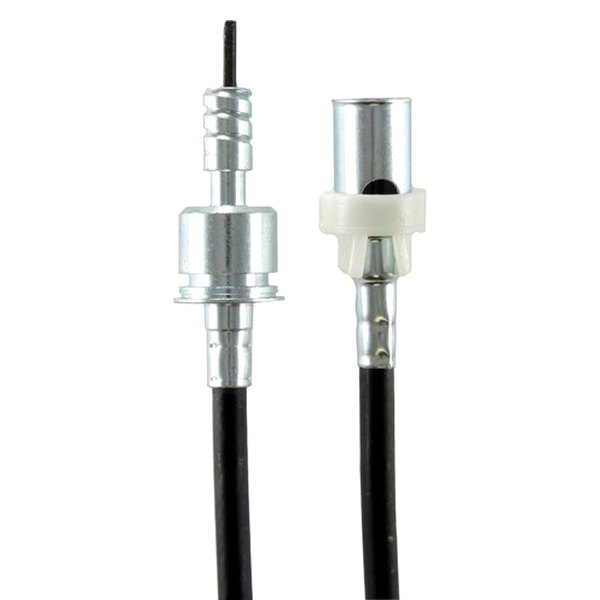
So its basically a metal collar with a plastic clip that snaps into the groove on the speedo socket.
Lead Driver
Joined: Jul 2017
Posts: 9,610
Likes: 1,181
From: San Jose, CA
I don't like to extend your job out farther than necessary, but I would hold off on doing anything to the speedometer instrument itself until you dial in the cable first. Once done with that, if you still have issues with lack of smooth operation, or anything else that leads you to believe you have an issue, then by all means dig into the speedo itself.
I don't disagree with the other poster that said to go in and give it a dab of something now and then as just good general maintenance. I would just hesitate to do so until you're certain you either need to, or get more info from others as to what product to use.
At least that's what I'd do, but that's probably just to save me from some work!
Paul
I don't disagree with the other poster that said to go in and give it a dab of something now and then as just good general maintenance. I would just hesitate to do so until you're certain you either need to, or get more info from others as to what product to use.
At least that's what I'd do, but that's probably just to save me from some work!
Paul
More Turbo
Joined: Feb 2021
Posts: 525
Likes: 84
I don't like to extend your job out farther than necessary, but I would hold off on doing anything to the speedometer instrument itself until you dial in the cable first. Once done with that, if you still have issues with lack of smooth operation, or anything else that leads you to believe you have an issue, then by all means dig into the speedo itself.
I don't disagree with the other poster that said to go in and give it a dab of something now and then as just good general maintenance. I would just hesitate to do so until you're certain you either need to, or get more info from others as to what product to use.
At least that's what I'd do, but that's probably just to save me from some work!
Paul
I don't disagree with the other poster that said to go in and give it a dab of something now and then as just good general maintenance. I would just hesitate to do so until you're certain you either need to, or get more info from others as to what product to use.
At least that's what I'd do, but that's probably just to save me from some work!
Paul
I'll snip a piece of the cable tomorrow - 1/16" i hope should do the trick... I can't recall but this isn't just a bunch of metal strands welded together right? Snipping the tip shouldn't get it all frayed and looking like medusas head... right?
Lead Driver
Joined: Jul 2017
Posts: 9,610
Likes: 1,181
From: San Jose, CA
Yes it is in fact. Unless they've changed the way they make them, then it's still a bunch of strands. But I think you're ok at the ends because the strands are crimped by the mother-of-all-crimpers I believe.
So if you just nip the end you should not open up a can-o-worms so to speak. However, I feel like right tool will minimize the risk of fraying ends. Something like a cut-off wheel vs a snipper. But your oscillating tool might be the ticket too. Not sure though since I have not spent much time with that type of implement of destruction.
Maybe others have some insight. I've heard of people cutting speedo cables for decades with lots of different tools. But I've only used a die-grinder with thin cuttoff wheel, so I'm no expert on which ones are the best.
Paul
So if you just nip the end you should not open up a can-o-worms so to speak. However, I feel like right tool will minimize the risk of fraying ends. Something like a cut-off wheel vs a snipper. But your oscillating tool might be the ticket too. Not sure though since I have not spent much time with that type of implement of destruction.
Maybe others have some insight. I've heard of people cutting speedo cables for decades with lots of different tools. But I've only used a die-grinder with thin cuttoff wheel, so I'm no expert on which ones are the best.
Paul