






Engine Temp

Thread Starter
|
Mountain Pass

Joined: Feb 2014
Posts: 159
Likes: 3
Engine Temp
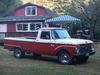
Good Evening Everyone, I live in hot south Louisiana, I have a mostly stock 1965 sb 3 on the tree with hang on air.
I built a 390 bored .060 with mild torque cam. Truck runs perfect.
In slow traffic the engine temp starts to come up if I idle it a lot waiting in the traffic temp keeps going up.
I took the old 4 blade fan and installed a 6 blade flex fan with a fan shroud and it does a little better but still goes up.
Has anyone had this problem?
I am thinking about putting an electric fan on?
I know it might be to tight of space to put a pusher fan in between the grille and a/c condensor core.
Would like to get your thoughts on the temp thing.
Thanks
Sonny K.
I built a 390 bored .060 with mild torque cam. Truck runs perfect.
In slow traffic the engine temp starts to come up if I idle it a lot waiting in the traffic temp keeps going up.
I took the old 4 blade fan and installed a 6 blade flex fan with a fan shroud and it does a little better but still goes up.
Has anyone had this problem?
I am thinking about putting an electric fan on?
I know it might be to tight of space to put a pusher fan in between the grille and a/c condensor core.
Would like to get your thoughts on the temp thing.
Thanks
Sonny K.

Logistics Pro


Joined: Jun 2003
Posts: 3,928
Likes: 276
Good Evening Everyone, I live in hot south Louisiana, I have a mostly stock 1965 sb 3 on the tree with hang on air.
I built a 390 bored .060 with mild torque cam. Truck runs perfect.
In slow traffic the engine temp starts to come up if I idle it a lot waiting in the traffic temp keeps going up.
I took the old 4 blade fan and installed a 6 blade flex fan with a fan shroud and it does a little better but still goes up.
Has anyone had this problem?
I am thinking about putting an electric fan on?
I know it might be to tight of space to put a pusher fan in between the grille and a/c condensor core.
Would like to get your thoughts on the temp thing.
Thanks
Sonny K.
I built a 390 bored .060 with mild torque cam. Truck runs perfect.
In slow traffic the engine temp starts to come up if I idle it a lot waiting in the traffic temp keeps going up.
I took the old 4 blade fan and installed a 6 blade flex fan with a fan shroud and it does a little better but still goes up.
Has anyone had this problem?
I am thinking about putting an electric fan on?
I know it might be to tight of space to put a pusher fan in between the grille and a/c condensor core.
Would like to get your thoughts on the temp thing.
Thanks
Sonny K.

More Turbo

Joined: Dec 2019
Posts: 740
Likes: 160
From: Orange County

I have a 7 blade, no shroud, no clutch, 3-core radiator on a 460 in sunny So Cal. No overheat problems. Recently moved from a 160 to a 195 thermostat, and it sits right at 195 on highway or idle. That's not tons of interesting info, but I did want to offer that I recently considered swapping to an electric fan for better MPG, reduced noise, and more HP to the tires. I did a bunch of research on fans and posted a thread (https://www.ford-trucks.com/forums/1...ngine-fan.html). I got good feedback from the group - some here swear by their electrics, some suggested it wouldn't make much difference for me.
I ran a test - highway driving - with the fan installed and then with the fan completely removed. Water temp stayed good and steady in both cases. I recorded 1% better mpg w/o the fan, and no difference in sound levels in the cab or in the engine compartment. No reasonable way to detect HP difference.
Considering the failure modes of an electric fan or a fan clutch, the increased complexity of both, and increased cost, I easily decided to stay with the fixed fan.
As suggested above, I would check that the radiator is clean and sized right for the engine, and try a 7 blade. From what I found, it requires a very large and properly controlled electric that will pull more than a 7 blade.
I ran a test - highway driving - with the fan installed and then with the fan completely removed. Water temp stayed good and steady in both cases. I recorded 1% better mpg w/o the fan, and no difference in sound levels in the cab or in the engine compartment. No reasonable way to detect HP difference.
Considering the failure modes of an electric fan or a fan clutch, the increased complexity of both, and increased cost, I easily decided to stay with the fixed fan.
As suggested above, I would check that the radiator is clean and sized right for the engine, and try a 7 blade. From what I found, it requires a very large and properly controlled electric that will pull more than a 7 blade.

Logistics Pro

Joined: May 2015
Posts: 4,475
Likes: 974
From: Tri Cities, TN

I feel your pain, I lived in Louisiana for a lot of years. Cooling is a function of BTU in BTU's out. All the 390 trucks with AC used a 24 or 24.5 quart coolant fill. That is actually more than the 460 trucks. Kinda shows that Ford knew the 390's were hard to cool. You have to have enough coolant capacity that it circulates slow enough to dissipate the heat. Moving more air thru a radiator that is to small is only a Band-Aid fix. I would stay away from electric fans they just tax an electrical system that was never designed for that. Lose that flex fan. Use a fan like Christmas pictured 5 or 6 blade. I use a 20 inch diameter 2 1/2 inch pitch 5 blade with a thermostatic clutch, no shroud, from a mid 90's F350. If you have headers you really need a fan that is moving a lot of air all the time because those things add a tremendous amount of heat to the engine compartment.
Trending Topics

Fleet Owner

Joined: Jun 1999
Posts: 24,552
Likes: 74
From: Creedmoor, North Carolina
Not a real problem, as soon as you start moving the temps go right back down. If you are stuck in traffic just shut it off if you are concerned, light turns green, put your phone down and start it back up. 
John
John
FTE Stories
Ford Trucks for Ford Truck Enthusiasts

Top 6 Best Deals Available on New Fords & Lincolns Right Now
Brett Foote
This Hennessey Takes the Expedition Tremor's Off-Roading Capability to the Next Level
Verdad Gallardo
Top 10 Fords at 2026 Carlisle Ford Nationals
Joe Kucinski
3 Best / 3 Worst Parts of Modern Ford Ownership
Brett Foote
10 Amazing Upgrades That Solve Common Ford Truck Owner Headaches
Pouria Savadkouei
Every 2026 Ford Engine Explained
Brett Foote
10 Ugly Ford Trucks That We Still Kinda Love
Joe Kucinski
10 Things Every Truck Owner NEEDS (2026 Edition)
Michael S. Palmer
Rezvani's Latest Post-Apocalyptic Monster Is a Ford F-150 Raptor Underneath
Verdad Gallardo
Fleet Mechanic


Joined: Sep 2016
Posts: 1,459
Likes: 70
From: Southern Maryland
Sometimes you get stuck in traffic and the old style fans just can't keep up. I have a newly re-cored radiator and a 6 blade 19.25" clutch fan, about 2 and 1/2" from the radiator and no shroud. I went to a car show in Colonial Beach Virginia Sunday and the temperature on my way back home was around 93. There is a single lane each way bridge between Maryland and Virginia and I was stuck in bumper to bumper traffic for over an hour as 2 lanes necked down to one. I made the mistake of turning the AC on and the engine temp started going up and even when I shut it off it kept creeping up. I knew if I could just make it to the bridge I would be able to speed up enough to keep it from over heating, but boy did I cut it close!
The only way to solve it for situations like that is to use an electric fan with thermostat switch. I think a fan on the inside pulling air through the radiator will work better than a pusher fan. A fan shroud might also be a solution.
Edit: corrected dimensions
The only way to solve it for situations like that is to use an electric fan with thermostat switch. I think a fan on the inside pulling air through the radiator will work better than a pusher fan. A fan shroud might also be a solution.
Edit: corrected dimensions
Logistics Pro
Joined: Jun 2003
Posts: 3,928
Likes: 276
Electric fans using a PWM controller do not tax the charging system with spike draws the way an analog controller can. They have soft-start technology, the voltage to the fans is variable and is regulated by the controller depending on engine temperature.
My truck originally had a generator. If your truck already has an alternator then you won’t have any problem running a fan through a PWM controller. The fan is powered through the controller and is not wired directly to the battery.
My truck originally had a generator. If your truck already has an alternator then you won’t have any problem running a fan through a PWM controller. The fan is powered through the controller and is not wired directly to the battery.

Laughing Gas
Joined: Jul 2007
Posts: 753
Likes: 133
From: Phoenix
IMO running an electric fan in Phx is the way to go. If you use a traditional fan with or without a hydraulic clutch, then a fan shroud is absolutely necessary. Fan blade should be roughly halfway in and out of the shroud to get max air flow across the radiator. I am running 3 fans, radiator 18" thermostat controlled adjustable of course and two condenser fans individually controlled automatic and manual override in case the auto switch fails.

Fleet Mechanic
Joined: Dec 2016
Posts: 1,261
Likes: 714
I've always had this imaginary line on the temp gauge that I considered the danger zone. Now, summer in AZ, with the A/C crankin' decided to use an IR thermometer to decode the nearly useless gauge. Turns out my imagined danger zone was not even close to reality.
Interestingly, from the Operator's Manual: "Overheating is indicated only when the pointer moves all the way to the H mark or beyond, and remains there for more than a minute or two."
Logistics Pro
Joined: May 2015
Posts: 4,475
Likes: 974
From: Tri Cities, TN
Good point.
I've always had this imaginary line on the temp gauge that I considered the danger zone. Now, summer in AZ, with the A/C crankin' decided to use an IR thermometer to decode the nearly useless gauge. Turns out my imagined danger zone was not even close to reality.
Interestingly, from the Operator's Manual: "Overheating is indicated only when the pointer moves all the way to the H mark or beyond, and remains there for more than a minute or two."
I've always had this imaginary line on the temp gauge that I considered the danger zone. Now, summer in AZ, with the A/C crankin' decided to use an IR thermometer to decode the nearly useless gauge. Turns out my imagined danger zone was not even close to reality.
Interestingly, from the Operator's Manual: "Overheating is indicated only when the pointer moves all the way to the H mark or beyond, and remains there for more than a minute or two."

Cargo Master
Joined: Apr 2001
Posts: 2,697
Likes: 46
From: Vancouver
Further to the efficacy of the sender, it should be understood that if a considerable amount of coolant is lost, the sender will not be in contact with liquid coolant, and even though the temperature of the steam in the intake manifold may be 220* or more, the gauge might or might not send the appropriate signal to the gauge.
Eric.
Eric.