When you click on links to various merchants on this site and make a purchase, this can result in this site earning a commission. Affiliate programs and affiliations include, but are not limited to, the eBay Partner Network.
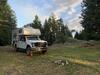
6 months ago we loaded our Northstar onto the new Ford F-350.
My choice was to use a 4 inch foam block of 25 pounds per square inch load bearing foam.
The blue stuff. Hard to find. Expensive.
Here is my update.
When I removed the camper for a dealer oil change a few days ago, there were some 1/4 inch compression groves in the foam along the edges and down the center. I did not account for the Northstar having no actual sealed bottom floor but a lattice framework subfloor joists of what look like true 1x4's. This is outlined with the grooves in the foam.
But that's O.K. If the camper settles up to 1/2 inch into the foam that will anchor it from moving around.
The entire bottom is sprayed with what looks like black undercoating to fend off rot.
I also noticed that we loaded the camper a little off center so the grooves were closer to the wheel well on one side than the other. If the camper settles in and rides deeper in the groves that could be a problem, so i may lay a very thin and sticky rubber mat over the foam or even an exterior grade piece of plywood.
The other option is to make a wooden frame supporting all the floor joists with a 3/8's plywood and 3/4 inch stall mat (which i have) over that.
I need to cut a hole in whatever I come up with, under the water drain so it drains all the way to the bed mat of the truck.
I feel the 4 inch foam is about the correct elevation for the N* in the 350 along with the 4 inch foam backstop so the N* doesn't slide in far enough to injure the camper tail lights.
With the N* about halfway up with the jacks, and while I was crawling around under there I discovered the recesses of the floor joists were exactly 4 inches in depth.
What do I have laying around but another 4x8 block of blue foam that could fill the interstices between the floor joists?
I had to cut the blocks so as not to cover any wiring between the joists. Some spaces were the bottom of the shower enclosure and battery box and would not accept the 4 inch foam.
BTW, the N* wiring person did an excellent job of routing and tieing down the wiring.
I have one more block to glue up there around the camper water drain hole, and special care will be taken to make sure the water drains to the lowest bed mat and out the front bed drain holes. Here are some pix of the foam blocks, used in this case for insulating the floor even more with a total of 8 inches of closed cell foam. That's got to be at least R-30. Most of the 40 gallon water tank which lives inside the box will have 8 inches of insulation which will be comforting during colder winters.
You can see some of the blue foam has come off with the camper. the black hole is where the fresh water drain is located.
The camper bottom is 49 1/2 inches wide and the foam is 48 inches wide. If I use the foam riser again I'll cut it in 2 pieces the long way and stretch each piece out to the wheel wells with a spacer in between. I'm still mulling over the possibility of having the spacer coincide with the fresh water drain. We'll see.
jefe
UPDATE to the update:
Further refinement today.
All the spaces under the camper that can be insulated have been filled with blocks of 4 inch blue foam, glued with special foam glue. The cracks have electrical wiring. The larger hole is the drain for the fresh water tank, draining down to the rubber mat.
I turned the blue foam block upside down and cut the riser the long way but off center as the camper framing has a rib right down the center and I wanted it to rest on foam. Split the bulkhead foam block in the center and added a splice and glued it to the long foam pieces. The pair of pressure treated 2x4's i had laying around space the foam board with pressure to the wheel wells giving a wider platform for the base of the TC.
Left and Right side long views of the joint between foam and wheel wells. Once the camper is on I have a couple pieces of warranted out Trex that will just fill the void between the camper sides and the wheel wells.
Here is the drain hole, chamfered into the foam in what I'm hoping is the right place. Bulkhead is to the left.
Thanks for the update Jefe. I just finished the pieces for my riser and cut the top and bottom 1/2" BB ply lengthwise. Easier to carry and store, in my case, a set of 2x8 then a set of 4x4 panels plus being able to push it right out to the wheel wells occurred to me as I was triple measuring. I'll add a spacer in the middle if needed, but want to use it first to see if it moves. But I think the two ply/foam panels should stay put sitting on a stall mat and a truck bed mat covering the top with the camper sitting on it. If it moves, I may try stair tread grip tape first.
This Hennessey Takes the Expedition Tremor's Off-Roading Capability to the Next Level
Slideshow: The VelociRaptor Expedition gains a lift, upgraded suspension, Brembo brakes, and trail-ready equipment while retaining the stock 440-horsepower EcoBoost V6.
Rezvani's Latest Post-Apocalyptic Monster Is a Ford F-150 Raptor Underneath
Slideshow: Called the Fortress, the 850-horsepower pickup combines Raptor underpinnings with military-inspired features, survival equipment, and a starting price of $285,000.