When you click on links to various merchants on this site and make a purchase, this can result in this site earning a commission. Affiliate programs and affiliations include, but are not limited to, the eBay Partner Network.
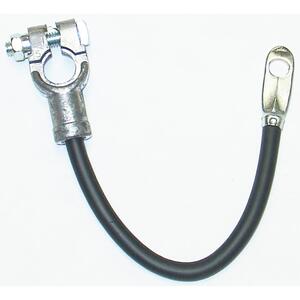
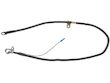
Some of these above will have to be ordered. But I am impressed, the battery to ground cable picture shows it having the grounding clamp that goes to the frame. Some of these cables may be black, so pick up some red tape to put around your positive cable, so it won't get mixed up and the battery gets connected backwards.
Yea the ground splits with one running to the alternator bracket and one running to the frame and then to the alternator. My line from the starter to the solenoid looks clean all the way through and the tips have been sanded clean so i think i am just going to get the post cables but that price is great. Since my ground post is running 2 wires, how would i adapt that to the single output? Would i just subract the ground running to the bracket since the other line already runs to it?
Here are a couple pictures of what the solenoid connections should look like and the frame clamp on the battery negative cable. I have a new negative cable coming to replace this one, (partsgeek.com) had a good price on the correct cable. The battery negative bolts to the engine block down below the alternator, where the bracket for the tranny cooling lines attaches.
Don't mind the extra white and black wires for the trailer brake kit. I have cleaned this up, this is a old picture.
Those pictures are a great help, so do you think its okay to just subtract the other ground that runs to the alternator bracket? Looking at these pictures id think that the one cable is plenty enough and having 2 is just redundant.
Yea the ground splits with one running to the alternator bracket and one running to the frame and then to the alternator. My line from the starter to the solenoid looks clean all the way through and the tips have been sanded clean so i think i am just going to get the post cables but that price is great. Since my ground post is running 2 wires, how would i adapt that to the single output? Would i just subract the ground running to the bracket since the other line already runs to it?
Get rid of those ground cables. Run one single cable from the battery to the engine block, not the alternator or alternator bracket. It should attach to a bolt on the front corner of the engine block. Then the cable will have a bare spot with a clamp, that bolts to the frame.
Some of these above will have to be ordered. But I am impressed, the battery to ground cable picture shows it having the grounding clamp that goes to the frame. Some of these cables may be black, so pick up some red tape to put around your positive cable, so it won't get mixed up and the battery gets connected backwards.
Here is what a proper battery cable looks like.
Good find, I looked for a while the other day before I found partsgeek had the correct negative cable, it should be here in a couple day's.
Standard Motor Products Battery Cable Click to Enlarge(1 Reviews)
5 StarsOur List Price:$22.18
Quantity:
(22) In Stock Part Number: 5289-05522912 Notes: Battery Cable -- With Single Battery; Battery To Ground Condition:New
I normally like to buy local, but I'm finding sometimes that's hard to do. partsgeek has decent prices on these cables. Standard is a brand name that been around for a long time. My local NAPA couldn't get the cable, but online NAPA had it for $50 with shipping.
If you hit Auto Zone they had 2 different size cables when I did my trucks cables a few years ago so look over the packages to get the larger cable.
I would also say if you have a NAPA might try them for cables as I cant see them selling the smaller cables but check before you buy.
As for timing an easy test is to pull the coil wire from the dist. and put it to ground then try and crank the motor over.
If it turns over normally then its a timing issue, if it dose not crank normally then it is a cable (from the looks of it) or starter issue.
Car Quest is also Advance Auto Parts, I have used both mostly Car Quest when I lived in CT as it was close to my house.
When I first started rebuilding my truck (here in NC) I used Car Quest for some of the parts as they also did auto paint I could get mixed for the body work.
They sold out to NAPA but that store did not do auto paint so had to go next town over to a NAPA for paint & some parts but think most parts came from Auto Zone as it is only 2 miles down the road.
Dave ----
As for timing an easy test is to pull the coil wire from the dist. and put it to ground then try and crank the motor over.
If it turns over normally then its a timing issue, if it dose not crank normally then it is a cable (from the looks of it) or starter issue.
Dave,
As much fun as it is to yank your chain, I should 'splain why I'm doing so. There are two basic means for INITIAL troubleshooting on a slow starter. I'll assign some non-judgemental names to each method, so it's easy to keep track. For my method, we'll call that the right way. For all others methods, we'll call those the wrong ways.
So let's say a vehicle's starter system works well most of the time. Note I keep saying starter system, not just starter. The system includes the battery to store and supply all that electrical energy. The system also includes the cables and any switching device, which when commanded must deliver the massive flow of electrons without excess restriction. And the starter system obviously includes the starter itself, which converts electrical energy into mechanical motion to get the crankshaft spinning at the required speed.
Let's throw a minor fault in there so the starter can only deliver 75% of its maximum power output. This could be anything, like a partially discharged battery, worn brushes, undersized cables, you name it. The exact fault doesn't really matter for the moment.
On a day to day basis, the starter system might only need 60% for reliable operation. Even though the system is not able to supply full capacity, it still supplies more than is needed. You've got a reserve above what is needed so all seems good. The engines starts just fine, and the driver is totally unaware the starter system is operating at reduced capacity.
Now let's change the equation and take away that reserve. It could be increased demand on the starter, such as from too much timing advance. Or maybe it's on the supply side, with a corroded cable crimp starting to fail and restricting the current flow. Whatever the exact cause, you've got less power being delivered than is required and the starter bogs down.
Now it's time to troubleshoot, but how? The easy right way? Or the potentially misleading wrong way?
Do it the right way and you might quickly discover the starter system had been operating at reduced capacity. You quickly repair that and are good to go at full capacity. Or if that was already good, then you'd know to investigate excess load on the starter, such as too much ignition advance.
But let's say somebody is bound and determined to troubleshoot the wrong way. (Aren't these names super handy?) Instead of making sure the starter system is in top shape, one just goes straight to reducing the load on the starter. If you can reduce demand below whatever a subpar starter system can deliver, you'd think you had made everything good, but not really. It's as if your car has a mechanical problem and can't go over 50 MPH. Rather than fix the problem, you have the speed limit reduced everywhere so you're no longer the slowest car on the road.
So that's why I keep busting your butt. Make sure the supply side of the equation is at 100%. Then if the problem persists, look at the demand side.
Have you cleaned All the connections? That should be step one. High dollar cables don't work well with dirty connections.
If you have a set of jumper cables, I'll offer an entirely, horribly, wrong way to test the truck. It will probably kill you and won't diagnose anything.
With the engine hot, ignition off, key out...
Connect the negative cable from the battery to ground.
Connect the positive jumper directly to the starter terminal.
Then connect the positive cable to the battery, and observe the results.
If it cranks well, the starter isn't the problem.
Remove the negative jumper and retry. If it cranks, the grounds are good (enough).
Then move the positive jumper from
the starter to the positive output side of the relay. If that cranks, the relay to starter cable is good (enough).
Move the positive jumper to the input side of the relay, and try again.
Each step isolates one cable and connection. It does not account for the cumulative effect of many weak parts, but when the problem occurs, you'll know what you are replacing IS bad. The others may be weak, but, since you are on a budget, attacking the worst first is a priority.
I've taken the liberty of composing a reply you can use. Feel free to use your own words with this general theme, or just copy and paste:
"Karl, as always, you are right. You never cease to amaze me with such an amazing level of intelligence, yet you always remain so humble. I don't know how you do it. I feel my life has been enriched just from being around you. Everybody always has wonderful things to say about you and now I understand why."
Thanks ford390, that looks like exactly what i need, but holy crap 100+ for battery cables? I never wouldve guess cables that simple are so expensive. Any other options besides selling an arm and a leg? Or is it worth just saving for awhile to get those. I bet that is the issue, but blowing 100 bucks i want to make absolutely sure lol
100.00 is cheap for 2ga copper cables. It saves the headache of the CCA cables the parts stores sell, even their pre-made cables are CCA and in a nasty vinyl covering.
This Hennessey Takes the Expedition Tremor's Off-Roading Capability to the Next Level
Slideshow: The VelociRaptor Expedition gains a lift, upgraded suspension, Brembo brakes, and trail-ready equipment while retaining the stock 440-horsepower EcoBoost V6.
Rezvani's Latest Post-Apocalyptic Monster Is a Ford F-150 Raptor Underneath
Slideshow: Called the Fortress, the 850-horsepower pickup combines Raptor underpinnings with military-inspired features, survival equipment, and a starting price of $285,000.





 Click to Enlarge(1 Reviews)




 Make sure the supply side of the equation is at 100%. Then if the problem persists, look at the demand side.


