When you click on links to various merchants on this site and make a purchase, this can result in this site earning a commission. Affiliate programs and affiliations include, but are not limited to, the eBay Partner Network.
Was freshening up my engine head and decided to clean up the distributor. I pulled it out and now I am confused on putting it back in. I snapped a picture (below) before I pulled it, and I have NOT rotated the engine since. Am I able to insert it back in that same way it is in the picture? I did not make any markings on the distributor before pulling it. Also important to know that engine was running before I started this.
If I am not able to do this, I assume I will have to bring engine to TDC, but then I get confused from there. Do I just make sure the rotor is lined up with #1 cyl? Or does the housing have to be lined up somehow as well. Also, will I need a timing light after to tweek it, as its not something I have.
any help would be appreciated. This is basically the first classic I have owned and worked on so I am new to this stuff. I always wanted a bigger engine, but after scrolling the forums, the 240/300 sounds like one of the most basic engines to learn on and info readily available.
Hunter, I'll give you my opinion while you're waiting for additional responses. I'm not very familiar with that engine, so.....
Since you don't recall where the rotor was pointed when you removed the distributor, your safest bet is to crank the engine (with a breaker bar) until piston #1 is at the top of the compression stroke. You can verify this by removing the spark plug and placing your finger on the plug hole as the compressed air tries to bypass your finger. With a light, look into the cylinder and move the breaker bar until the piston is at its highest travel. This is the ready-to-fire position so, consequently, the spark plug wire going to #1 should fire at this point and the rotor should point at the position of the distributor cap corresponding to plug wire #1. Marking on the distributor is only needed to indicate where the tower of #1 wire is when the cap is installed. So make a little mark there. Now place the distributor into position making sure that, when it seats, the rotor points to this position. Get it? #1 at the fire position, Plug wire #1 pointing to the rotor, ready to fire. You may have to rotate the rotor and gear a little to find its position in the camshaft drive gear. Also, you may notice the distributor driver gear teeth are on a "slant". So when the distributor is almost seated, the rotor will change positions slightly as the teeth mesh. If it's not lined up to the mark, lift it slightly, rotate the rotor back a little so when it seats and changes position, it's at your mark. It may take several tries. That should get you close and the engine should start. Some people can set timing with a vacuum gauge or by ear, but you really need a timing light to dial it in precisely. Good learning experience...and good luck.
Hunter, I'll give you my opinion while you're waiting for additional responses. I'm not very familiar with that engine, so.....
Since you don't recall where the rotor was pointed when you removed the distributor, your safest bet is to crank the engine (with a breaker bar) until piston #1 is at the top of the compression stroke. You can verify this by removing the spark plug and placing your finger on the plug hole as the compressed air tries to bypass your finger. With a light, look into the cylinder and move the breaker bar until the piston is at its highest travel. This is the ready-to-fire position so, consequently, the spark plug wire going to #1 should fire at this point and the rotor should point at the position of the distributor cap corresponding to plug wire #1. Marking on the distributor is only needed to indicate where the tower of #1 wire is when the cap is installed. So make a little mark there. Now place the distributor into position making sure that, when it seats, the rotor points to this position. Get it? #1 at the fire position, Plug wire #1 pointing to the rotor, ready to fire. You may have to rotate the rotor and gear a little to find its position in the camshaft drive gear. Also, you may notice the distributor driver gear teeth are on a "slant". So when the distributor is almost seated, the rotor will change positions slightly as the teeth mesh. If it's not lined up to the mark, lift it slightly, rotate the rotor back a little so when it seats and changes position, it's at your mark. It may take several tries. That should get you close and the engine should start. Some people can set timing with a vacuum gauge or by ear, but you really need a timing light to dial it in precisely. Good learning experience...and good luck.
That I can do. I am familiar with finding TDC and everything. My biggest concern was if you had to keep the distributor housing a certain direction when installing. But thinking about it, as long as rotor is pointing at cylinder #1, and cap is installed so that #1 plug wire is above that, you would just rotate the housing so the two clips line up with the cap?
Another question, the manual says it recommends 6 degrees before top dead center. Is that something I want to do when installing, or is that something that is done using a timing light? Ive attached a picture of the timing marks, do I just set the mark at 6 degrees BTDC and aim the rotor at #1 when installing?
Get a timing light!!! The distributor needs to be installed in a place where you can turn it to adjust the timing. Since you don't know where the rotor was when you removed it you'll have to start over. Get the engine to TDC, put the distributor part way in so you can turn it about 30* each way, lay the cap on and if you didn't take the wires out, point the rotor to #1 and seat the distributor. You'll have to compensate for the spiral gear when you set the distributor. It will then start and need timing to your 6*. The points have to be set first before timing. Better yet get a Pertronix points eliminator kit and never have to mess with them.
But wait! There's More! Aren't you entertained? What were you freshening up on the distributor, applying a coat of Lemon Fresh Pledge or something? /jk
I don't know about the Sixes, but V8 Fords (and other makes) are famous for the crankshaft balancer outer weight ring to slip +/- several degrees off from TDC due to age, this is very common. Even with a timing light (or ... especially with a timing light) this condition can really cause some headscratching, because setting the timing to factory spec will usually cause it to run much worse.
You will most definitely have a much better understanding of how all this distributor & ignition timing works when done. Nothing wrong with that.
I'm not understanding the complicated answers. Just put the dizzy housing back in the hole exactly as shown in the photo with the rotor in the exact same orientation. Install the cap which should only go on one way. Assuming you did NOT disconnect the plug wires then all you'll need to do is start the engine and check timing with a light. If you disconnected the plug wires without marking where they go then you're starting off at ground zero. You'll need to locate #1 piston at TDC, locate rotor at where ever you want #1 cylinder to be on the rotor cap, and connect wires according to firing order.
Also recommend following Tedster9's advice of looking at the crankshaft balance pulley for signs of slipping.
Thanks for all the help! I am pretty confident now. I am going to look into maybe renting a timing light when the time comes or make friends with someone who has one! I do have the plug wires still in place, labeled. You guys will be the first to know if it doesnt work!
Just a follow up to one of the replies, I really like the idea of a pertronix ignition instead of points. But trying to find one that works for my distributor, any idea? I cant seem to find a solid answer that it is meant for it. Research narrowed me down to the Pertronix 1261 or the 1266. Would hate to waste that sort of money and find out it doesnt work for mine.
Contact points & condenser went bye-bye for some very good reasons, but they worked very well when sorted out back then, and they can work very well today, too. They do require maintenance about every 8k to 10k miles. It's a little more complicated today too because quality ignition parts are generally no longer carried at most auto parts stores. If you buy a $5 "tune up" kit it will contain no-name el-cheapo points made from recycled beer cans and a condenser that doesn't work right out of the box. Before buying a Pertronix Ignitor though, something to consider.
Loadomatic ignition distributors are different than most, it was an attempt to rely solely on engine manifold and carburetor venturi vacuum to derive the signals governing the timing advance. There is no mechanical or RPM based centrifugal advance mechanism inside. What this means is only the factory carburetor can be used if any sort of normal performance is expected. I guess, it wasn't a very well loved system. Make sure the factory type carburetor is still installed before trying to tune it.
If you can find what's called a "dual distributor", a conventional distributor with both centrifugal and vacuum advance that will work with your engine that might be the way to go.
This would also maybe open up a lot more options for different carburetors. Fordsix.com has some good articles on the Loadomatic and maybe some things to think about. Maybe there aren't any dual distributors that will fit your engine, I dunno. Or maybe they are rare, expensive. Maybe they would take something different than the 1261, I dunno that either. But I'd want to find out what's what with your engine before pulling the trigger.
Contact points & condenser went bye-bye for some very good reasons, but they worked very well when sorted out back then, and they can work very well today, too. They do require maintenance about every 8k to 10k miles. It's a little more complicated today too because quality ignition parts are generally no longer carried at most auto parts stores. If you buy a $5 "tune up" kit it will contain no-name el-cheapo points made from recycled beer cans and a condenser that doesn't work right out of the box. Before buying a Pertronix Ignitor though, something to consider.
Loadomatic ignition distributors are different than most, it was an attempt to rely solely on engine manifold and carburetor venturi vacuum to derive the signals governing the timing advance. There is no mechanical or RPM based centrifugal advance mechanism inside. What this means is only the factory carburetor can be used if any sort of normal performance is expected. I guess, it wasn't a very well loved system. Make sure the factory type carburetor is still installed before trying to tune it.
If you can find what's called a "dual distributor", a conventional distributor with both centrifugal and vacuum advance that will work with your engine that might be the way to go.
This would also maybe open up a lot more options for different carburetors. Fordsix.com has some good articles on the Loadomatic and maybe some things to think about. Maybe there aren't any dual distributors that will fit your engine, I dunno. Or maybe they are rare, expensive. Maybe they would take something different than the 1261, I dunno that either. But I'd want to find out what's what with your engine before pulling the trigger.
That sums it all up. Found the articles you were refering to and it cleared a lot up.
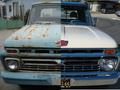
The truck is bone stock, with rust trim. I plan on making it a sunday driver eventually but the goal is just learning how to work on it and getting it on the road. Seeing as the distributor and carb go together and wouldnt work in any sort of performance build is fine by me. Just glad I found out now, before I bought any extras! Now I just plan on making the 240 reliable and the moment it requires more money then its worth (which isnt much), I will look into a swap for something with more power. With that being said, I will not be getting a pertronix for it!
Thanks for all the help from everyone, this forum has been a game changer.
The unfortunate thing, is I also found out it was last registered in another province. So now I need to get an inspection before she can be legal. Anybody familiar with this in Alberta, shoot me a PM! It will be a long road ahead but enjoying the ride!
I bet you can get it running fine. Seek out NOS Autolite or Motorcraft points and condenser. That famous auction site, Green Sales, maybe a long time in business parts-jobber in your area with still yet a few dusty boxes on the top shelf. 10k miles is a long time for collector cars, if it's a daily driver that might be different.
If you stick with points then buy a timing light. You will need it every time you do a tune up. And a dwell meter. Adjusting the dwell angle (points gap) changes the timing.
Genuine Ford (Motorcraft) points are part number C9AZ12171B (DP-3).
Genuine Ford (Motorcraft) condenser is part number C9AZ12300A (DC13A.
If you stick with points then buy a timing light. You will need it every time you do a tune up. And a dwell meter. Adjusting the dwell angle (points gap) changes the timing.
Genuine Ford (Motorcraft) points are part number C9AZ12171B (DP-3).
Genuine Ford (Motorcraft) condenser is part number C9AZ12300A (DC13A.
appreciate the part numbers. How well would knockoffs from rockauto work? I ask because I purchased the middle of the road stuff from them (points, condenser) I can understand the timing light, and looking online, they can be had for $20 used which is a no brainer. But when it comes to that dwell meter....looks to be above my head. After a quick readup on them, looks like a multimeter. Have one of those. But if its one that has some special setting to check the dwell timing, and if its more then $80, itd be best to just get a pertronix, no? The goal in the end is just something I can drive on the weekend (in the summer...i live in canada with snowy winters, like its supposed to be below -31*C before windchill this week). So most of the year is spent with the truck in the garage and me tinkering with it.
Rezvani's Latest Post-Apocalyptic Monster Is a Ford F-150 Raptor Underneath
Slideshow: Called the Fortress, the 850-horsepower pickup combines Raptor underpinnings with military-inspired features, survival equipment, and a starting price of $285,000.