When you click on links to various merchants on this site and make a purchase, this can result in this site earning a commission. Affiliate programs and affiliations include, but are not limited to, the eBay Partner Network.
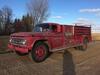
Good evening, been searching the forum for some time now and does anyone have an idea for axle code?
Also looking to replace or upgrade the firewall mounted brake booster because there is no pedal pressure and you can here air whooshing when pedal is pressed. Just drove 200 miles with no brakes and it was an exciting evening, fortunately had drive line brake to use after downshifting.
Also if anyone is interested in any fire truck parts please feel free to contact me, getting rid of all pumps and such.
Thank you!
Last edited by Paul Nelson; Aug 23, 2020 at 08:22 PM.
Reason: Typo
So you have a firewall mounted booster, as you would see in a current car or truck?
You should be able to find that through NAPA medium heavy parts and other parts stores. You need to talk to someone who knows what a medium truck is, as the "default" lookups stop at F350.
Also, at the top of this forum please read the "For sale/wanted" thread.
Looks like a '64 with engine code "M". That would be a FT engine, 330 2V, HD version.
Good afternoon and thank you! I found that one on Napa as well, but I am looking for something more modern and easy to acquire and also upgrade master cylinder to dual. Have many people tried a newer easier to come by booster and master cylinder? I'm not one bit interested in out dated over expensive parts honestly.
It has the Clark direct drive 5 speed transmission but haven't been able to figure out the rear axle yet. No tags or anything to be found. I will have to jack it up to get the ratio but it does 70-75 without spinning high rpms at all and lots more pedal.
Also looking to see what all steering boxes have been adapted to these? Going to be doing a lot of backing up and maneuvering.
A later model dual master can be done. Many will bolt right up, but may not have the capacity to keep 6 wheel cylinders happy, or provide enough assist to make stops without drama.
Others have been down this road, let's see if we get any comments.
If you can make that thing run 70-75, you are 15 to 20 mph over the usual reports. Single speed axle?
Steering boxes....again, let's see what comes up from other users.
It's a two speed rear axle, just haven't checked ratio yet. I would guess I was only 2200 rpm at 70. It was perfectly content at that speed and lot of throttle left, hopefully get a tach put in one of the extra dash spots here soon.
I wouldn't see why a newer dual master cylinder off a F350 or heavier would move more fluid than an old single cylinder master. The old single system isn't actually very safe if there is any failure.
If we get a full decode we might get axle info. Looks like a single letter ("O" or "C") for the axle code, which may be the front axle. If so, the rear axle was a special order.
Ratio info on those is sometimes stamped on the carrier near the two speed motor.
Do a search for "Eaton axle identification". You will find PDFs of new and old info. Hard to sort through.
As to the brakes, the firewall mounted booster was one way they did the job. Most, afaik, were frame mounted hydrovac units. Still a single leaking wheel cylinder would bring the whold system down.
FWIW, pick a new title for your thread, "1964 Fire Truck" or something similar will set it apart. Serving suggestion.
Did it actually feel like you were doing 70 mph or was that just what was showing on the speedo?
Two speed axle trucks have a device on the back of the speedo that is controlled by the electric two speed shift selector, this device changes the speedo gearing to match the ratio's of the two speed axle, if they are not synced the speedo can be off by several mph.
I had my wife following in out 2014 Cruze diesel and called her a few times to verify the speed was right on the speedometer. Had it doing 75 mph easily more than a few times on the trip. Even went through a few of the automated speed signs that flash your speed and everything was right on.
Pulling it into the shop this weekend to start removing water tank and pumps so will start to get a better look at everything then.
Any leads on more modern booster and master cylinder or power steering box? I can fabricate just about anything but it helps to see what other people have done and learned.
If we get a full decode we might get axle info. Looks like a single letter ("O" or "C") for the axle code, which is the front axle. The rear axle was a special order.
Ratio info on those is sometimes stamped on the carrier near the two speed motor.
Do a search for "Eaton axle identification". You will find PDFs of new and old info. Hard to sort through.
As to the brakes, the firewall mounted booster was one way they did the job. Most, afaik, were frame mounted hydro-vac units. Still a single leaking wheel cylinder would bring the whole system down.
FWIW, pick a new title for your thread, "1964 Fire Truck" or something similar will set it apart. Serving suggestion.
Thru 1969, if the front axle was an option (like this case), the AXLE code contains 3 digits with the first 2 pertaining to the rear axle.
Since the space where the first 2 digits would normally be is blank, the rear axle was a Domestic Special Order installed after the truck left the assembly line.
1964: There were 2 different C front axle codes, 1 O front axle code. OP will have to determine what this letter is (it's not a zero, though the letter O may look like one).
C = Ford 5,000 lbs. capacity front axle or Ford-Rockwell/Timken 6,000 lbs. capacity front axle without Heavy Duty front brakes.
O = Ford-Rockwell/Timken model FD-903 9,000 lbs. capacity front axle with Heavy Duty front brakes.
Also if anyone is interested in any fire truck parts please feel free to contact me, getting rid of all pumps and such.
Thank you!
Hi Paul,
I've got a C900 set up as a fire truck...and im looking for fire-related stuff. I tried to pm you, but i guess i dont have that priviledge. Why dont you email me at martinlwfleming (and add that gmail ext)
Good evening everyone and thank you for the replies. It seems to be and eaton 16244 with 6.33 ratio in the rear. Obviously will have to get a tach installed here. Lol
That must be the ratio of the low side of the two speed axle.
You said you verified it was doing 70 mph, with a direct 5th gear and standard 42" tall tires to run 70 mph at 2500 rpm it would have to have 4.44 high side ratio.
I honestly don't know the exact RPM yet, I just know it wasn't revving high at all and I had lots of pedal left and engine wasn't working hard. I'll have a tach in it soon to get a better reading than butt dyno. It's stamped 6.33 on the housing though. But it had no problem hitting 75 on the interstate today and staying right with traffic, might have been switched at some time?
Well you aren't pushing as big a barn door as a flatbed or dump would have, with the overhead above the cab etc. But, IMO if you were really going 70-75 and had engine left, you have:
--a really quiet muffler and were running 3500+ rpm, and your engine is in great shape.
--taller gears and a 391, with a quiet muffler
Usually a 330 hits a wall in the vicinity of 60 mph, + or -.
I totally understand the skepticism, I grew up on a farm/ranch in montana and we had a few various old ford grain trucks. They where not exactly known for their speed, that's for sure, but definitely stood out in the longevity department. Probably by the time I have a tach put in I will have switched out the outdated 330 and clark with a 351w and zf5 with drive line brake that I have all ready to go.
This Hennessey Takes the Expedition Tremor's Off-Roading Capability to the Next Level
Slideshow: The VelociRaptor Expedition gains a lift, upgraded suspension, Brembo brakes, and trail-ready equipment while retaining the stock 440-horsepower EcoBoost V6.
Rezvani's Latest Post-Apocalyptic Monster Is a Ford F-150 Raptor Underneath
Slideshow: Called the Fortress, the 850-horsepower pickup combines Raptor underpinnings with military-inspired features, survival equipment, and a starting price of $285,000.