When you click on links to various merchants on this site and make a purchase, this can result in this site earning a commission. Affiliate programs and affiliations include, but are not limited to, the eBay Partner Network.
Hey guys. Can someone clarify for me what is the relationship between GVWR and the payload number? I'm unclear as the payload doesn't seem to necessarily go up as the GVWR goes up. And also, what are all the increasing GVWR numbers relating to given it's, in this example, an F250, SRW 4x2? (In other words, why is the GVWR going up for the same truck?) And why the dashes in some lines?
Thanks in advance. Sorry for my seemingly dumb questions. I'm just not a car/truck guy so am quite clueless.....
Hey guys. Can someone clarify for me what is the relationship between GVWR and the payload number? I'm unclear as the payload doesn't seem to necessarily go up as the GVWR goes up. And also, what are all the increasing GVWR numbers relating to given it's, in this example, an F250, SRW 4x2? (In other words, why is the GVWR going up for the same truck?) And why the dashes in some lines?
Thanks in advance. Sorry for my seemingly dumb questions. I'm just not a car/truck guy so am quite clueless.....
There are several variables at play here:
1) 10,000 lbs. has been a Class 2 truck GVWR limit for many years.
2) 9,900 lbs. is a no-cost “paper downgrade” to below 10K lbs. to help lower registration fees in some jurisdictions. There are no mechanical differences.
3) >10,000 lbs. GVWR means the truck is fitted with an optional Diesel engine and optional HD Trailer Tow Package; the GVWR has been increased to restore payload otherwise lost to the Diesel’s weight.
More complete sections of the chart are included below.
Right. The “Max Payload” spec is based on a base trim model with no unnecessary options. Once you add options, then you add weight, which in turn reduces payload.
Every truck carries a white and yellow “Load Label” on the driver-side B pillar that states the official payload spec for that particular vehicle.
For example, the max payload spec for our truck configuration is 4200 lbs. The official as-built payload spec for our truck is 3912 lbs.; see the label pic below.
Ahhhh...... clear as mud!
Adding options and lowering payload correspondingly makes total sense. Just like adding options to a camper.
100% understood that the door sticker is the "final" spec. Only concern, I guess, is knowing where a truck falls in payload/GVWR when ordering what you want and not having the sticker in front of you, in the case one is not on the lot. Hopefully the dealer can give that spec on what your configuration is, before handing over your $$.
Still seams a bit murky, but clearer now. I guess the numbers are for solid knowns like changes in engine. Listing all the numbers for every different combo of options would be a chart the size of a phone book......
Thank you guys for taking the time out the help.
I've seen the sub-10,000 lb GVWR mentioned before with respect to fee/taxes. That does seem to be a bit of a paper game. Is that a state to state, bean-counter thing? Someone randomly saying if it's over 10k lbs, it must be a commercial vehicle?
I suspect some states went to classes in defining taxes so folks would stop trying to register commercial use trucks as passenger vehicles. In my state they simply asked whether I was using my F350 commercially, which I was not, and that was that. On the other hand, my F150 was used commerically and they never asked so go figure.
DOT uses stated axle and tire ratings, plus registration for determining legal or not.
If you are not over the stated GVWR, axle or tire ratings, and the vehicle is registered for the weight being carried, you are legal. This includes any trailer tires and/or axle ratings.
For example, my truck with 14,000 GVWR and my trailer with 20,000 GVWR I would need to register it at 34,000 lbs. As long as I don't go over individual axle or tire ratings, or 34,000 total, I'm legal.
I just bought a used 2017 F350 DRW 4.10's (14,000 GVWR). There was a lot of discussion with regard to vehicle weight and payloads, there was no deal unless I could get the actual truck weighed, which I did myself. The dealer gave me the run around about not knowing the location of any truck scales (there was a public scale 3 miles from the dealership). Brochure (base model no upgrades) said 7400#(+/-) with a 6600#(+/-) payload, actual truck weighed 9000# (with 3 adults & 1/2 tank fuel) which left me with a 5000# payload. Actual payload = GVWR minus weight of truck, full tank of fuel, all passengers, gear, dog/cat, water bottles, properly inflated tires, etc. Only way I know how obtain the true payload is to weigh the actual vehicle of interest and do the math (new or used - non-commercial). Here in MA we are able to register trucks like these with passenger tags as long as its not being used for commercial purposes (it helps significantly with registration fees). If you register as private and get caught using it commercially there are substantial penalties. I'm legal on my GCWR to 35,000# with a conventional trailer (14,000 GVWR plus a 21,000# trailer) or 40,000# with a 5TH wheel or gooseneck (which is a limitation of the bed hitch itself as I understand the data).
There should also be a load label on the driver-side B pillar stating the official as-built payload.It probably won’t be perfect, but it should be pretty close.
This topic always confuses me. I bought my truck new and haven't done anything but add some off road lights, I'll guess at 100lbs to be safe with the bar and lights out front of the grill.
My driver side B piller says "...occupants and cargo..." 3290 lbs. And the vin sticker says GVWR 10,000 lbs - Front GAWR 4400 lbs - Rear GAWR 6340.
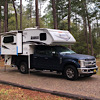
So without going over a scale with an already purchased slide in camper that is said to weigh 2340 lbs, how would I know if this 2019 F250 4x4 gas engine SuperCab Lariet can handle it legally?
There are a couple of calculations to go through. One is to compare the as-built payload spec with the camper weight. 3290 lbs. of payload minus 2340 lbs. of camper theoretically leaves 950 lbs. for people, tools, accessories, supplies, personal gear, coolers, flashlights, water, propane, camper batteries, camper options, bed mat, tie downs, turnbuckles, everything.
Another is to make sure the loaded truck is not exceeding GAWR specs. That’s usually a concern for the rear axle before the front.
There are ways to reduce the truck weight: remove tailgate, bed cleats, and rear seat headrests and floor mats.
Rezvani's Latest Post-Apocalytic Monster Is a Ford F-150 Raptor Underneath
Slideshow: Called the Fortress, the 850-horsepower pickup combines Raptor underpinnings with military-inspired features, survival equipment, and a starting price of $285,000.