When you click on links to various merchants on this site and make a purchase, this can result in this site earning a commission. Affiliate programs and affiliations include, but are not limited to, the eBay Partner Network.
The way the frame is buckled like that I wouldn't be surprised if it didn't leave the highway, entered a ditch and abruptly stopped by hitting something solid, there is also that nasty crack to the front bumper. With your level of skill I'm confident you could repair and straighten the areas. Then measure corner to corner from corresponding points on the frame. If you felt there was a weak spot just box that section..
These are pretty simple frames . A good amount of cross measuring and possibly some tack welds to hold things until you get the m11 in and it should be good to go . I am a little baffled by the shops wanting a rolling chassis ( other than to move it around ) as for measuring purposes it should be on stands to eliminate any suspension inconsistencies . This is a great little tool that you will find allot of use for with your mustang builds also .
Is the center section of the rear end housing punched in ? That was a heck of a stump if it is.
2/29/2020 >>> Yes...the rear end housing is dented (never saw one that bad before) & the third member has a crack in it, so I'll be investing in a new 9" rear.
3/1/2020 >>> Correcting my statement from 2/29/2020.....the rear end housing is not bent in, I looked at it from about 15 feet away and thought the same, it turned out to be a shadow causing it to look that way. The housing is fine, the third member does have a crack however I'm changing that anyway.
When I saw the front buckle, I was confused. With the frame all tied together, I wondered where the energy of that bend went. Now we know. Not sure how it got there, but it makes more sense than just that single buckle.
As to the frame, I'm would even classify myself as a novice on this stuff, but I'm glad to give my opinion.
It comes down to two issues; money and the type of work you want to do on this truck.
There is great satisfaction in taking the original parts and rebuilding them. With this option you will always have the concern of parts failing. Although with your skill level, that concern is greatly reduced.
With the turn key chassis, you are guaranteed parts that will last a long time and you will spend less time working with rusty parts that want to fight you.
What story do you want to be able to tell with this truck?
If I had the skill and money I would do one of each. But I don't, so I'm staying stock.
I don't think there is a wrong answer, just a determination of where you want to spend your time and energy.
Good points.... yes, I'm confident I have the abilities to fix it. As noted above, it comes down to money vs. time & I guess I'll add longevity. This along with our other cars will be handed down to our kids once my wife & I pass on (hopefully a long time does the road) so I want something that will last for many years without my kids inheriting a basket case.
No matter if I save the stock frame or go with a turnkey chassis it will no longer be 100% stock because I definitely want to go modern suspension and a non-stock engine so I'm really only saving the frame in this case.
Time will tell regarding what I do...I'll get the cab off hopefully this week and see if I find any other damage.
The way the frame is buckled like that I wouldn't be surprised if it didn't leave the highway, entered a ditch and abruptly stopped by hitting something solid, there is also that nasty crack to the front bumper. With your level of skill I'm confident you could repair and straighten the areas. Then measure corner to corner from corresponding points on the frame. If you felt there was a weak spot just box that section..
I agree, I think more happened than a simple fender bender..
How easy do these frames twist?
Met a guy in the hardware store today while I was buying lumber to build the dollies for the box & cab. Turns out he's a seasoned alignment guy who is very old school which is awesome for me because I need his skill set for an alignment on my 70 Challenger. We spent about 30 minutes talking, I'm guessing we could have spent 30 more minutes easily but his friend was bugging his to go.
We got to talking, I told him what I had and what my issue was and he said it most likely was a simple fix in my own garage with a little heat and common sense and a whole lot of measuring. He agrees with the masses here on the forum that these frames are normally pretty easy to remedy without needing a frame shop. He said the "gotcha" is if the frame is twisted, then it becomes a frame shop repair and in extreme cases the frame is junk depending upon the severity of the twist.
Once I get the cab off, I guess I'll get it level on jack stand and start measuring.
These are pretty simple frames . A good amount of cross measuring and possibly some tack welds to hold things until you get the m11 in and it should be good to go . I am a little baffled by the shops wanting a rolling chassis ( other than to move it around ) as for measuring purposes it should be on stands to eliminate any suspension inconsistencies . This is a great little tool that you will find allot of use for with your mustang builds also .
That's awesome...Thanks a lot...I may just pick one of these up.
Just to clarify, the frame shop wanted a rolling chassis to get it on and off their rig only, nothing to do with the squaring of the frame. Sorry if I confused that in my earlier explanation.
Going to break this up into 2 posts sine there is a lot to cover.
First off, I built a caddy for the box and got that secured onto it, and then I proceeded to remove the cab from the frame as well as build a caddy for the cab and get it secured on to it.
Here are pictures of all that. The cab is really solid, I didn't find any rot through anywhere on it. Very please with that and about the only good peace of news I got today (see next post on the frame).
Okay....so now for the bad news. This frame has more twists in it than a pretzel.
Remember that part in the frame by the cab where it popped up (most likely energy transfer), well one the first pics in this post shows it's also budged on the side of the frame in the same spot.
The pics show different angles of the various twists. I honestly do think this chassis is salvageable, but I welcome opinions and expertise advice.
There is one pic of the back of the cab which explains why the box on the drivers side was a couple inches lower than the passenger side. line up the frame support to the cab an you'll see what I mean.
Are you sure that there is not something off with the suspension or tires. When I had my frame all apart you could lift one corner and the whole thing could flex. Pick up the whole back end and give it a shake and it was amazing how much it moved.
Are you sure that there is not something off with the suspension or tires. When I had my frame all apart you could lift one corner and the whole thing could flex. Pick up the whole back end and give it a shake and it was amazing how much it moved.
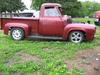
Haven't gone through anything on the suspension yet...I do know and you can see in the pics that the driver's rear tire is different than the other three, I have to checked the size.
^^^What he said.^^^ Put it on jack stands and cross measure from corresponding bolt holes and rivets in X's from side to side. Typical tolerance is +/- 1/8-1/4". If you can X out within an 1/8th inch you're golden. Over a 1/4 and you should do some straightening. Be sure your floor is level, too.
^^^What he said.^^^ Put it on jack stands and cross measure from corresponding bolt holes and rivets in X's from side to side. Typical tolerance is +/- 1/8-1/4". If you can X out within an 1/8th inch you're golden. Over a 1/4 and you should do some straightening. Be sure your floor is level, too.
QUESTION: Where is the best place to put the jack stands to get the most accurate measurements?
I would put them as close to the last cross member front and rear as possible avoiding any obvious damage . This should give you measurements where you need your suspension to be and everything in between for cab , fender and box mounts . The very end of the frame horns are the most commonly bent , the easiest to fix and least important as for the most part they hold your bumpers .
I would put them as close to the last cross member front and rear as possible avoiding any obvious damage . This should give you measurements where you need your suspension to be and everything in between for cab , fender and box mounts . The very end of the frame horns are the most commonly bent , the easiest to fix and least important as for the most part they hold your bumpers .
This Hennessey Takes the Expedition Tremor's Off-Roading Capability to the Next Level
Slideshow: The VelociRaptor Expedition gains a lift, upgraded suspension, Brembo brakes, and trail-ready equipment while retaining the stock 440-horsepower EcoBoost V6.