When you click on links to various merchants on this site and make a purchase, this can result in this site earning a commission. Affiliate programs and affiliations include, but are not limited to, the eBay Partner Network.
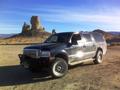
I've had my 2000 Excursion for about a year. When I bought it, the seller told me that the steering was a bit wander-y and that someone told him he needed new ball joints but someone else told him that the ball joints were fine. I've put about 10,000 miles on it since then and noticed that the steering is a bit vague, but not *that* bad and I torqued down the sway bar links in the front which got rid of 90% of the clanking and banging that was going on up there. The vibration at speed was getting a bit worse over the last couple months and sometimes braking hard would cause some uncommanded steering to happen, plus there was a lot of squeaking and other noises coming from the front end that were all very dependent on the angle of the steering wheel. So the other night, I pulled the truck (which I refer to as the Big Ugly Truck for Towing, or for brevity's sake: The B.U.T.T.) into the shop to look at the front end and see what I could see.
First of all, this is a very difficult vehicle to get into the air. My 20 ton bottle jack doesn't have enough stroke to be able to lift the tires off the ground in any of the places that it fits. After playing with my floor jack, some jack stands, a little bit of cribbing, and the bottle jack, I was able to get both front wheels up in the air.
This isn't exactly my first rodeo. I've done more than my fair share of wheel bearings and ball joints and other suspension-adjacent work on all sorts of vehicles, but I have never in my life had a wheel bearing that was this loose yet still actively rolling. I didn't measure exactly how much deflection there was at the top and bottom of the stock-size tire, but I think there might have been enough room to grow a few rows of corn. And maybe some beans.
Once I got myself unpuckered, I ordered up two new Timken coarse-thread units from Rock Auto. Part number is 515020 and after shipping and the 5% discount code it was 39 cents shy of $170 per side. Since these were coming from the Lorraine, OH warehouse, it took under two days for them to arrive on my doorstep. During that time, I watched every video and read every how-to I could find and pieced together what I could. The thing I was dreading the most was getting the studs out of the old wheel bearing assembly and moving them over to the new ones. That said, let's see how they unpack:
These are freaking heavy, but the box is constructed accordingly. And, yes, that does say "Made in USA" right there on the label. Inside, we've got:
Taking it out, it's a nice shiny new hub:
But, wait... what is this tucked under the hub in the box?
Could it be!?
Yes! The Timken unit includes four brand-new studs! Nowhere in the description on Rock Auto's website do they indicate that those studs are included (unless I missed it... but I read it three or four times), so I'm glad I wasn't able to easily find the Ford part number for those studs! That's at least $20 worth of hardware there that I thought I'd have to source separately.
Unfortunately, this is where the step-by-step guide is going to have to end for today. I won't be able to get the truck back into the shop until Friday night, but once it's all done I'll add the full write-up as well as a video. But for now, step one: Buy the Timken units.
I pulled the truck (which I refer to as the Big Ugly Truck for Towing, or for brevity's sake: The B.U.T.T.) into the shop to look at the front end and see what I could see.
.
B.U.T.T. - LMAO The wife named ours the crusty pig. Very rusty when I got her and very thirsty. The Excursion, not the wife.....
B.U.T.T. - LMAO The wife named ours the crusty pig. Very rusty when I got her and very thirsty. The Excursion, not the wife.....
My wife named ours the Bus. Yet she refuses to let me paint it school-bus yellow!
Regarding the hubs, when I bought my Ex it had 86,000 miles on it and the front end was a mess. I replaced the right front hub (it also came with new studs) and was pleasantly surprised by how easy the job was. 70,000 miles later I replaced the left front.
I don't remember what brand I used, but I did buy quality parts. I've never been penny-wise and pound-foolish.
My wife named ours the Bus. Yet she refuses to let me paint it school-bus yellow!
Regarding the hubs, when I bought my Ex it had 86,000 miles on it and the front end was a mess. I replaced the right front hub (it also came with new studs) and was pleasantly surprised by how easy the job was. 70,000 miles later I replaced the left front.
I don't remember what brand I used, but I did buy quality parts. I've never been penny-wise and pound-foolish.
You are a better man than I! I had to learn that lesson the hard way over many years and much frustration!!
Just one more work day I need to get through and then it's off to the shop to install the new hotness! I'm also going to see if I can figure out what's going on with the ESoF hubs while I'm in there. I've been using them in "manual" mode and I know that the Warn manual hubs are better, but before I give up entirely I'd at least like to see exactly why they aren't working. I suspect that a large part of the problem is that no one has ever done anything to lubricate anything in there. It's damned near impossible to turn the locks by hand so you know that there's no way a couple vacuum pulses would be able to do it. It's kind of embarrassing, but other than oil changes, a new coil, and some new plugs I haven't had a chance to do any of the maintenance catch-up that I typically do on a new-to-me vehicle. When I've had the time, there's been something else taking up the space in the shop and when I've had an empty bay, I haven't had the time!
FWIW the correct way to jack the wheels off the ground is to place the bottle jack under one side of the axle, place a jack stand and then jack up the other side of the axle and place a jack stand.
FWIW the correct way to jack the wheels off the ground is to place the bottle jack under one side of the axle, place a jack stand and then jack up the other side of the axle and place a jack stand.
Well I know that now, but where the heck were you on Tuesday night when it was all up and down and up and down!?
You are a better man than I! I had to learn that lesson the hard way over many years and much frustration!!
I learned that lesson young and seldom break the rule. The last time I broke that rule I had bought a cheap tool and paid for it. I was putting Hardie siding on a house and had loaned out my framing nailer. So I bought one of the Harbor Freight brand nail guns knowing that when the job was done so was the tool. Those guns are Chinese made. They're also Chinese engineered. Engineered by the same people that think eating rice with two sticks is a good idea. Anyway, nail guns typically have a cleanout. A small slot in the barrel that allows you to remove a nail that gets jammed. On any decent gun that slot closes to no more than 1/4" when the gun is ready to fire. On that Harbor freight gun it was nearly 3/4". I had shot several sleeves of nails when the inevitable happened and the nail caught the cleanout just right, exited the gun through the side of the barrel, bounced off the siding and hit me in the thumb. That was in the days before we had cameras in our phones, which was too bad. I had a 3" framing nail through my thumb (side to side) with my thumb almost centered on the nail. I was extremely lucky that it caught neither the nail nor bone, but it did take a trip to the ER to get the nail removed. I later realized just how lucky I was. It was 1/8" from shattering bone. It was about 1/2" from going through the knuckle. It wasn't until later that it hit me, "what happens if it misses your thumb?" Does it hit me in the sternum? *********? Knee?
Anyway, that's the only time I've broken that rule in more than 30 years. We all need a reminder from time to time....
Originally Posted by wae
Well I know that now, but where the heck were you on Tuesday night when it was all up and down and up and down!?
Rumor has it that you've not been going to the gym enough lately. It was for your own good.
Well, I have both succeeded and failed. I had planned to put together a video and whatnot for this but the battery in the camera died on me so much of what I had done fell on blind CMOS and a deaf DSP. I was, however, successful in getting the wheel bearings swapped out and things are much, much nicer now. The ride is smooth, steering is predictable, the awful road noise is gone (because it wasn't road noise), braking is better, and most of the popping and banging noises are gone.
Now, you're thinking to yourself: "You dummy, make sure your battery is fully charged before you start something like that!" And, you're both right and wrong. Apparently, I am a dummy, but the battery was charged. For some reason, and I still do not have an explanation why, it took me about two and a half hours to remove the axle retaining ring from the first side I was working on. I own a halfway decent set of snapring pliers that I have used to remove and install a few hundred snaprings in the past, but for some reason every time I got the ring to start to spread so that I could pull it forward, the pliers would pop out of the ring and I'd be right back where I started. So I have a couple hours' worth of me looking like a total retread alternating between dropping about fifty FBPM (that's F-bombs Per Minute), banging my head against the shock tube, and just rocking back and forth mumbling to myself. That footage isn't going to see the light of day, but by the time the ring was off, the battery was dead.
After fighting it for two and a half episodes of Magnum, pi, it finally came off and everything was back on track. You need a total of 2 sockets for the job: a 21mm deepwell and a regular 21mm. Actually, you could probably just do the whole thing with the deepwell, come to think of it. Instead of coming up with some ingenious method to hang the brake caliper from a rubber strap or a ziptie, I found that the leaf spring makes a perfect shelf for the caliper and bracket to rest on. Once the four retaining nuts were removed, I used a chisel between the backing plate and the old hub assembly to get it separated. It takes a little banging, but it'll come off with some percussion. Some brake cleaner and some rags to clean that out and then installation is reverse of removal.
The first time around, I went to put the rotor on and discovered that I had put the dust cover on backwards. Don't make that mistake. But here's where things got a bit frustratingly weird: I had put the retaining clip back on the axle by this point so when I realized I had to take it off again in order to be able to turn the dust cover right way around, I considered running off and joining the circus instead. After a deep breath, I resigned myself to my fate and grabbed the snapring pliers. The ring came off without any drama whatsoever. Just "click" and it slid off the axle. About 15 seconds of effort, if that. As it turns out, when I went to the other side, the first thing I did was to pull the locking hub and then the retaining clip and don't you know it; It popped off perfectly the very first time. I have absolutely no idea how in the world it took me around 150 minutes to remove the first ring the first time. I was even doing the job the sober!
The other problem that I ran in to was that despite ordering the "coarse thread" version and despite the part number of the box being correct for "coarse thread", the threads were not a match to the truck's original lug studs. The original studs were definitely coarse thread so I can only assume they put the wrong hub in the box. So... I threw the hubs on the press and pressed out 24 studs and then used ugga-duggas to pull the old studs into the new hubs. Not the end of the world, but just a bit irritating. So second lesson: Check the studs before you go to far.
I'm just glad to have it finished. I'm a bit disappointed that I'm not able to really give a good write up or video for it, but other than that one snapring, it's really an easy repair.
Next up, I need to look at the locking hubs. The vacuum hoses are just gone, so I suspect that might be the root cause.
The ride is smooth, steering is predictable, the awful road noise is gone (because it wasn't road noise), braking is better, and most of the popping and banging noises are gone.
fifty FBPM (that's F-bombs Per Minute), banging my head against the shock tube, and just rocking back and forth mumbling to myself.
Next up, I need to look at the locking hubs. The vacuum hoses are just gone, so I suspect that might be the root cause.
50 FBPM? That's on the upper end of the amateur scale, unless the neighbors can hear them. And I find throwing wrenches to be superior to head banging....
If the vacuum hoses are gone, the system's "open" and those hubs are susceptible to contamination. That may be what ate up the bearings. It also raises the question of how is that line sealed on the other end so that the ignition isn't affected by a vacuum leak? I'm wondering if the previous owner just disabled the hubs and replaced the T connector(s) and line(s) to the hub(s) with a simple inline connector.
Glad that the ride's up to your standards, but that vacuum issue needs to be tracked down. And if you're going to drive the Ex, make sure to find a temporary seal at the hub so no contamination gets in to eat up another set of bearings.
50 FBPM? That's on the upper end of the amateur scale, unless the neighbors can hear them. And I find throwing wrenches to be superior to head banging....
If the vacuum hoses are gone, the system's "open" and those hubs are susceptible to contamination. That may be what ate up the bearings. It also raises the question of how is that line sealed on the other end so that the ignition isn't affected by a vacuum leak? I'm wondering if the previous owner just disabled the hubs and replaced the T connector(s) and line(s) to the hub(s) with a simple inline connector.
Glad that the ride's up to your standards, but that vacuum issue needs to be tracked down. And if you're going to drive the Ex, make sure to find a temporary seal at the hub so no contamination gets in to eat up another set of bearings.
I used to throw wrenches, but it's so much work to have to walk across the shop, dislodge them from the drywall like some sort of grease-covered Arthurian character, and carry them back just to have to do it all over again!
The vacuum nipples on the knuckles are absolutely capped off right now - I've got a wide and sundry assortment of caps and little spring clamps to hold them on so it should be good for the next couple weeks before I have time to dig back into it. I didn't go looking for The Other End, though, because I had previously tested for vacuum leaks and even when the t-case is in 4WD mode, it's all sealed up. My working assumption is that at least that part of the system either failed in such a way that it's blocked off or someone capped it. The vacuum hose on the right side was actually partially present but very heavily degraded and disintegrating, so I strongly suspect that the previous-previous owner must have decided to block off the system instead of just putting in a buck and half worth of vacuum hose.
You are absolutely right, though - water is much better at getting past seals than grease and it will carry grit with it. I cleaned out the passage in each knuckle with brake cleaner, compressed air, and pipe cleaning brushes. Frankly, even if the vacuum lines are intact, that would probably be a good thing to spend 3 minutes on while you're in there anyway, just to be sure.
I used to throw wrenches, but it's so much work to have to walk across the shop, dislodge them from the drywall like some sort of grease-covered Arthurian character, and carry them back just to have to do it all over again!
Having 2 or 3 of the most common sizes handy greatly reduces the number of trips.
Rezvani's Latest Post-Apocalyptic Monster Is a Ford F-150 Raptor Underneath
Slideshow: Called the Fortress, the 850-horsepower pickup combines Raptor underpinnings with military-inspired features, survival equipment, and a starting price of $285,000.






 The wife named ours the crusty pig. Very rusty when I got her and very thirsty. The Excursion, not the wife.....