When you click on links to various merchants on this site and make a purchase, this can result in this site earning a commission. Affiliate programs and affiliations include, but are not limited to, the eBay Partner Network.
Y2KW57, How hard is it to install the recommended Leece-Neville alternator? Does the wiring and/or the mounting need to change?
Yes, and yes.
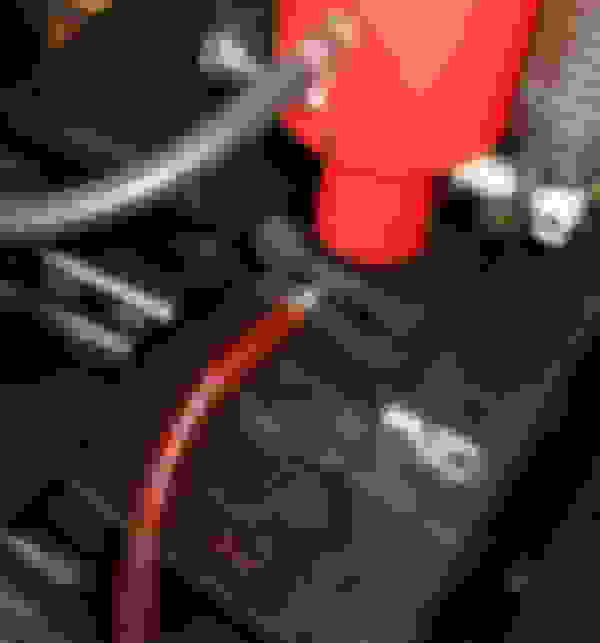
The wiring MUST be changed, in so far as the stock B+ charge output wire (Black/OrangeStripe... the big fat wire on the red nut post) is wholly inadequate to deliver the current that you paid for with the cost of the alternator.
The stock B+ wire has too much resistance, which skews the PIE equation against our favor. We need to decrease the resistance to the batteries. The stock B+ supply wire to the GPR is plenty adequate... that's not what we paid the big bucks for an alternator to address. We want an alternator to deliver enough current to the batteries to replenish the demands placed on them, so we need to less resistance between the alternator and the batteries.
That's what the big fat red wires are for in my photos above. One big fat red wire goes to the curbside battery. The other big fat red wire goes to the roadside battery. Both big fat red wires are fused, nearest to the power generating source, which in this case, is right at the back of the alternator. Fuses are sized for the current carrying capacity determined by the gauge thickness and length of the wire the fuses are inline with.
What this means is that the stock B+ wire can be left in place, unmolested. The stock B+wire is protected by fusible links. The stock B+wire feeds the glow plugs, and connects to the starter relay, which ties in with the starter and the batteries, initially through the curbside battery. Nothing is changed there.
What the additional big fat red wires do is augment the stock B+ wire, providing an additional path for current to pour out of the alternator into hungry depleted batteries. The resistance of the stock wiring is removed, not be removing the stock wiring, but by providing an alternative, less resistive path for current to flow. Those big fat red wires (as well as the equally big fat black negative wires that were also added) only have one job to do... and that is to see that there is no impediment to current flow from the alternator to the batteries.
This is so important, Ford produced a wiring kit for the Low Cab Forwards, to be installed in service in any situation where this exact same Leece Neville alternator (sold as a blue box Ford part number) was retrofitted after the fact of production in the 6.0L LCF-450/550 trucks. Ford, International, Prestolite, and LeeceNeville each stated, in writing, that production charge wiring may need to be increased in size to accommodate the higher output of this alternator. Rather than replace the existing wiring, a simpler solution is to supplement the wiring, which reduces resistivity, without digging out and disrupting the original charge wiring harness.
Fortunately, the control wiring harness needs no alteration or augmentation. In the case of the 99-03 7.3L, there isn't even a need for translation, as the same shell connector on our series of 6G alternators exists on the voltage regulator used in the Leece Neville alternator, as it is the same F-600 regulator, only in the Leece Neville, it is the Heavy Duty version of that regulator.
I supplemented the grounding with negative leads as well, as I did not want to rely on the alternator bracket, front cover, and any gasketing material at the sealing surface between the front cover and the block, in order for the alternator to ground to the engine block. The amount of current flowing through the ground and grounding leads is equal to the current flowing through the positive leads, so the level of resistance needs to be equal as well for optimal performance in the charging circuit.
The Leece Neville, like most commercial heavy duty alternators, offers a direct grounding post on the back of the alternator... not relying solely on the case ground. To this post I added two heavy gauge negative leads, one directly to the engine block, and one directly to the roadside battery, which of it's own accord also has ground lead directly to the block.
I attached the direct to block ground lead (which bypasses the resistance vagaries of front cover seals, and bypasses corrosion between the many mating slip surfaces of stacked washers on alternator mounting points that some folks use, etc) to an existing threaded hole above the OEM block ground, as follows:
The second negative lead from the ground post on the back of the Leece Neville alternator was routed directly to the negative post of the roadside battery, as seen in the photo below (photo shown here for the black wire, not the red wires)
Note that I did have to change the original Leece Neville ground post bolt to a longer one to maintain original full length thread engagement... again, to decrease any resistance. The lugs to the ground cables I used were rather thick, as the copper stranding was compressed all the way through the bolting flats of the cable lug, so I felt that increasing the bolt length a little would maintain the same thread engagement depth, while accommodating not just one, but two rather thick lugs held under the flanged bolt head.
This is what I mean about how thick the cable lugs were at the mounting flats...
Note that even Ford's 6G small case alternator has a threaded provision to install a grounding bolt to the case, rather than rely entirely on the alternator mounting bolts. My truck has two alternators, and the second alternator is currently a small case 6G (a modified NipponDenso is slated to replace this 6G alternator in the secondary position, should it ever die). Below you can see my 6G alternator received the same treatment, with two different ground leads attached to the rear threaded grounding boss.
The first ground lead was open wire braiding to the frame, to draw stray AC noise and EMF away from the hall effect type turbine shaft speed sensor on top of the transmission, should a diode fail in the lower alternator. Search for my thread entitled "That's me in the corner, that's me in the spot-light...losing my transmission" for details that explain the symptoms and manifestation of this problem, and the solution. (A good working alternator is sufficient solution... I sometimes go overboard. A little.)
The second ground lead was direct to the curbside battery...
Getting back to the Leece Neville wiring, with the recognition that the Ford ignition and sense wiring for alternator excitation remains unchanged, here is a summary photo of the additional wiring added to the Leece Neville alternator installation to accommodate the higher current output without cooking the stock wires, or losing the benefit of the higher alternator output to the batteries due to resistance of the stock wires.
One final note on wiring enhancements... I added a secondary parallel positive lead between the positive posts of the batteries, in order to match the reduced resistance afforded by the additional negative leads between back of alternators, front of block, and battery negative posts.
I use AGM batteries, so my original battery terminals and cables are still completely in tact, which includes this massive lug of OEM lead that Y connects the positive leads at the curbside battery. This is where I chose to attach my duplicate paralleling cable to lower the resistance between batteries:
This is what the double positive paralleling leads look like leaving the curbside battery:
For the pass across the radiator, the routing follows the same path as the original positive paralleling cable. Rather than bundle the two leads tightly together, I separated them a couple of inches apart, for heat dissipation, and a more distributed cross sectional profile that would be flexible in a frontal collision, where more ductile conformance might prevent a dead short from a crushed rad support. The cable separation also enabled me to take advantage of existing posts to attach cable supports
That's about it for wiring.
As for mounting the Leece Neville alternator, the OEM alternator bracket base needed some ever so slight massaging to fit the 160mm girth of this larger alternator. I would argue that the bracket needs less modification than what a large case 6G requires, even though the large case 6G has a smaller diameter stator than the Leece Neville. The issue with the large case 6G is the location of one of the three mounting bosses that the bolts which attach the driven end and the slip ring end of the alternator case halves together. With the large case 6G, it isn't so much that the girth of the alternator is so big as much as it is the fact that the axial mounting boss on the perimeter of the alternator collides with the valley of the alternator bracket.
The Leece Neville issues are different. The case half mounting bosses are clocked differently, so there isn't such a peaked point of interference. This means instead of notching the alternator bracket, one can gradually feather the alternator bracket down with a flap disc in two locations, which is sufficient to gain secure fitment with sufficient clearance, and without any stacked washers that would elevate the alternator that already kisses the hood insulation without being elevated by washers.
Washer elevation, while quick and convenient, creates other problems, especially with a Leece Neville alternator. Not the least of these problems is the axial center point of the alternator rotor shaft is already shifted outboard of the original belt path. Any further shift outboard by raising the alternator mounting surface through washers... would only further reduce the range of travel of the belt tensioner, that is already biased to the tighter side of midpoint by virtue of the axial center shift.
The Leece Neville diameter nests in the T mount posts differently as the case is cast. The nesting serves as a more space efficient way to stuff that much alternator within the confines of a three post mounting standard that is already fixed for the Ford vehicles for which this alternator was designed to be fitted to. The cast frame diameter nesting within the T mount also contributes to the rotational axis shift outboard of the original belt path. So the stacking of washers further stacks the tolerances in the same direction... outboard. Not good.
So modify the bracket. The gradual feathering with a flap disc does not induce the stress concentration or crack propagation potential that an abrupt V notch to fit the large case 6G mounting boss protrusion might impose, so I was actually more comfortable modifying the (now obsoleted, no longer available new from Ford) factory alternator bracket to fit the Leece Neville than I was the large case 6G, which while perfectly acceptable, was not what I chose, as the benefit of the large case 6G was not great enough for the expense or effort, given the other options available.
I did take extensive photos of the bracket modification I did in situ, but somehow those photos have disappeared, at least until I find them again.
if you are building your own cables then you might ss well learn how to do in correctly and for that I will share the best DIY tech I know of on the subject.
try as I did for years to build quality cables using quality components they just fell short of what in the marine industry is a minimum standard.
if you are building your own cables then you might ss well learn how to do in correctly and for that I will share the best DIY tech I know of on the subject.
try as I did for years to build quality cables using quality components they just fell short of what in the marine industry is a minimum standard.
Thanks for the best link on How to Crimp & purchasing quality wiring components.
This should be required reading for all DIY cable makers.
It's great how a single forum post can add so many levels of knowledge.
Thanks again, Bob
My truck HAS dual alternators, as shown in the photos and described in the text of the post immediately above.
yes sorry about that. Whatever reason the photos didn’t come through correctly on my phone until this morning when I looked at it again and slapped my forehead. 😬
EDIT- actually I just figured out what happened. I saved your post to my Books on my phone and was reading it there and it took a while to read and you posted the portion about the duel alternators while I was reading it. I did not check back before asking the question. Either way thanks for the great post!!!
Sometimes one can leverage the tools that one already has in the shop to do the work of purpose built tools. I have various specialty wire crimpers and dies, but not the exact type listed in the good article that @pirate4x4_camo linked.
Just to add that there is more than one way to skin a cat, in the photo below I'm using steel blocks cut into half hexagonal dies guided by two spring backed pins on my H frame shop press to create a circumferential crimp on a heavy gauge fine strand (for suppleness) battery cable.
As with so many of the threads on this forum, I am in awe regarding the depth of knowledge shown on this thread, as well as the generous attitude to share all this knowledge with the team. I always feel like everyone on this forum has my back when faced with the challenge of keeping my old truck running, this is the true definition of the value of community at its very finest. Thanks so much Nathan
My 160 amp alternator (with both internal and external bridge rectifiers) from QuickStart has been serving me faithfully without a single glitch for almost 10 years (roughly 130,000 miles).
Looks great. What gauge wire did you use? Also, does the external rectifier run to the GPR or is that still off the black and yellow wire from the alternator?
I used 4ga. The external rectifier connects to the driver side battery only. The only non-factory power distribution wiring I have added is a bunch of extra grounds all over the truck. Everything else is stock. I found that poor contact at the batteries alone can make a huge difference. Simply cleaning the clamps and battery posts on a regular schedule keeps my system running smoothly. I can tell if I have left it for too long when the starter isn't spinning as enthusiastically as it usually does.
It isn't possible to argue with 10 years of successful operation, so please don't misinterpret the following concern as something that is bound to happen.
External rectification is just that... external rectification. A remotely located, external rectifier, means that the un-rectified AC generated by the alternator is sent traveling along 2 to 4 feet of wire (read:antenna) to finally become rectified into DC.
My concern here would be that this antenna offers opportunities to radiate stray AC voltage and ripple... the kind of electromagnetic noise that I don't want to be picked up by the camshaft position sensor circuit, causing errors or shut downs.
I've had my fair share of bad alternators causing the transmission to have mechanical faults, due to the signal interference with the TSS (turbine speed shaft sensor), causing bad data, which led to what felt like catastrophic transmission failure. Fortunately, once I pulled the TSS fault code, I immediately thought of stray AC and EMF from a bad diode in the lower alternator, because the TSS works the same way as the CMP (camshaft position sensor, or CPS), in that both are Hall Effect type sensors. From this experience, in this model vehicle and engine, I would not want to have unrectified AC coursing through the engine compartment via an antenna like wire harness to become rectified into DC. Why add more opportunity for stray AC and ripple to be picked up?
Generally speaking, if the OEM's are not doing it this way, I give them the benefit of the doubt that they likely have justifiable reason for not doing it this way.
But that all being said, I'm not arguing with the success of others. I'm just offering my experience with electrical interference from alternators in this application as a single (actually dual, it happened twice) data point(s) for your consideration.
Y2KW57,
Can you please explain the disconnect on the negative terminal?
1). Why you thought it was necessary.
2). Is it's rating high enough not to be a down grade of your extra wires.
3). Your extra thoughts.
This Hennessey Takes the Expedition Tremor's Off-Roading Capability to the Next Level
Slideshow: The VelociRaptor Expedition gains a lift, upgraded suspension, Brembo brakes, and trail-ready equipment while retaining the stock 440-horsepower EcoBoost V6.
Rezvani's Latest Post-Apocalyptic Monster Is a Ford F-150 Raptor Underneath
Slideshow: Called the Fortress, the 850-horsepower pickup combines Raptor underpinnings with military-inspired features, survival equipment, and a starting price of $285,000.