


Jekyll and Hyde Starting Problems

Moderator


Joined: Jan 2001
Posts: 57,004
Likes: 2,748
From: Virginia

I had another engine where the advance weights would get rusty and stick, advancing the timing too far and causing this problem. I knew what it was, so what i tried till I got time to fix it was pump the throttle a couple of times to flood the engine. This killed the ignition for the first few revolutions (just like pull the ignition wire off) and gave the starter some momentum to get the engine turning. Once it cleared it would slow down again but it would start.
Senior User
Joined: Jul 2008
Posts: 213
Likes: 0
From: Foothills of cascades
I had another engine where the advance weights would get rusty and stick, advancing the timing too far and causing this problem. I knew what it was, so what i tried till I got time to fix it was pump the throttle a couple of times to flood the engine. This killed the ignition for the first few revolutions (just like pull the ignition wire off) and gave the starter some momentum to get the engine turning. Once it cleared it would slow down again but it would start.
Moderator
Joined: Jan 2001
Posts: 57,004
Likes: 2,748
From: Virginia
I just had a thought of something else it could be; Possibly your connection to the ignition module is bad or the ignition module itself is bad. If you have the large silver box on the fender, that is a duraspark II ignition box. You will see a bunch of wires coming out of it, two of them are grouped together away from the others. One is the ignition/battery power, the other is a power wire that is only hot during cranking. It should have a red/blue striped wire going to it. The wire at the module itself may be white or red. This wire comes directly off the start circuit, and when the module gets this signal during cranking, it automatically retards the timing electronically a certain amount to combat the problem you are having. So any problem with this feature is going to aggravate the problem you are having.
If you check the timing, and it's around 10 or 12 BTDC, I would suspect something like the above. If you check it and it's 15 BTDC or higher, I would turn it back just a little bit. The higher you can run it, the better throttle response and fuel mileage you will get. But of course you can go too high and have the problems you are having.

Post Fiend
Joined: Feb 2008
Posts: 5,831
Likes: 121
From: St Albert, Alberta
If that helps you get it started, I think it's going to be the timing. What caused it all of a sudden I don't know. I have never had the advance weights stick on a Ford, but I guess it's possible. Have you noticed lately the idle speed is a little higher? The timing being advanced with no other intervention will make the idle speed higher.
I just had a thought of something else it could be; Possibly your connection to the ignition module is bad or the ignition module itself is bad. If you have the large silver box on the fender, that is a duraspark II ignition box. You will see a bunch of wires coming out of it, two of them are grouped together away from the others. One is the ignition/battery power, the other is a power wire that is only hot during cranking. It should have a red/blue striped wire going to it. The wire at the module itself may be white or red. This wire comes directly off the start circuit, and when the module gets this signal during cranking, it automatically retards the timing electronically a certain amount to combat the problem you are having. So any problem with this feature is going to aggravate the problem you are having.
If you check the timing, and it's around 10 or 12 BTDC, I would suspect something like the above. If you check it and it's 15 BTDC or higher, I would turn it back just a little bit. The higher you can run it, the better throttle response and fuel mileage you will get. But of course you can go too high and have the problems you are having.
I just had a thought of something else it could be; Possibly your connection to the ignition module is bad or the ignition module itself is bad. If you have the large silver box on the fender, that is a duraspark II ignition box. You will see a bunch of wires coming out of it, two of them are grouped together away from the others. One is the ignition/battery power, the other is a power wire that is only hot during cranking. It should have a red/blue striped wire going to it. The wire at the module itself may be white or red. This wire comes directly off the start circuit, and when the module gets this signal during cranking, it automatically retards the timing electronically a certain amount to combat the problem you are having. So any problem with this feature is going to aggravate the problem you are having.
If you check the timing, and it's around 10 or 12 BTDC, I would suspect something like the above. If you check it and it's 15 BTDC or higher, I would turn it back just a little bit. The higher you can run it, the better throttle response and fuel mileage you will get. But of course you can go too high and have the problems you are having.

Cargo Master


Joined: Jan 2019
Posts: 3,369
Likes: 16
From: Caraway, AR
What are the differences, other than that, between the two? Are they interchangeable?
Post Fiend
Joined: Feb 2008
Posts: 5,831
Likes: 121
From: St Albert, Alberta
They are interchangeable. But you will need need to shave off the centre locating rail on the vehicle harness. As it is clocked differently on the white box. The White box was used 79-82 on the 2.3L on Canadain emissions vehicles mostly if I remember correctly. FMofC had the base timing on these vehicles well advanced to give a little more get up and go from a standing start.
Post Fiend
Joined: Feb 2008
Posts: 5,831
Likes: 121
From: St Albert, Alberta
They are for all intense purposes identical other than retarding timing on crank.
FTE Stories
Ford Trucks for Ford Truck Enthusiasts

Top 10 Fords at 2026 Carlisle Ford Nationals
Joe Kucinski
3 Best / 3 Worst Parts of Modern Ford Ownership
Brett Foote
10 Amazing Upgrades That Solve Common Ford Truck Owner Headaches
Pouria Savadkouei
Every 2026 Ford Engine Explained
Brett Foote
10 Ugly Ford Trucks That We Still Kinda Love
Joe Kucinski
10 Things Every Truck Owner NEEDS (2026 Edition)
Michael S. Palmer
Rezvani's Latest Post-Apocalyptic Monster Is a Ford F-150 Raptor Underneath
Verdad Gallardo
Top 10 Most Expensive Ford Trucks Ever Sold on Bring a Trailer
Joe Kucinski
2027 Ford Super Duty Buyer's Guide (Every Model, Engine, & Package)
Brett Foote
Moderator
Joined: Jan 2001
Posts: 57,004
Likes: 2,748
From: Virginia
Cargo Master
Joined: Jan 2019
Posts: 3,369
Likes: 16
From: Caraway, AR
How much does it retard the timing? And what are the parameters on that. I mean on/off on the retard feature.

Post Fiend
Joined: Feb 2008
Posts: 5,831
Likes: 121
From: St Albert, Alberta
Yes and not sure what your point is.
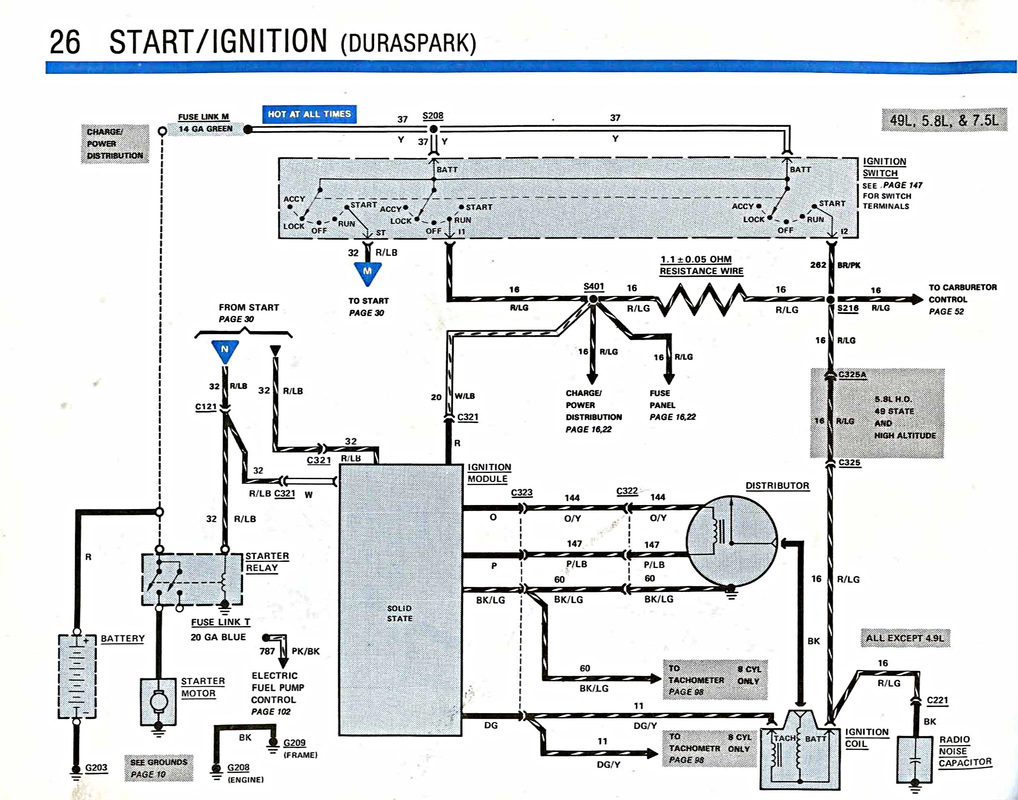
The ford Duraspark II system feeds a full 12V to the coil on start. The module has 2 12V feed wires, white for start red for run. When the vehicle is cranking the module adjusts the dwell on the coil to take full advantage of the 12V fed to the coil to give the hottest spark possible without overloading the coil or the module. It has been done this way since Duraspark/Electronic Ignition was introduced by Ford in 74. The DS II module can not switch a 12V fed coil reliably long term, eventually, the module will overheat and fail. This is why the DS 1 modules were made as they can (at least later on) switch a 12V fed coil reliably long term
If you have a dwell meter or timing light with a dwell function you can clearly see the dwell change between the crank and run. The system adjusts the dwell during crank not the timing.
See below DS II wiring schematic to understand. what is going a bit better.

Lead Driver


Joined: Nov 2013
Posts: 7,182
Likes: 1,174
My best guess is that wire is a signal for the DuraSpark module to temporarily increase the voltage to the coil for a hotter spark during cranking. This would be very similar to the use of a ballast resistor on older vehicles, and does two things:
1) Lower voltage to the coil after start extends its life. This reduced voltage is the designed input, suitable for the vast majority of the time. It's really an 8v coil (just guessing on the number), not 12v. It's fine to briefly bump up the input for short periods and get a hotter spark, but the coil would overheat if operated continuously like that.
2) With the starter engaged, the battery voltage drops close to 10v or so. This is perfectly normal and is expected. (Compare this to the 13.5v+ you'd normally have with the engine running.) Unfortunately, this brief lower voltage also decreases the coil output, resulting in a weaker spark just when you need it as strong as can be. This temporary shortcoming can be minimized by telling the The DuraSpark module to give the coil everything she's got:
Post Fiend
Joined: Feb 2008
Posts: 5,831
Likes: 121
From: St Albert, Alberta
This was tech lifted from the DS I Module. DS II Blue modules all had fixed dwells with one setting for the start and one for crank. And the timing was fixed in both modes.
The DS I module adjusted dwell time with engine RPM and had a crank retard feature, and adjusted the dwell during crank like DS II does. Ford just took the crank retard feature of the DS I module and included it in the start circuit of a DS II module to get the white strain relief modules..
Realy if anyone is looking to for an igntion upgrade the switch to DS I is no brainer. And it leaves the system looking completely stock but gives all the advantages of the GM style HEI systems without the reliability issues.