When you click on links to various merchants on this site and make a purchase, this can result in this site earning a commission. Affiliate programs and affiliations include, but are not limited to, the eBay Partner Network.
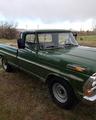
I picked up a pristine seafoam green 1971 F100 Sport Custom today. To say I'm excited would be an understatement.
One owner, completely unmolested, and always garaged. The wiring harnesses are pristine and not hacked up or spliced. Everything works except for the stock ammeter. The needle doesn't move. Just stays right in the middle. Any particular place to start looking or reasons why they stop working? Does the gauge itself generally fail?
Nice truck. The ammeter is a shunt type which means that all the charging current doesn't go through the gauge as a part of the charging circuit. This means that the gauge isn't as noticeably responsive as one in a vehicle where all the current does go through the gauge in series such as older Dodge trucks. This is why the Dodges have overheated wiring connections and lots of failures. The gauge on the Fords usually will show some charging right after you start the engine as the battery is slightly discharged and the alternator is working hard to recharge the battery. One method would be to put a carbon pile on the battery and really load the system and watch the gauge respond.
Thanks! I went down to the garage and messed around with it some. With the ignition and engine off, I can turn on the headlights and see a very very slight deflection towards the discharge side. Is it normal operation for it to deflect when the alternator isn't putting out?
Well I'll be honest, if this is the amount of deflection the factory built into the gauge, then it is completely worthless, even when working properly. Seems like they could have changed the scale or sensitivity of the gauge itself to show more deflection without shunting more current and causing such a fire hazard?
The ammeter never moved much even when new. It was a mere novelty gauge in reality. The brightside is at least they didn't set the truck on fire like the mopars.
Yeah I wish all the trucks had used the ammeter that was in the '66 to '77 Broncos. I had "assumed" that the Bronco gauges were common to other vehicles, but I don't know what those would have been.
These use an inductive loop and the charge wire simply passes through it. No danger of overloading the gauge or fittings, and nothing to get loose other than the very well designed main connector. If it got rusty, or somehow damaged, it could over heat. So not completely out of the woods in that regard. But they did not often get rusty or fail and most of the EB's I work with still have pristine connectors. Now though, after 50 years and counting, some of the gauges themselves are actually starting to fail. They still work, but they get loose and bounce around a lot just from driving.
But they read very consistently, seemingly accurately, and had good resolution (which is what you're not liking with yours eric8.
Unfortunately probably not worth trying to retrofit it to such a pristine truck and wiring harness as yours. Better to install a small digital volt-meter maybe, in the cigar lighter or some semi-discrete panel somewhere.
Or I suppose there is some way to make them work better? Perhaps fiddling with the gauge itself, or making sure the shunt wiring is in good shape.
I remember when I replaced the voltage regulator on my '79 the ammeter (which had never worked at all) read like a dream afterwards. Long sweep and seemed to indicate what was going on. For all of a week!
Never worked again after that, and I never took much time to fiddle with it.
Thanks for the info Paul. I've been doing some reading and apparently Ford issued a bulletin that instructed technicians to turn the switch to accessory, turn on all lights, and if the meter showed any deflection (no matter how slight) that the meter was working as intended. So I guess it's working!
I sent my ammeter down to a guy in Texas who converts them to voltmeters. It was worth the price. That said I have since converted the instrument panel to a Dakota Digital instrument cluster. It was a bit pricey but worth it. One other option I indulged in was a GPS modular which it uses to set its speed, no need for a speed cable connected to the transmission.
After reading the replies to your post about the factory amp meter movement I went out to my truck and tested my meter as it did not look like it was moving, watched it real close with the lights off/on with motor not running and it did not move at all. I also lost my odometer reading a few months ago so I put together a 3 gauge unit with a trans fluid temp gauge (for my newly rebuild C4), A volt meter & a GPS speedometer / odometer gauge. The GPS unit works great and holds odometer reading even when I turn key off.
A buddy of mine uses the same unit for the speedometer in his T hot rod roadster.
"eric8" that is a fine looking truck! Congrats on the find.
"tpdanials" that is a well cared for Chevy too.
Thanks Gary. You wouldn't believe the condition of this thing. It has definitely spent its life being loved on an in a garage. Look at this factory aluminum trim. Almost unheard of to see it still in this kinda shape: