When you click on links to various merchants on this site and make a purchase, this can result in this site earning a commission. Affiliate programs and affiliations include, but are not limited to, the eBay Partner Network.
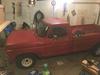
I have been doing lots of reading on making a lwb into a swb and I found one post where they cut the flange and bolted to two parts and welded it together but I can’t seem to find it now. I’m wanting to do it to my 78 f150 reg cab 2wd. The tapered frame is the issue. If anyone has any advise it would be greatly appreciated. Where I have my frame marked out there is a 2” diffrence. So wondering what the options are to make the two parts line up
So you pretty much marked out 4 5/8” cut it out and welded back together? Were you able to pull the two parts of the frame together fairly tight with the bolts? And how much of the flange did you cut away? That’s a sweet build by the way!
The halves, once overlapped, are very close to one another. The bolts sucked them together the rest of the way very nicely. No worries about it whatsoever. I don't remember how much I trimmed off the ends.
I scribed marks on the frame as reference points. Then I slipped the halves together and ratchet strapped them together until I was at the proper length, drilled, bolted, then welded.
I have been doing lots of reading on making a lwb into a swb and I found one post where they cut the flange and bolted to two parts and welded it together but I can’t seem to find it now. I’m wanting to do it to my 78 f150 reg cab 2wd. The tapered frame is the issue. If anyone has any advise it would be greatly appreciated. Where I have my frame marked out there is a 2” diffrence. So wondering what the options are to make the two parts line up
I believe that the frame on the F-250 is substantially thicker than the F-100 and F-150 so your situation is a little different from what JP3 was working with. Since I plan on doing this to an F-100, I have also been researching this. There are quite a few YouTube videos that should be watched. When removing 16" from the frame, you will need to take care to align at least two of the three frame surfaces to avoid tweaking the frame. Most of the videos I've looked at so far make 90º cuts and align the top and side frame rail where the surfaces are straight. The lower rail is where you will see a small mismatch due to that taper. Two inches may indicate that you need to select a better cutting site.
One guy cut the bottom rail at less than 16" on one end. He then cut and bent that tail out of the way until the other two rails were tacked in place. Finally he trimmed and bent the tail to fill the gap and welded it up.
Myself, I would not do any welding until I had both sides firmly in place, aligned and level.
I’ve looked at that frame to find a better place to cut but no matter where I pull from I’m looking at 2” diffrence. If I don’t do the overlap I’m looking at doing the 16” cut out and but welding it. Put heat to the back part of the frame and bring each side in 1”
My personal opinion is that these frames are only slightly stiffer that a wet noodle and any sort of minute mismatch will never be noticed.
We *are* dealing with 70's build tolerances afterall. Haha.
The bolts pulled the halves flush and I welded them. It was really quite easy. I did the diagonal cut so the halves would overlap over an longer span than they would have with a straight cut.
If I were doing it again, I would do it the same way.
It would very easy to make both cut frames match exactly.It might be a bit more complicated to explain it via this wording. I'll try.
The frame is shaped like a square "U".If you cut along the verticle(widest)frame part, at the top,from front to back (or vice -versa), just below the top flat 2-3 wide frame top.Now do the same at the bottom of the frame. What you have done is separate the top & bottom of the frame from the side of the frame.3 pieces are now free and clear of each other.The verticle wide part can now bent/moved in or out to match the other frame section. Go back 6 or 8 " or more & heat (only if needed) if you need a gradual bend in or out.Trim or add whatever needed to the top and bottom free floating lips and weld it all up back to the wide verticle frame piece.It should all match up great by doing this and if needed plate/re-inforce/gusset ---whatever... if you want. So much easier to just do it as opposed to telling how.
A million years ago ; I was struggling with a hard hit mangled trunk opening on a customers car;an old established body man told me "Gary,it's just metal". He was right !
One more thought. The top or bottom lip don't line up-match anymore? (they probably won't). Cut a narrow "V' in the lip as deep as you need to let the 2-3" wide lip to bend in or out. This is all very easy stuff to do. The crucial thing is measure,measure ,measure.
I don't know about the frame on the 3/4 ton, but the 1/2 ton frame is going downhill as it goes forward along with tapering inward.
It's a project I want to do, just not on my 22k mile truck. I have another truck located minus engine and trans that is supposed to be a nice, sub 100k lwb truck with no body damage in a light blue.
I think that I'm now seeing where I misunderstood the OP. I was talking about the variance that will be encountered between the top frame rails and the bottom frame rails with a 90º cut of 16". This is usually less than an inch. This gap can be handled in such a way that it would be hard to tell that the frame was cut and shortened, not even from a worms eye view. Apparently, the OP was referencing a discrepancy between left and right frame rails. One or two pipe clamps should be able to close a two inch gap cold. Cold is better than hot since you can assume equality of force and thereby equal movement of the two rails. Some models, such as my '76 F-150, have a bolt-on crossmember in this area that should be removed in order to allow more of the frame to bend. My '76 F-100 doesn't have this crossmember. Heavy wall 2X2" steel tubing can then be placed inside the frame rail so that HD clamps can be used to lock things down prior to making final measurements. The most critical measure checks for squareness using an X pattern. There should be frame alignment pegs fore and aft on each rail. The distance between LF and RR needs to be equal to the distance between RF and LR plus or minus a quarter inch.
Take a look at the following video from 5:15 to 5:25. Note the relatively small gap and the fact that this fellow used only a couple of clamps. This is a bumpside but the frame should be basically the same as what you and I have (1/8th inch thick).
When Ford introduced the Twin I-beam front suspension in 1965, the front track width increased by several inches over the previous Mono-Beam solid axle setup. However, they continued to use the same-width rear differential, resulting in a mismatch between the front and rear track widths of the bumpside-era trucks. However, this was corrected beginning with the 1973 2WD and some 4WD models. While the frame remained basically the same from the rear of the cab forward, everything from the back of the cab rearward was widened out to 38", an increase of 4". The following chart shows the widths of the rear frame rails of various models:
I believe that the frame on the F-250 is substantially thicker than the F-100 and F-150 so your situation is a little different from what JP3 was working with.... etc ...
Not long after getting my '77 F-150, I parked it beside my brother in law's '77 F-250 and did a lot of comparison measuring, the differences were not in frame material thickness, but rather brakes, rear axle, front springs. I was surprised at how "same" the frames were, even thickness was same as I recall, rear springs same too. His was a 4 spd with NP205 and 400.
Rezvani's Latest Post-Apocalyptic Monster Is a Ford F-150 Raptor Underneath
Slideshow: Called the Fortress, the 850-horsepower pickup combines Raptor underpinnings with military-inspired features, survival equipment, and a starting price of $285,000.