


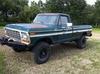

1968 F100 360FE problem

Thread Starter
|
New User
Joined: Apr 2018
Posts: 15
Likes: 0
1968 F100 360FE problem
Hey to all, I am new here and this is my first post. I have a 1968 F100 with a 360, straight shift. The truck is original paint and original interior with only 58,600 miles. A true time capsule. Now for my problem. It all started when I rebuilt the original Autolite 2100 carburetor due to flooding issues. Needless to say "MY" rebuild failed for some reason because after reinstalling the flooding issue got worse. I might add that the truck before my rebuild cold started with manual choke just fine and ran like a champ. But, after sitting about 15 minutes after being ran the fuel bowl would leak down causing it to flood and be hard to start when the engine was warm. Soooo, I bought a newly reconditioned Autolite 2100 carb from Autoline out of Canada through Autozone. I have had very good luck with them in the past on other vehicles. I installed the new carb, and 8 new Motorcraft spark plugs, gaped them to .035, changed the oil out of fear of having gas in the oil due to previous flooding issues and started the engine. Started fight up, idled fine, but, when driving she bucks and jerks like it has a miss fire. Readjusted the settings on the carb to no avail. Spoke with some old head mechanics around here that said I need to swap that carb out cause I may have gotten a bad one or the fuel pump could be going bad. So I replaced the carb again,same problem. Replaced the fuel pump, didn't help. Checked the timing, it was at 12 DBTDC book says should be 6DBTDC. However I could tell  BTDC seemed a little smoother so I locked it down there. Rotor cap and rotor button are good. I pulled a vacum on the distributor and the weights do advance. I am at a loss. The truck, starts fine warm or cold. Idles perfectly. But buck and jumps when driving. No tach, but seems to miss at about, just guessing here, 1500 rpm and above. 35 to 50 mph. Seems to smooth out at 60 mph and above.Advice please.
BTDC seemed a little smoother so I locked it down there. Rotor cap and rotor button are good. I pulled a vacum on the distributor and the weights do advance. I am at a loss. The truck, starts fine warm or cold. Idles perfectly. But buck and jumps when driving. No tach, but seems to miss at about, just guessing here, 1500 rpm and above. 35 to 50 mph. Seems to smooth out at 60 mph and above.Advice please.

Ford Parts Specialist
Joined: Nov 2006
Posts: 88,826
Likes: 784
From: Simi Valley, CA

Hey to all, I am new here and this is my first post. I have a 1968 F100 with a 360, straight shift. The truck is original paint and original interior with only 58,600 miles. A true time capsule. Now for my problem. It all started when I rebuilt the original Autolite 2100 carburetor due to flooding issues. Needless to say "MY" rebuild failed for some reason because after reinstalling the flooding issue got worse. I might add that the truck before my rebuild cold started with manual choke just fine and ran like a champ. But, after sitting about 15 minutes after being ran the fuel bowl would leak down causing it to flood and be hard to start when the engine was warm. Soooo, I bought a newly reconditioned Autolite 2100 carb from Autoline out of Canada through Autozone. I have had very good luck with them in the past on other vehicles. I installed the new carb, and 8 new Motorcraft spark plugs, gaped them to .035, changed the oil out of fear of having gas in the oil due to previous flooding issues and started the engine. Started fight up, idled fine, but, when driving she bucks and jerks like it has a miss fire. Readjusted the settings on the carb to no avail. Spoke with some old head mechanics around here that said I need to swap that carb out cause I may have gotten a bad one or the fuel pump could be going bad. So I replaced the carb again,same problem. Replaced the fuel pump, didn't help. Checked the timing, it was at 12 DBTDC book says should be 6DBTDC.
However I could tell 8DBTDC seemed a little smoother so I locked it down there. Rotor cap and rotor button are good. I pulled a vacuum on the distributor and the weights do advance. I am at a loss. The truck, starts fine warm or cold. Idles perfectly. But buck and jumps when driving. No tach, but seems to miss at about, just guessing here, 1500 rpm and above. 35 to 50 mph. Seems to smooth out at 60 mph and above.Advice please.
However I could tell 8DBTDC seemed a little smoother so I locked it down there. Rotor cap and rotor button are good. I pulled a vacuum on the distributor and the weights do advance. I am at a loss. The truck, starts fine warm or cold. Idles perfectly. But buck and jumps when driving. No tach, but seems to miss at about, just guessing here, 1500 rpm and above. 35 to 50 mph. Seems to smooth out at 60 mph and above.Advice please.
Cargo Master


Joined: Oct 2011
Posts: 2,241
Likes: 299
From: Kenner,La.
360
If the spark plug wires are original they should also be replaced. Do a vacuum check on the distributor vacuum advance unit. Also try to set the points with a dwell meter instead of a feeler gauge. Or just replace the points with a Petronics kit. You should also have around 8 volts on the “Bat” side of the coil when the engine is running. Set the timing with the engine idling as slow as it will run to avoid the centrifugal advance from giving a wrong setting.
Good luck
Good luck
Thread Starter
|
New User
Joined: Apr 2018
Posts: 15
Likes: 0
I believe the vacuum canister is bad on the distributor. With the vacuum line hooked up to the carb I experience the problem I explained earlier. This morning I disconnected the vacuum line from the carb and advanced the timing from 8 DBTDC to 12 DBTDC With the vacuum port on the carb plugged off, I then drove about 5 miles reaching about 60 mph. The jecrking stopped completely and it ran smoothly like nothing was wrong. Does it hurt to operate it like this? My parts store is having a hard time finding an EXACT replacement for the vacuum canister.
Ford Parts Specialist
Joined: Nov 2006
Posts: 88,826
Likes: 784
From: Simi Valley, CA
I believe the vacuum advance is bad on the distributor. With the vacuum line hooked up to the carb I experience the problem I explained earlier. This morning I disconnected the vacuum line from the carb and advanced the timing from 8 DBTDC to 12 DBTDC With the vacuum port on the carb plugged off, I then drove about 5 miles reaching about 60 mph.
The jerking stopped completely and it ran smoothly like nothing was wrong. Does it hurt to operate it like this?
My parts store is having a hard time finding an EXACT replacement for the vacuum advance. .
The jerking stopped completely and it ran smoothly like nothing was wrong. Does it hurt to operate it like this?
My parts store is having a hard time finding an EXACT replacement for the vacuum advance. .
1965/67 F100/350 352 / 1968/69 F100/350 360/390 // 1965/66 Galaxie/LTD 352/390.
This was once a very common advance, should be available from NAPA, indie auto parts stores.
Give the parts store the Motorcraft part number, it can be crossed over to the brands they sell.

Post Fiend
Joined: Apr 2002
Posts: 19,311
Likes: 97
From: Waterloo, Iowa
Originally Posted by Bama1968
The jecrking stopped completely and it ran smoothly like nothing was wrong. Does it hurt to operate it like this? My parts store is having a hard time finding an EXACT replacement for the vacuum canister.
This is a different system than the RPM driven mechanical advance. Without vacuum advance you'll likely lose a few MPG, and it also helps the engine run cooler. Retarded ignition timing can lead to a sometimes hard to diagnose overheating. Don't "have" to have vacuum advance but any street driven car or truck will benefit.
Don't worry about the timing on the front end, somewhere between 10° and 20° is fine, spool it up and see where it stops advancing on the far end at the damper/balancer, that's what counts. Once you get close to 20° initial it would gradually get harder to crank, with starter kickback. But the initial timing isn't critical.
About 34° BTDC or so is what you want to see with pump gas around 3000 RPM or less. Make sure it's done advancing all the way. Keep advancing the distributor in small amounts till it pings under hard full throttle acceleration and back off a bit.
THEN, when you find a vacuum canister, install it, hook up the vacuum line back up, but Don't **** with, don't touch, the distributor timing anymore. The vacuum cans are adjustable with a 3/32" Allen wrench, tailor the amount of vacuum advance till it runs good in part throttle acceleration. This can be tricky because
A. It can't really be measured easily, unless you can talk your buddy into riding in the engine bay with a timing light while you cruise down the highway. If you were to rev up the motor in neutral with the vacuum advance connected it will show an inaccurate number, because there is no load in the engine. Load is really low at highway cruise, but there is still some.
B. The vacuum cans are generally adjustable for "when" but not "how much" advance so they can be touchy. They can pull in too much on the far end, you may have to limit this with a stop. Again, don't mess with the initial or mechanical advance to compensate for too much vacuum advance getting pulled in. As you're starting to guess this can be a PITA setting up a distributor but it only needs done once and you'll thank yourself every time you drive it. It is the heart of any engine.
Trending Topics
Thread Starter
|
New User
Joined: Apr 2018
Posts: 15
Likes: 0
Excellent advice. I appreciate your input immensely and will do as you instructed. Thanks so much.
FTE Stories
Ford Trucks for Ford Truck Enthusiasts

2027 Ford Super Duty Buyer's Guide (Every Model, Engine, & Package)
Brett Foote
Top 10 Ford Truck Tragedies
Joe Kucinski
AEV FXL Super Duty - the Super Duty Raptor Ford Doesn't Make
Brett Foote
Lobo Vs Lobo: Proof the F-150 Lobo Should Be Even Lower!
Michael S. Palmer
Ford's 2001 Explorer Sportsman Concept Looks For a New Home
Verdad Gallardo
10 Best Ford Truck Engines We Miss the Most!
Joe Kucinski
2026 Shelby F-150 Off-Road: Better Than a Raptor R?
Brett Foote
2027 Super Duty Carhartt Package First Look: 12 Things You NEED to Know!
Michael S. Palmer
10 Most Surprising 2026 Ford Truck Features!
Joe Kucinski
Thread
Thread Starter
Forum
Replies
Last Post
Bama1968
1967 - 1972 F-100 & Larger F-Series Trucks
27
Jul 17, 2018 08:00 AM
Dustin_in_PDX
1973 - 1979 F-100 & Larger F-Series Trucks
6
Oct 14, 2017 05:51 PM
cbowden1
1961 - 1966 F-100 & Larger F-Series Trucks
6
Sep 4, 2016 08:41 PM
83F-250OWNER
1980 - 1986 Bullnose F100, F150 & Larger F-Series Trucks
16
Mar 9, 2003 03:45 AM
76ford4x4man
FE & FT Big Block V8 (332, 352, 360, 390, 406, 410, 427, 428)
20
Feb 25, 2003 08:50 AM