


Vacuum test, backfire


Thread Starter
|
New User
Joined: Mar 2018
Posts: 3
Likes: 0
Vacuum test, backfire
I set out the other day to check on my friend’s 65 F100 backfiring problem. The engine was replaced with a 390 some time ago and has a C6 tranny, Mallory Unilite distributor, and new Holley Street Warrior (600cfm) carb. Backfire symptoms did not change with new carb.
The first thing I noticed that it was idling very fast (1960 rpm according to the tach on my timing light but was set for its 4 cyl max so actual rpm 3920rpm?). Vacuum at power brake hose 18”. Blipping the throttle would increase to 22” momentarily and return to 18”. Air/fuel ratio pegged my old Heathkit Exhaust Gas Analyzer past 11.5 (rich) air fuel ratio. Carb idle adjustment screw was already backed off all the way. Spraying carb cleaner, a momentary rpm drop was heard on passenger side valve cover.
I just found out that they think the fast idle started with the new carb but not old. Duh... And new carb factory settings were changed by adjusting idle speed in an effort to lower it...
I had mentally noted that the choke plates didn’t open (but not binding) and nothing was connected to the positive choke terminal. But I didn’t know this carb at all and figured I should research it first... What’s the best place to pull the +12 volts from the electric choke? The electric choke is probably is just holding the carb in a fast idle.
Is there a tightening sequence to the valve cover and torque value?
So I’ll fix the electric choke issue and valve cover vac leak if I get out there this weekend. In the meanwhile, any thoughts as to what else might be causing these observations and would they be related to backfiring? Is the valve cover leak only part of the problem? Why doesn’t the vacuum drop when blipped (high rpm?)?
BTW, the only vac lines were the brake booster and one from the carb to the automatic tranny. I did see 2 hex head plugs at the top front of the intake manifold by the radiator hose-are these vacuum ports?
Also, the exhaust is directed towards the ground and terminated under the truck bed. Aside from heat, shouldn’t the exhaust gas be brought outside the vehicle body?
Thanks
The first thing I noticed that it was idling very fast (1960 rpm according to the tach on my timing light but was set for its 4 cyl max so actual rpm 3920rpm?). Vacuum at power brake hose 18”. Blipping the throttle would increase to 22” momentarily and return to 18”. Air/fuel ratio pegged my old Heathkit Exhaust Gas Analyzer past 11.5 (rich) air fuel ratio. Carb idle adjustment screw was already backed off all the way. Spraying carb cleaner, a momentary rpm drop was heard on passenger side valve cover.
I just found out that they think the fast idle started with the new carb but not old. Duh... And new carb factory settings were changed by adjusting idle speed in an effort to lower it...
I had mentally noted that the choke plates didn’t open (but not binding) and nothing was connected to the positive choke terminal. But I didn’t know this carb at all and figured I should research it first... What’s the best place to pull the +12 volts from the electric choke? The electric choke is probably is just holding the carb in a fast idle.
Is there a tightening sequence to the valve cover and torque value?
So I’ll fix the electric choke issue and valve cover vac leak if I get out there this weekend. In the meanwhile, any thoughts as to what else might be causing these observations and would they be related to backfiring? Is the valve cover leak only part of the problem? Why doesn’t the vacuum drop when blipped (high rpm?)?
BTW, the only vac lines were the brake booster and one from the carb to the automatic tranny. I did see 2 hex head plugs at the top front of the intake manifold by the radiator hose-are these vacuum ports?
Also, the exhaust is directed towards the ground and terminated under the truck bed. Aside from heat, shouldn’t the exhaust gas be brought outside the vehicle body?
Thanks


Lead Gopher


Joined: Aug 2012
Posts: 10,066
Likes: 1,622
From: Seattle

OK, don't throw anything at me for saying this very basic sounding stuff....
The vacuum in an engine comes from the action of the pistons themselves. Most of the rest of the engine builds up pressure rather than a vacuum. The valve covers shouldn't normally have a vacuum under them, except for the vacuum of the PCV valve connection. That's why the PCV valve is in the valve cover, because if you tried to connect a vacuum to another vacuum they would fight each other.
All automotive engines are lubricated with oil and when oil is churned by moving parts pressure is produced. Piston rings and valve guides also leak slightly producing pressure in the crankcase. Many years ago, they simply vented the pressure into the atmosphere with a road-draft tube and breather cap. Today they use a positive crankcase ventilation or PCV system to handle this and other tasks like removing any built up condensation inside the engine.
If you ARE getting a vacuum draw from the passengers valve cover leak - try this. Temporarily disconnect the PCV valve and try again. If you still get a vacuum draw it could be an indication of a burned or cracked valve or valve seat. Which could also contribute to a backfire condition. I'd be trying a leak-down test about then.
They are real easy to use. Remove all the spark plugs. Turn the engine by hand to put a given cylinder at TDC (valves closed) and screw the appropriate adapter into the spark plug hole. Connect the long hose to the adapter and an air compressor to the left hand connector. If you get a leak it helps determine where it is.
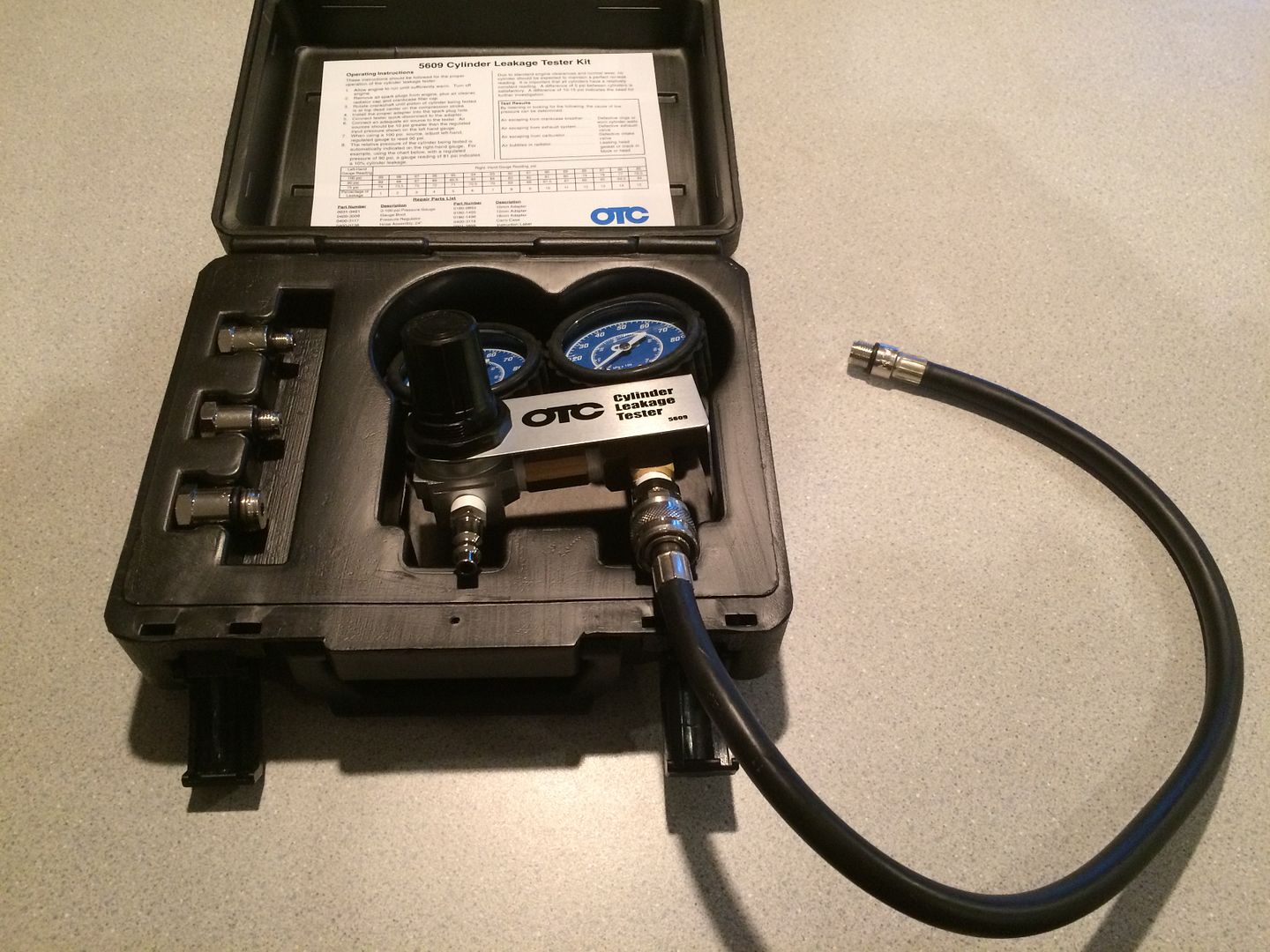
If the air is escaping out the tail pipe - exhaust valve leak
If the air is escaping out the carburetor - intake valve leak
If the air is coming out of the valve cover breathers - piston rings leaking typically
Chad
The vacuum in an engine comes from the action of the pistons themselves. Most of the rest of the engine builds up pressure rather than a vacuum. The valve covers shouldn't normally have a vacuum under them, except for the vacuum of the PCV valve connection. That's why the PCV valve is in the valve cover, because if you tried to connect a vacuum to another vacuum they would fight each other.
All automotive engines are lubricated with oil and when oil is churned by moving parts pressure is produced. Piston rings and valve guides also leak slightly producing pressure in the crankcase. Many years ago, they simply vented the pressure into the atmosphere with a road-draft tube and breather cap. Today they use a positive crankcase ventilation or PCV system to handle this and other tasks like removing any built up condensation inside the engine.
If you ARE getting a vacuum draw from the passengers valve cover leak - try this. Temporarily disconnect the PCV valve and try again. If you still get a vacuum draw it could be an indication of a burned or cracked valve or valve seat. Which could also contribute to a backfire condition. I'd be trying a leak-down test about then.
They are real easy to use. Remove all the spark plugs. Turn the engine by hand to put a given cylinder at TDC (valves closed) and screw the appropriate adapter into the spark plug hole. Connect the long hose to the adapter and an air compressor to the left hand connector. If you get a leak it helps determine where it is.

If the air is escaping out the tail pipe - exhaust valve leak
If the air is escaping out the carburetor - intake valve leak
If the air is coming out of the valve cover breathers - piston rings leaking typically
Chad

Lead Driver

Joined: Aug 2003
Posts: 6,305
Likes: 18
From: Boulder Creek, Ca

Welcome to FTE! 
I would suggest posting pic's and perhaps member's could chime-in with comments or suggestions. Unfortunately seem to recall new member's have to have submitted X number of thread, or post before they can submit pictures; unless they use another source. I switched to an online photo storage site but found they basically controlled access to my photo galley unless I was willing to pay an additional cost so I now post pic's directly from digital camera using the 'image link' on the menu bar.
Curious as to the source you are using for vacuum advance, some carbs rely on a metered vacuum, others use primary vacuum. Both of my 65's have Holley 600 CFM and use a meter source for vacuum advance, I made the mistake of connecting the vacuum advance to primary vacuum port located at the base of the carburetor, ran horribly, move the line to metered source on the passenger side of the carb. just above/below the fuel level check screw?
IMO, best routing the exhaust out the back and or to the rear slightly angled outward. Originally had then routed in front of the fender and found on long distant travel arrived with a migraine headache.
Anyhow tossing out idea's ' food for thought'? Again Welcome to FTE, looking forward to your input and post pic's when U can.
I would suggest posting pic's and perhaps member's could chime-in with comments or suggestions. Unfortunately seem to recall new member's have to have submitted X number of thread, or post before they can submit pictures; unless they use another source. I switched to an online photo storage site but found they basically controlled access to my photo galley unless I was willing to pay an additional cost so I now post pic's directly from digital camera using the 'image link' on the menu bar.
Curious as to the source you are using for vacuum advance, some carbs rely on a metered vacuum, others use primary vacuum. Both of my 65's have Holley 600 CFM and use a meter source for vacuum advance, I made the mistake of connecting the vacuum advance to primary vacuum port located at the base of the carburetor, ran horribly, move the line to metered source on the passenger side of the carb. just above/below the fuel level check screw?
IMO, best routing the exhaust out the back and or to the rear slightly angled outward. Originally had then routed in front of the fender and found on long distant travel arrived with a migraine headache.
Anyhow tossing out idea's ' food for thought'? Again Welcome to FTE, looking forward to your input and post pic's when U can.

Lead Driver
Joined: Jul 2011
Posts: 6,599
Likes: 34
From: Rockingham, VA
Welcome to FTE!
I would suggest posting pic's and perhaps member's could chime-in with comments or suggestions. Unfortunately seem to recall new member's have to have submitted X number of thread, or post before they can submit pictures; unless they use another source.
I would suggest posting pic's and perhaps member's could chime-in with comments or suggestions. Unfortunately seem to recall new member's have to have submitted X number of thread, or post before they can submit pictures; unless they use another source.
Thread Starter
|
New User
Joined: Mar 2018
Posts: 3
Likes: 0
Thanks for all the advice/input!
Thanks for the write up Chad. I don’t think folks should be offended by not assuming what posters know /don’t know. Sometimes, it’s a simple reminder... eg, when the carb cleaner at the valve cover momentarily lowered rpm, I thought ah-ha- found a vacuum leak (which I was testing for) rather than asking should there even be a vacuum there! Will do PCV & leakdown tests as suggested. Btw, are any of the cylinders on the 390 at TDC at the same time? Also, can use a 7 gallon air tank for the leakdown test? Truck is out on a ranch... Thanks!
Dave- I’m told this Mallory Unilite dizzy determines the vacuum advance electonicly and does not use vacuum. It’s been running many years like this. At the moment, I am willing to assume that advance in the dizzy is not an issue (until otherwise discovered)
Before looking at this F100, I was thinking it could be an intake valve problem (they were just looking at the backfire only as a timing or carb issue)....
All thoughts, advice, input welcomed!
Thanks!!
Thanks for the write up Chad. I don’t think folks should be offended by not assuming what posters know /don’t know. Sometimes, it’s a simple reminder... eg, when the carb cleaner at the valve cover momentarily lowered rpm, I thought ah-ha- found a vacuum leak (which I was testing for) rather than asking should there even be a vacuum there! Will do PCV & leakdown tests as suggested. Btw, are any of the cylinders on the 390 at TDC at the same time? Also, can use a 7 gallon air tank for the leakdown test? Truck is out on a ranch... Thanks!
Dave- I’m told this Mallory Unilite dizzy determines the vacuum advance electonicly and does not use vacuum. It’s been running many years like this. At the moment, I am willing to assume that advance in the dizzy is not an issue (until otherwise discovered)
Before looking at this F100, I was thinking it could be an intake valve problem (they were just looking at the backfire only as a timing or carb issue)....
All thoughts, advice, input welcomed!
Thanks!!

Logistics Pro


Joined: May 2015
Posts: 4,474
Likes: 974
From: Tri Cities, TN
Thanks for all the advice/input!
Thanks for the write up Chad. I don’t think folks should be offended by not assuming what posters know /don’t know. Sometimes, it’s a simple reminder... eg, when the carb cleaner at the valve cover momentarily lowered rpm, I thought ah-ha- found a vacuum leak (which I was testing for) rather than asking should there even be a vacuum there! Will do PCV & leakdown tests as suggested. Btw, are any of the cylinders on the 390 at TDC at the same time? Also, can use a 7 gallon air tank for the leakdown test? Truck is out on a ranch... Thanks!
Dave- I’m told this Mallory Unilite dizzy determines the vacuum advance electonicly and does not use vacuum. It’s been running many years like this. At the moment, I am willing to assume that advance in the dizzy is not an issue (until otherwise discovered)
Before looking at this F100, I was thinking it could be an intake valve problem (they were just looking at the backfire only as a timing or carb issue)....
All thoughts, advice, input welcomed!
Thanks!!
Thanks for the write up Chad. I don’t think folks should be offended by not assuming what posters know /don’t know. Sometimes, it’s a simple reminder... eg, when the carb cleaner at the valve cover momentarily lowered rpm, I thought ah-ha- found a vacuum leak (which I was testing for) rather than asking should there even be a vacuum there! Will do PCV & leakdown tests as suggested. Btw, are any of the cylinders on the 390 at TDC at the same time? Also, can use a 7 gallon air tank for the leakdown test? Truck is out on a ranch... Thanks!
Dave- I’m told this Mallory Unilite dizzy determines the vacuum advance electonicly and does not use vacuum. It’s been running many years like this. At the moment, I am willing to assume that advance in the dizzy is not an issue (until otherwise discovered)
Before looking at this F100, I was thinking it could be an intake valve problem (they were just looking at the backfire only as a timing or carb issue)....
All thoughts, advice, input welcomed!
Thanks!!
A 7 gal. tank isn't enough air to do a leak down. Just do a regular compression test. The lowest reading should be within 75% of the highest.
Before you start it remove every vacuum line on the carb and put a cap plug on the fittings. That way you eliminate any vacuum leaks downstream from the carb.
Pull the sight plugs and check the float settings. If the idle mixture screws have been moved screw them in "gently" until they bottom out then back them out 1 1/2 turns.
The wire to the electric choke needs to be ran to a switched source of power inside the cab an a 10 amp inline fuse installed in the line.

Thread
Thread Starter
Forum
Replies
Last Post
cgunning17
1980 - 1986 Bullnose F100, F150 & Larger F-Series Trucks
13
Sep 7, 2018 08:05 AM
lvin4jc
1961 - 1966 F-100 & Larger F-Series Trucks
12
Aug 20, 2011 02:49 AM
georgedavila
Fuel Injection, Carburetion & Fuel System
6
Sep 30, 2003 12:10 PM
cigarxtc
1973 - 1979 F-100 & Larger F-Series Trucks
31
Jan 2, 2002 07:52 PM


