When you click on links to various merchants on this site and make a purchase, this can result in this site earning a commission. Affiliate programs and affiliations include, but are not limited to, the eBay Partner Network.
Here's my question after doing some research on this subject. So it is possible to leave the old brake differential valve in place and just use it for the front brakes (discs) then one would need to buy a manually adjustable (dial) brake proportional valve for just the rear drums. From what i have read the manual proportional valve would be mounted between the original brake differential valve and the rear t-section that splits to the rear drums.
My question is instead of doing this can I just purchase a disc/drum proportional valve that mounts right next to the m/c and call it a day and run new brake lines to it?
Just curious if anyone knows the original location of the proportioning valve on the 1969 F100 with the 360fe? Mine is located on the drivers side behind the engine on the inside of the frame rail. I am (possibly) wanting to replace all of the brake lines with pre-bent line from Dennis Carpenters and want to be sure that those pre bent lines will fit. Also, I have some what of a predicament to figure out. When I bought my truck the guy before the guy had swapped out the original front drums for disc brakes from a donor 78/79 F100 truck. If I want to buy pre-bent brake lines for the front should I get the pre-bent lines for a 1969 F100 or get the lines for a 78/79 F100 truck or by a kit to make my own?
If that's original (it might be, but I kinda doubt it), it's not a valve at all.
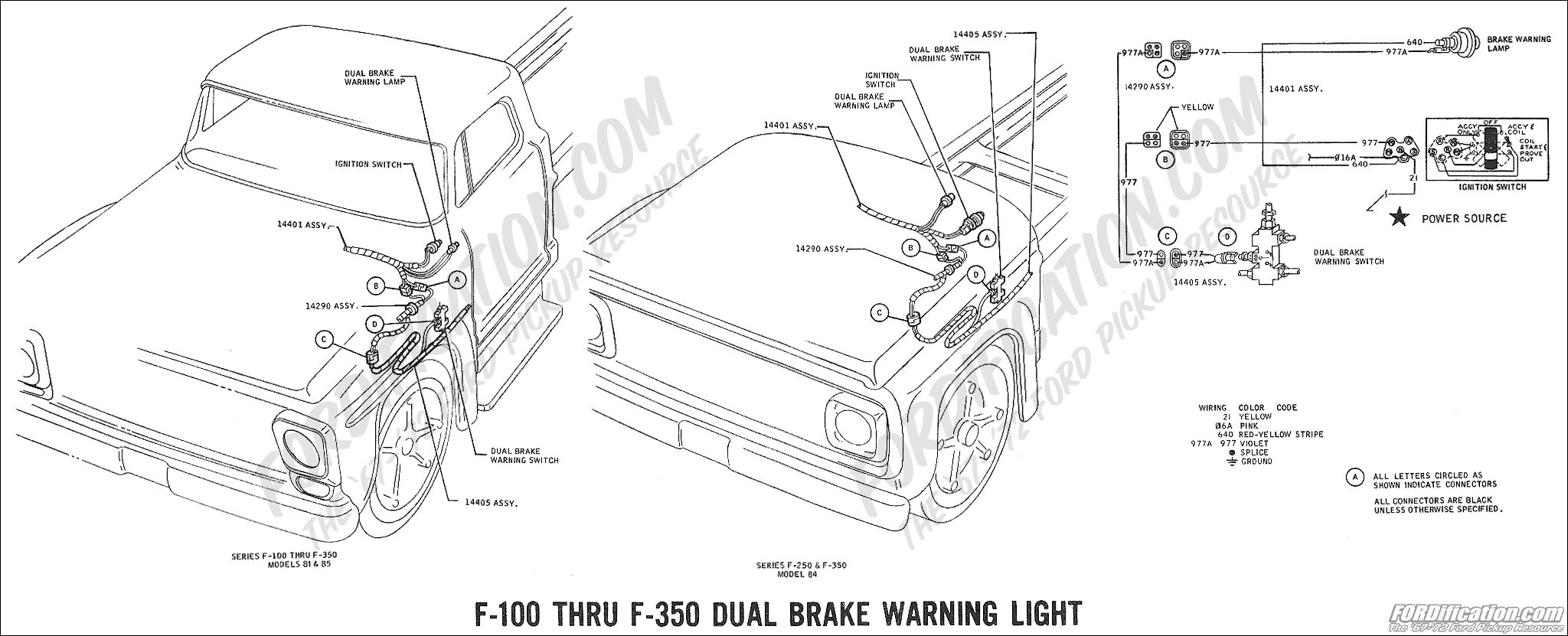
It looks to me like it's the "Dual Brake Warning Light Switch".
This is what alerts the vehicle operator that there has been a failure in brake pressure in one half of the system.
When the hydraulic pressure fails, it allows the pressure on the other side of the switch to move the switch contact so that it grounds out (which completes the circuit so that the warning lamp comes on).
Valves change the direction of fluid flow. This does quite the opposite, it's the fluid flow (as minor as that is) that changes the normally-open switch into the closed position.
I do not see a "proportioning valve" for the 1969 trucks.
This picture will help some:
The illustrations that apply to your vehicle are probably the one on the left and the wiring diagram on the right.
Considering that the front drum brakes were swapped out and disk brakes were installed, you may be asking this circuit to do something that it was never intended for.
It is designed to warn you if half your brakes fail.
A "Proportioning Valve" is intended to provide different amounts of hydraulic fluid to different parts of your brake system.
Disk brake calipers require more fluid than drum brake wheel cylinders; providing identical amounts of fluid to all four cylinders and calipers might mean that the disk brakes never close (or don't close well enough to work). As a result, a Proportioning Valve should allow more hydraulic fluid to flow into the calipers than into the wheel cylinders.
Even if you have disk brakes all the way around, it's still worthwhile to apply hydraulic pressure to the rear calipers before applying pressure to the front calipers; this slight delay assists with fishtailing.
So it seems like you are talking about two different things here.
I can offer one piece of advice: don't try using half of the Warning Switch and half of the Proportioning Valve. You'll likely get failures out of each instead of what you're hoping for. For the Dual Brake Warning Light Switch, it stays off when the hydraulic pressure is equal on opposite sides of the switch; if half that pressure is missing, the warning light will stay on all the time. For the Proportioning Valve, if you let the fluid go out from half of the valve, the rest of the fluid probably wouldn't operate the remainder of the valve. You'd likely get no brakes whatsoever.
Without being sure of myself here, I would suggest that you look at some of the more recent Proportioning Valves. They seem to provide both proportionate pressures and failure warning. I'm not sure which is most appropriate for your situation.
If you are content with the brake warning system, I'd leave that old component in there and fab new lines to match up to it.
If you really want proportionate flow in your braking system, remove the warning switch and replace it with one of the newer proportioning valves that does both. Mount it in the same general area, so that you can use the existing switch wires without lengthening them.
Regardless of which course you choose, make sure you correctly center the warning switch after you've bled out the brake lines. If it isn't centered correctly, it won't work as intended.
One other observation: it looks like you've got six lines and five hydraulic connectors on that switch. I'm guessing that the P.O. left the dry line in place because it was too much trouble to remove it; the implication is that the line was replaced at some point (probably the newer-looking line that goes into the body panel?). As may be: you've probably got one line coming from your Master Cylinder and one line each to Right Front, Left Front, Right Rear and Left Rear brakes. I don't think there is a "T" between this switch and the rear brakes.
And can I use this to change out the m/c that is already in my truck. The one below is ported on both sides. But my question is how can I be sure this has the correct bore size?
Pressure differential valves came into existence in 1967 (on ALL domestically-produced vehicles, when tandem MCs were first mandated by federal law).
'67-'72 Bumpside F100s weren't available with factory front disc brakes. Front disc brakes were only (optionally) available on F250 and F350 trucks beginning in 1968 ('68-'72).
In 1973, all F100 through F350 trucks came standard with factory front disc brakes. Power brakes was optional. The brake valves on these trucks (beginning with the Dentsides) had 3 internal funtions in the brake valve body.
Metering or, 'hold-off', to the front brakes. The brake system had to reach a certain pressure point before the metering valve would open and allow pressure to be applied to the front discs (somewhere likely in the 100 PSI range). This gave the rear drums reaction time to overcome the tension of the retracting springs and start moving the brake shoes towards the friction surfaces of the drums. The momentary delay was designed so that the front and rear brakes would apply at the same time. With no metering (hold-off) delay, the front discs would always be applying instantly and well before the rear drums had time to apply.
There is also a pressure differential valve, contained in the disc/drum brake valve, that works the same as the pressure differential valve on the Bumpsides.
The 3rd function of the disc/drum brake valve is proportioning. Contrary to popular belief, the proportioning valve does not operate every time the brake pedal is applied. In its normal state, and under 'normal' driving conditions, the proportioning valve is normally open. Under normal driving conditions, the pressure applied to the front brakes will be equal to the amount of pressure applied to the rear brakes.
In the case of a 'not normal driving condition' (panic stop), pressure in the brake system will be substantially higher. This pressure acts on annular ends of the proportioning poppet valve, overcomes the tension of the internal coil spring and pushes the proportioning poppet valve over to begin restricting the pressure rise on the rear drums, in proportion to the amount of pressure being applied on the front discs.
I do appreciate all of the history behind the proportioning valve but my question still goes unanswered. Do I/should I replace to old differential valve with the proportioning valve below (the one above had wrong outlet sizes that didn't match the m/c above) for a disc/drum application? I would like to replace all of the old antiquated parts so I have a good baseline on the truck. I have purchased new rotors for the front, new pads, bleeder screws, banjo bolts, hoses for the front, clips, new shoes for the rear, drum rebuild kit, and I have new brake lines as well. I just don't want to miss anything.
I know that I am asking a lot here, believe me. I just want to be sure that I buy the correct parts the first time and not have to deal with the hassle of finding out that I bought the wrong parts then having to return said parts.
Can I change out the m/c to the one above and use the below prop valve with that m/c? Would I need to change out the booster as well or can I leave the one that is on there?
I do appreciate all of the history behind the proportioning valve but my question still goes unanswered. Do I/should I replace to old differential valve with the proportioning valve below (the one above had wrong outlet sizes that didn't match the m/c above) for a disc/drum application? I would like to replace all of the old antiquated parts so I have a good baseline on the truck. I have purchased new rotors for the front, new pads, bleeder screws, banjo bolts, hoses for the front, clips, new shoes for the rear, drum rebuild kit, and I have new brake lines as well. I just don't want to miss anything.
The aftermarket disc/drum brake valve in your photo is a reproduction of a GM valve that was used on some (unkown) General Motors vehicle. I don't know the specs of at what pressure set point the metering valve opens and I don't know what the specs are at what point (PSI) the proportioning valve becomes active or what the percentage of pressure rise is on it (?).
I've seen factory publications of what these specs are for an early T-Bird and an early Mustang but, I've never seen this information for a Dentside truck. However, the Ford engineers designed the brake valves for trucks of given GVW rating and the valves were engineered to work within those parameters --since there are more than one valve design for them.
The pressure differential valve could be deleted and the aftermarket valve could be added in its place. Some correct control in the proper functions of the valve would be better than none.
The pressure differential valve could be deleted and a manually-adjustable proportioning valve could be added. This will do away with the pressure differential valve function (and would also do away with the metering function if it was a Dentside disc/drum brake valve being replaced). The issue then becomes what are you adjusting the proportioning pressure setting to, by turning the ****? Without a set of brake pressure gauges to see this pressure figure, you don't know. --even if you do have a set of pressure gauges, what should the pressure setting be adjusted to since I've never seen the figured published and this figure is unknown?
The MC you have pictured is another reproduction of a GM product. It's a Corvette MC. They come in two bore sizes: 1.00" and 1-1/8". Depending on what booster you use, 1.00" would tend to make the brakes sensitive with a dual diaphragm booster and a 1-1/8" MC on a single diaphragm booster would take a fair amount of leg force to actuate the brakes.
It's your vehicle, your money and your choice what you ultimately do but, since I've done the disc brake/power booster conversion twice on Bumpside F100 trucks, I would recommend a dual diaphragm booster (for a '68-'72 F350), a 1-1/16" bore MC --(conventional style cast iron MC or a 'modern' design MC --your choice) and a disc/drum brake valve from an F100/F150 Dentside through '86 Bullnose truck.
I have a '75 F350 dual diaphragm booster/brackets on my '69 F100 short bed Ranger with '77 F100 front discs/suspension, '84-'86 F150/Bronco disc/drum brake valve and a 'modern' 1-1/16" bore MC for a '95 Ford Explorer. On my friend's '72 F100 long bed Sport Custom, I installed a '72 F350 dual diaphragm booster, '75 F100 front discs/suspension, a disc/drum brake valve from an '82 F100/F150 and a '95 Ford Explorer MC.
It's a proven setup that works exceedingly well and since I posted the information/photos of this combination when I did this conversion on my truck in October, 2014, there have been numerous people on this forum who've also done the same swap on their trucks with exceptional results.
Wow, you do fantastic work. Thank you for all of the recommendations, much appreciated. I just need to figure out where I can get those parts you speak of. I don't have any scrap yards around here to go through.
I know that I am asking a lot here, believe me. I just want to be sure that I buy the correct parts the first time and not have to deal with the hassle of finding out that I bought the wrong parts then having to return said parts.
Can I change out the m/c to the one above and use the below prop valve with that m/c? Would I need to change out the booster as well or can I leave the one that is on there?
"...and a stop light switch built into..." Good LORD! These folks don't know what their product does!
The Dual Brake Warning Lamp does not come on when the brake pedal is pressed! It has NOTHING to do with the "stop lights"! Further, the Dual Brake Warning Lamp Switch cannot cause the brake lights to illuminate. The ONLY bulb it controls is the Brake Warning Lamp.
Even if they have correctly implemented a pressure differential switch, are they really claiming that it only works for the front brakes? They say that the front brakes and the rear brakes are fully isolated from each other. To me, this means that the Brake Warning Lamp cannot be activated by a failure of the pressure in either of the rear brake lines! The protection intended by the Dual Brake Warning Lamp Switch is to warn the vehicle operator that either the front brakes have failed, or the rear brakes have failed. If you change over from the Dual Brake Pressure Warning Lamp Switch to this hybrid of a Proportioning Valve and brake warning switch, you may inadvertently remove half of your safety warning capability.
F100-1969, you'd probably be better off to study ultraranger's thread(s) on his brake swap(s). The answers to your questions are likely there. The thread(s) may not refer specifically to the parts you are considering, but there are bound to be equivalents that will work for you.
For me, I wouldn't put a GM part into my truck without an exhaustive search for the Ford equivalent.
BTW, if you're going to be bending your own brake lines, you should be able to install the flare nuts that you actually need (not necessarily the ones that came with the brake line, or with the MC, etc.)
"...and a stop light switch built into..." Good LORD! These folks don't know what their product does!
The Dual Brake Warning Lamp does not come on when the brake pedal is pressed! It has NOTHING to do with the "stop lights"! Further, the Dual Brake Warning Lamp Switch cannot cause the brake lights to illuminate. The ONLY bulb it controls is the Brake Warning Lamp.
Even if they have correctly implemented a pressure differential switch, are they really claiming that it only works for the front brakes? They say that the front brakes and the rear brakes are fully isolated from each other. To me, this means that the Brake Warning Lamp cannot be activated by a failure of the pressure in either of the rear brake lines! The protection intended by the Dual Brake Warning Lamp Switch is to warn the vehicle operator that either the front brakes have failed, or the rear brakes have failed. If you change over from the Dual Brake Pressure Warning Lamp Switch to this hybrid of a Proportioning Valve and brake warning switch, you may inadvertently remove half of your safety warning capability.
F100-1969, you'd probably be better off to study ultraranger's thread(s) on his brake swap(s). The answers to your questions are likely there. The thread(s) may not refer specifically to the parts you are considering, but there are bound to be equivalents that will work for you.
For me, I wouldn't put a GM part into my truck without an exhaustive search for the Ford equivalent.
BTW, if you're going to be bending your own brake lines, you should be able to install the flare nuts that you actually need (not necessarily the ones that came with the brake line, or with the MC, etc.)
The pressure-activated switch on the Wilwood manually-adjustable proportioning valve is only for the purposes of turning on the brake lights, in the event you don't have a brake light switch that's activated off the brake pedal itself.
The Wilwood valve doesn't have a metering valve circuit in it for the front brakes nor does it have a pressure differential valve function to sense for a balance of pressure between the front and rear brakes. It's a hydraulic manifold to route the front and rear brake circuits through and it has a manually-adjustable proportioning valve for the rear drums. No other brake functions are present in it.
This is why I ask you guys these questions, it's hard to figure out what is needed sometimes without asking people that have "been there and done that". I think that I am going to just go with the combo kit from LMC and call it a day. I'm just going to do away with the brake differential valve and run new lines to this prop valve.
Wow, you do fantastic work. Thank you for all of the recommendations, much appreciated. I just need to figure out where I can get those parts you speak of. I don't have any scrap yards around here to go through.
Thanks. The assembly of the newly rebuilt 240-headed 300 L6 engine I put in my truck was just finished up and fired for the first time yesterday (Saturday).
I can help you with some brake parts numbers of what I have on my truck or what you would need, If you're going the route of what I've done on my truck and on my friend's '72 F100 Sport Custom.
I always recommend getting a new, not rebuilt, MC. --most especially NEVER use a wrecking yard take-off MC. You're just asking for problems if you do, in which case you'll probably get your wish.
The MC I used was a brand new unit for a 1995 Ford Explorer --w/o cruise control, w/o proportioning valve. I bought it through NAPA under part number NMC M3246.
The '95 Explorer MC will require one 10M x 1.0 metric bubble flare fitting and one 12M x 1.0 metric bubble flare fitting. These fittings can be purchased through Classic Tube under part numbers ST8036 and ST8040, repectively. --Some hard line fabrication/flaring will be required using 3/16" brake tubing. No big deal.
The generic part number for the dual diaphragm brake booster is 54-73112. However, this could get you a booster with a long, fixed (non-adjustable) input rod (like is on my '69 F100) or, it could get you one with the adjustable input rod like the booster I installed on the '72 F100. It's a gamble at best.
The '68-'72 F350 dual diaphragm booster, with the adjustable input rod, has an input rod code of "FT8."
To get this specific style dual diaphragm booster, you can contact Prior Automotive in Dallas, Texas. Their part number for the dual diaphragm booster w/adj. FT8 input rod is 3700131.--core charge applies.
If you'e going to use a factory-engineered disc/drum brake valve, you may be able to find an OEM/NOS valve on EBay (like I did on my truck) or, you may have to source one from a donor truck (like the '82 F100/F150 brake valve that's on my friend's '72 F100 --Dentside F100/F150 brake valves would also be a possible source). --used valves have the potential to work or not work. I've had many more take-off valves that worked than those that didn't, since I've done a lot more disc brake conversions on vehicles other than just on old Ford trucks.
If you can't find a donor truck locally for the (core) brake booster and the booster mounting brackets/hard plastic dust boot, I have these items in my spare parts stash I would part with.
The needed mounting brackets and dust boot look like this.
The pressure-activated switch on the Wilwood manually-adjustable proportioning valve is only for the purposes of turning on the brake lights, in the event you don't have a brake light switch that's activated off the brake pedal itself.
So they have completely eliminated the safety warning system that indicates loss of brake pressure? No "Dual Brake Warning Lamp" capability AT ALL?
Rezvani's Latest Post-Apocalytic Monster Is a Ford F-150 Raptor Underneath
Slideshow: Called the Fortress, the 850-horsepower pickup combines Raptor underpinnings with military-inspired features, survival equipment, and a starting price of $285,000.