


Towing hitch help

Thread Starter
|
New User
Joined: Jan 2018
Posts: 4
Likes: 0
 Towing hitch help
My 2015 Ford F150 XLT 2.7 crew cab with tow package have a question. I am going to purchase a 14X7 dual axle cargo trailer with significant modifications to basically make it into a mini travel trailer. It has large AMG batteries located on the tongue, a solar system, water and grey water holding tanks. The estimated hitch weight is just under 400 lbs with a trailer weight of under 4,500 pounds. It comes with a sway control hitch system but not the equalizer bars/trailer brackets. The previous owner has airbags on his Dodge PU due to owning a larger trailer so was not interested or in need of the equalizer system. He did opt for a anti sway bar. I simply want to be safe and not opposed to buying a new complete system but there are so many options out there it gets confusing. I hardly need a 10K system for this small trailer but don't know the consequence of overkill. From some net info they suggest a 600 lb hitch rate with 6K trailer. Hard to understand why these are hard to find and cost more than the large capacity hitch systems. Other than one 2,000 miles journey this summer my use will be seldom and primarily within a few hundred miles. Unfortunately from my home to where I'd go in the summer is up and twisty. As as older senior I prefer not to take chances and want to do it right, with the correct system. Appreciate any tips from our great forum. CJ

Fleet Mechanic


Joined: Dec 2008
Posts: 1,911
Likes: 134
From: Burleson, Tx
My travel trailer is a total of 22' long and 8' wide. Weight is around 4100lbs but I haven't weighed it or gotten the tongue weight. I've pulled this (several times) about 900 miles one way with about 400 of it through the Rockies with a lot of twists and incline/declines and never had an issue without a weight distribution hitch and sway control.
I do not remember what the negatives are of using a system that is rated over what you're towing but I do remember there are some.
Personally I would build the trailer, take it for a test drive to see how it handles then decide from there where you should go with the extras.
I do not remember what the negatives are of using a system that is rated over what you're towing but I do remember there are some.
Personally I would build the trailer, take it for a test drive to see how it handles then decide from there where you should go with the extras.
Thread Starter
|
New User
Joined: Jan 2018
Posts: 4
Likes: 0
Thanks for the personal information on your experience. The Cargo trailer I'm buying already has been converted and I'm sure I'll make some modifications as well. I suspect the distribution of weight will be a significant factor for how it tows down the roadways. And it will become obvious once it's on the hitch as to whether I'll need a system to level things out. The builder is a meticulous chap and the unit was designed for ultimate off grid and off road extended fishing trips. Those large AMG batteries mounted on the front of the hitch are very heavy. The rear of the trailer has a full kitchen set up, fridge, two stoves, sink, flash water heather, and several wooden storage drawers and propane tank. The water and waste tanks are near the axles. As I write this I do realize the issue I've inquired about is basically simple and insignificant on the $ side of a solution. There are perhaps a dozen choices for hitch system, some under $175 complete and others $600 +. I've also found a few on craigs L. some cheap, some very pricey. Unfortunately with a 2015 F150 airbags seem pretty expensive to install and that may be the best solution.
Fleet Mechanic
Joined: Dec 2008
Posts: 1,911
Likes: 134
From: Burleson, Tx
I installed airbags on mine and the cost isn't too bad and I did a set on mine just to keep it level.
I went with this one Air Lift Single Load Controller System that has the Standard Duty Compressor and these bags Air Lift Air Bag Suspension Kit in the Ride Control Rear Leveling variety. Total is about $500 and it took about 3 hours to install it. But if you're having to pay someone to install that's where the cost will add up.
Post some pictures of the trailer, sounds like a really nice setup!!
I went with this one Air Lift Single Load Controller System that has the Standard Duty Compressor and these bags Air Lift Air Bag Suspension Kit in the Ride Control Rear Leveling variety. Total is about $500 and it took about 3 hours to install it. But if you're having to pay someone to install that's where the cost will add up.
Post some pictures of the trailer, sounds like a really nice setup!!

Lead Driver

Joined: Jun 2005
Posts: 8,465
Likes: 725
From: Calgary Canada
Just want to point out three things.
1) take the while combination to a cat scale when it's fully loaded so you know the real weights. People seem terrible at estimating these.
2) you are close to the point where ford says a weight distribution hitch is mandatory.
3) weight distribution hitch does a lot more than help reduce rear end squat. Far more important for safety is putting weight back onto the steering axle of the truck, which makes braking and steering much safer.
I always cringe when someone is choosing between airbags and a wdh. Neither one is a good substitute for the other IMO.
Happy towing.
1) take the while combination to a cat scale when it's fully loaded so you know the real weights. People seem terrible at estimating these.
2) you are close to the point where ford says a weight distribution hitch is mandatory.
3) weight distribution hitch does a lot more than help reduce rear end squat. Far more important for safety is putting weight back onto the steering axle of the truck, which makes braking and steering much safer.
I always cringe when someone is choosing between airbags and a wdh. Neither one is a good substitute for the other IMO.
Happy towing.
Fleet Mechanic
Joined: Dec 2008
Posts: 1,911
Likes: 134
From: Burleson, Tx
Totally agree and I hope it wasn't take that I was saying to do bags to take the place of the WDH. They definitely do different things.

Lead Driver

Joined: May 2015
Posts: 5,881
Likes: 359
From: Mts. S. of San Francisco
Our TT is about the same size, and just a tad lighter (tongue weight of about 400 lbs). We've been using an E2 WDH on it, which uses trunnion bars (no chains). The trunnion bars rest on a couple of L brackets, which provides a very mild anti-sway function.
So I don't think the anti-sway of this hitch is significant, and the main function is to transfer a portion of the tongue weight forward to the front wheels. We've towed this trailer all over California, including up and down winding mountain roads, and have had exactly zero sway or control problems.
So I don't think the anti-sway of this hitch is significant, and the main function is to transfer a portion of the tongue weight forward to the front wheels. We've towed this trailer all over California, including up and down winding mountain roads, and have had exactly zero sway or control problems.
Trending Topics
Laughing Gas
Joined: Mar 2004
Posts: 1,019
Likes: 6
From: Fountain Valley
My trailer is right at 8000#, I had 2000 pound Air-Lift bags on my 2013 and removed them I'll install them on my 18 when I get the frame brackets as all the rest is the same. I filled them at the license plate area to keep the costs down. I also use an equal lift hitch and a slider stabilizer and would not be without it and both trucks had sway control. I never had a tongue weight problem with a F-250 but the 150 is different.
Put 6 90 pound sacks of cement at the rear of your bed and see what happens.
Good luck.
Put 6 90 pound sacks of cement at the rear of your bed and see what happens.
Good luck.
FTE Stories
Ford Trucks for Ford Truck Enthusiasts

Top 10 Most Expensive Ford Trucks Ever Sold on Bring a Trailer
Joe Kucinski
2027 Ford Super Duty Buyer's Guide (Every Model, Engine, & Package)
Brett Foote
Top 10 Ford Truck Tragedies
Joe Kucinski
AEV FXL Super Duty - the Super Duty Raptor Ford Doesn't Make
Brett Foote
Lobo Vs Lobo: Proof the F-150 Lobo Should Be Even Lower!
Michael S. Palmer
Ford's 2001 Explorer Sportsman Concept Looks For a New Home
Verdad Gallardo
10 Best Ford Truck Engines We Miss the Most!
Joe Kucinski
2026 Shelby F-150 Off-Road: Better Than a Raptor R?
Brett Foote
2027 Super Duty Carhartt Package First Look: 12 Things You NEED to Know!
Michael S. Palmer
Laughing Gas
Joined: Apr 2017
Posts: 941
Likes: 25
From: Port huron MI
A WDH with too high of a rating will be very stiff, and can cause ride/ stability issues. All the hitches have a range, you want to be in the middle of it. Most importantly get your loaded weights from a scale, Then go to etrailer.com and use the drill downs to find a hitch in your weight range. They are normally fairly competitively priced but you can shop around. If you really only have 400 lb of tongue weight you wont need airbags unless you are loading the bed too. I have right around 1k lb tongue weight and it sits level when loaded.
Thread Starter
|
New User
Joined: Jan 2018
Posts: 4
Likes: 0
 Towing, hitches, airbags
I appreciate the replies to my original post. The converted cargo trailer is 14'X7'- total weight about 4K and estimated tongue weight 375lbs. On the front of the hitch is mounted a box holding 2 large AGM batteries which is the primary reason the tongue weight is what it is. I'll be putting perhaps 100lbs in the bed of the truck behind the axle (2wheel dr.) So far I've reviewed about a half dozen hitch systems as well as info on airbags. E-trailer has a very good article on choosing the right size hitch. Of interest is that that article suggests that many buyers of an RV feel they may upgrade and want to get a heavier duty hitch than needed in anticipation it might be needed later. The downside is that the ride quality suffers. Airbags work to level the truck but do nothing to transfer weight to the front wheels, and that effects steering and tire wear issues. The newer two or four point equalizer systems with sway control work best for trailers 24' long and longer. My conclusion is that I've learned enough to roll with option 1 and that's to just tow the trailer without a special hitch. The trailer is about 7' high and I'm pretty sure the weight is fairly even front to back; it also has dual axles and on a 14' trailer that would seem to suggest stability. Option 2. will be the less expensive, older type simple chain and bar equalizer if I determine sag in the rear end. I see these pop up on CL although most are for much larger trailers. I'll post an update once I tow this modified cargo trailer. Thanks again, I appreciate having a forum like this to exchange info.
Lead Driver
Joined: May 2015
Posts: 5,881
Likes: 359
From: Mts. S. of San Francisco
Thanks for the update. Hope everything works well for you. You probably will be OK. My experience is that an F-150 with the standard towing package (not the HDTP) will handle up to about 500 lb tongue weight (and associated trailer) without much of any assistance in the form of a WDH or anti-sway.
Of course, YMMV, and you will be the final judge of what you actually need. A trailer with a lot of frontal area and/or cross-wind profile might alter the equation a bit.
Of course, YMMV, and you will be the final judge of what you actually need. A trailer with a lot of frontal area and/or cross-wind profile might alter the equation a bit.
Laughing Gas
Joined: Apr 2017
Posts: 941
Likes: 25
From: Port huron MI
I'll put the flame suit on, I have had great luck with the harbor freight WDH over the last 7 years and you can get it under $200. Down side is its rated for 1k/10k.anything behind the axle is tongue weight so depending on how you pack you could be higher then you expect. It may pull fine now but you need to plan for emergency maneuvers and unexpected wind too.
Thread Starter
|
New User
Joined: Jan 2018
Posts: 4
Likes: 0
Cargo trailer hooked up to 2015 Ford F150
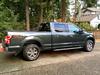
I thank those that replied to my post on equalizer hitches. The more I review the choices the better the variety of opinions and cautions. On a RV help sight the moderator makes a good point: people generally favor what they already have. In any event I have hooked the modified cargo trailer up to the truck. The trailer is a tandem (dexter) axle 7X15 with an estimated weight of just under 4,000 lbs and a hitch weight of about 400. I'm including some items I'll place in the bed towards the tailgate which is the favored way to estimate tongue weight. My F150 has the tow package, it's a 2wheel dr. XLT crew cab. When measuring for rear drop most suggest you put what you'd expect to have in the front (like two people or for us two near 300 including the pooch.
I attached the trailer to a 4" drop hitch that came with the trailer. On flat land and the trailer pretty loaded up for use I did my measuring without passengers in the front. I did not do any measuring on the truck when it was unattached but will do so once I park and store the trailer. Visually the set up looks pretty level; using a level I found the tongue on the trailer slight point toward the ground; I have a hard cover over the bed it was level. I took measurement from the center of both front and rear wheels from the pavement to the wheel well. While nearly on a level street there was only 1/8" difference from one side to the other (dr. to passenger). from back to front there was 3/4" difference with the rear that much lower. I did a very short around the block test drive; no surprises.
One caution I had about an equalizer hitch are the bars than can scrape the pavement. My cargo trailer hitch sits just 14 1/4" off the pavement. Depending on the hitch style (round vs sq. bars) and the cleats attached to the trailer frame many hitches may drag the bars. The hitch on the truck & trailer frame is equipped to add a stabilizer bar which seller included. Unless I'm a longer trip at freeway speeds I don't think for this size trailer it's needed. My only concern, and I may learn this soon is the weight on the rear will potentially impact steering. I see many open bed & cargo trailer in my area, mostly yard guys and general contractors with a variety of trailers hauling stuff to equal around 4,000 lbs and not one has a special hitch set up. I'll test the truck without a system and go from there.
I attached the trailer to a 4" drop hitch that came with the trailer. On flat land and the trailer pretty loaded up for use I did my measuring without passengers in the front. I did not do any measuring on the truck when it was unattached but will do so once I park and store the trailer. Visually the set up looks pretty level; using a level I found the tongue on the trailer slight point toward the ground; I have a hard cover over the bed it was level. I took measurement from the center of both front and rear wheels from the pavement to the wheel well. While nearly on a level street there was only 1/8" difference from one side to the other (dr. to passenger). from back to front there was 3/4" difference with the rear that much lower. I did a very short around the block test drive; no surprises.
One caution I had about an equalizer hitch are the bars than can scrape the pavement. My cargo trailer hitch sits just 14 1/4" off the pavement. Depending on the hitch style (round vs sq. bars) and the cleats attached to the trailer frame many hitches may drag the bars. The hitch on the truck & trailer frame is equipped to add a stabilizer bar which seller included. Unless I'm a longer trip at freeway speeds I don't think for this size trailer it's needed. My only concern, and I may learn this soon is the weight on the rear will potentially impact steering. I see many open bed & cargo trailer in my area, mostly yard guys and general contractors with a variety of trailers hauling stuff to equal around 4,000 lbs and not one has a special hitch set up. I'll test the truck without a system and go from there.

Postmaster
Joined: Feb 2014
Posts: 4,735
Likes: 1
From: Hattiesburg, Ms.
Just want to point out three things.
1) take the while combination to a cat scale when it's fully loaded so you know the real weights. People seem terrible at estimating these.
2) you are close to the point where ford says a weight distribution hitch is mandatory.
3) weight distribution hitch does a lot more than help reduce rear end squat. Far more important for safety is putting weight back onto the steering axle of the truck, which makes braking and steering much safer.
I always cringe when someone is choosing between airbags and a wdh. Neither one is a good substitute for the other IMO.
Happy towing.
1) take the while combination to a cat scale when it's fully loaded so you know the real weights. People seem terrible at estimating these.
2) you are close to the point where ford says a weight distribution hitch is mandatory.
3) weight distribution hitch does a lot more than help reduce rear end squat. Far more important for safety is putting weight back onto the steering axle of the truck, which makes braking and steering much safer.
I always cringe when someone is choosing between airbags and a wdh. Neither one is a good substitute for the other IMO.
Happy towing.
My particular truck is good for 500 tongue weigh and 5,000 trailer weight, anything above requires a WDH.
Andersen makes a fairly easy WDH, easy setup and easy to swap from trailer to trailer, and uses a chain system in lieu of the bars.
I still like air bags, but they’re no substitute for a well sorted WDH. I used to just hook up and go, but I’m older and I hope wiser and hate the ole “tail wagging the dog” effect....LOL

Thread
Thread Starter
Forum
Replies
Last Post