



Random Misfire

Thread Starter
|
Freshman User
Joined: Dec 2011
Posts: 47
Likes: 0
From: Boise
Random Misfire
I have searched, but can never articulate my issue well enough to find what I need... So sorry if this was an easily searchable problem. A couple months ago my truck jumped a tooth on the old timing gear. I replaced the timing set, making sure the notches were aligned, and the rotor was pointed at cyl. 1 when at 0º. It started and ran, and I drove it to work (35 miles round trip) and it seemed fine. I drove it two days later to my mom's to blow out her sprinklers, and I noticed an irregular idle and a random miss while driving. Didn't matter the gear either. Messed with the timing a little to get it home and the issue was still there but it never died or anything. Set the timing with my light to about 12-15º (need tape, marks are getting hard to read) and it seemed ok. Went to drive it to work again the other day and it idled weird. Figured it was the cold and started driving after letting it warm up a bit. It was missing in second and third both (first being granny), so I circle my neighborhood. After a lot of missing, and one big backfire, I parked it.
So today, I mess with timing, go through some threads on setting the carb mixture the correct way, and it sounds great, except for the random miss. Maybe every 6-8 seconds. While it's running, I put the light back on it and just let it sit, so I can see if the timing is wandering. Well, I noticed the light would cut out when the engine would miss. So from what I gather, it's a spark issue.
I replaced the coil a few months ago (also tried my old one), replaced the points and condenser, set them per my manual, My cap, rotor, and plugs are a few years old, but don't have more than 1,000 miles on them.
Anyone have any avenues to pursue? I'm no pro at this stuff but am figuring it out, but this has me stumped. I am greatly appreciative of this forum and the help I've gotten, and would like to say thanks in advance!
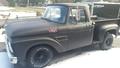
Truck is a 1965 F100, with 352 (I'm fairly sure), and a stock 2bbl carb. No mods, fuel pump is less than a year old, filter is new.
So today, I mess with timing, go through some threads on setting the carb mixture the correct way, and it sounds great, except for the random miss. Maybe every 6-8 seconds. While it's running, I put the light back on it and just let it sit, so I can see if the timing is wandering. Well, I noticed the light would cut out when the engine would miss. So from what I gather, it's a spark issue.
I replaced the coil a few months ago (also tried my old one), replaced the points and condenser, set them per my manual, My cap, rotor, and plugs are a few years old, but don't have more than 1,000 miles on them.
Anyone have any avenues to pursue? I'm no pro at this stuff but am figuring it out, but this has me stumped. I am greatly appreciative of this forum and the help I've gotten, and would like to say thanks in advance!
Truck is a 1965 F100, with 352 (I'm fairly sure), and a stock 2bbl carb. No mods, fuel pump is less than a year old, filter is new.
Last edited by SapperJoe; Oct 22, 2017 at 07:16 PM. Reason: Forgot vehicle specs

Post Fiend
Joined: Apr 2002
Posts: 19,311
Likes: 97
From: Waterloo, Iowa
First thing put the old condenser back in, just for test purposes. See this all the time. There's nothing really wrong with points and condenser but they have to be made of good stuff. When all cars and trucks had them they were made right. The replacement points and condenser from overseas today are trash and will not work. There's still lots of good NOS Autolite or Echlin points and condenser still available for not too much money.
Thread Starter
|
Freshman User
Joined: Dec 2011
Posts: 47
Likes: 0
From: Boise
I'll swap the old one back in tonight and let you know! I hadn't even thought to try that. I replaced them as a maintenance thing when I replaced my timing set, since I had never done it and the points looked pretty worn. Thanks for the suggestion!
Post Fiend
Joined: Apr 2002
Posts: 19,311
Likes: 97
From: Waterloo, Iowa
Well that's the sad thing, some of the replacement parts available today are worse than what we're throwing away. Not saying this will fix your problem, but it's the first thing to check whenever we hear "replaced condenser" and it's running like crap. Quality contact points were made with tungsten and had phenolic rubbing block, not melted down beer cans and recycled milk jugs. Should last 8k to 10k miles. Condensers even longer.
Mountain Pass
Joined: Jul 2017
Posts: 169
Likes: 5
From: Ahwatukee
I go along with Tedster9. My Galaxie started having weird problems shortly after a tune up, got worse and worse over several days. It turned out the new points were actually falling apart at the rivet(?!).
Pertronix is your friend!
Pertronix is your friend!
Post Fiend
Joined: Apr 2002
Posts: 19,311
Likes: 97
From: Waterloo, Iowa
Trending Topics

Fleet Mechanic
Joined: Aug 2016
Posts: 1,480
Likes: 6
From: Great White North
Check your plug wires at night in the dark and see if you are getting lightning under the hood.
FTE Stories
Ford Trucks for Ford Truck Enthusiasts

Top 10 Fords at 2026 Carlisle Ford Nationals
Joe Kucinski
3 Best / 3 Worst Parts of Modern Ford Ownership
Brett Foote
10 Amazing Upgrades That Solve Common Ford Truck Owner Headaches
Pouria Savadkouei
Every 2026 Ford Engine Explained
Brett Foote
10 Ugly Ford Trucks That We Still Kinda Love
Joe Kucinski
10 Things Every Truck Owner NEEDS (2026 Edition)
Michael S. Palmer
Rezvani's Latest Post-Apocalyptic Monster Is a Ford F-150 Raptor Underneath
Verdad Gallardo
Top 10 Most Expensive Ford Trucks Ever Sold on Bring a Trailer
Joe Kucinski
2027 Ford Super Duty Buyer's Guide (Every Model, Engine, & Package)
Brett Foote
Thread Starter
|
Freshman User
Joined: Dec 2011
Posts: 47
Likes: 0
From: Boise
I swapped my old condenser back in last night. It started up and sounded good for about a minute. It then started to stumble for 10-20 seconds until it died. I couldn't get it started again. It acted like it did when I jumped a tooth on my timing gear. As I was messing with it I had the loudest backfire that truck has made, and my neighbor came over. We messed with it more and decided my distributor cap is too loose. I bought a new cap and rotor, made sure I was at 0º when the rotor is at cyl. 1, and tried it again. I managed to get it running again, but this time it was really rough. After toying with the timing (advancing it from 0º) it ran a little better but was still rough. By this time it was pretty dark, and I was annoyed, so I gave up. I did look for any kind of arcing on my plug wires (or anything else for that matter) and didn't see anything.
Tonight I will set my timing again, make sure everything is as it should be and see if I can get any results.
Questions:
My neighbor mentioned the advance in the distributor could be binding up, but I know nothing about the inner workings of those things. It appears to be the original distributor (can't remember PN, but I think it started with C5--), and the inside, while not dirty, looks lightly corroded (corroded could be the wrong word). Could this be giving me these symptoms? Does anyone have the proper procedure for setting timing? I remember seeing a thread a few weeks back and can't find it again. Do these hard vacuum lines get plugged up very easily?
Thanks again!
Tonight I will set my timing again, make sure everything is as it should be and see if I can get any results.
Questions:
My neighbor mentioned the advance in the distributor could be binding up, but I know nothing about the inner workings of those things. It appears to be the original distributor (can't remember PN, but I think it started with C5--), and the inside, while not dirty, looks lightly corroded (corroded could be the wrong word). Could this be giving me these symptoms? Does anyone have the proper procedure for setting timing? I remember seeing a thread a few weeks back and can't find it again. Do these hard vacuum lines get plugged up very easily?
Thanks again!

Lead Driver


Joined: Aug 2003
Posts: 6,305
Likes: 18
From: Boulder Creek, Ca

If all else fails, and just a thought, see if able to isolate to a specific cylinder? I have used a hose but have since purchased a cheap automotive stethoscope. Suggest check each cylinder for possible faulty ignition, an adjustment, or faulty lifter? Last wire change found 1 of the newly purchased set of quality plug wires was missing the electrode that attaches to the spark plug. Also, just as a reminder, in re-setting the timing one should check idol mixture and vise versa.
RangerMercMan's suggestion possibly quick solution.
RangerMercMan's suggestion possibly quick solution.
Post Fiend
Joined: Apr 2002
Posts: 19,311
Likes: 97
From: Waterloo, Iowa
Can be frustrating but you're making progress. There's more to ignition timing than just setting the distributor. In fact that's not really all that important in a lot of ways. What really counts is the total centrifugal advance, governed inside the distributor. If the advance plate or weights &c are sticky or erratic, excessively worn etc it will never run right, the distributor is the heart of the engine. Maybe something else is going on here causing the trouble but it should be looked at.
It can be checked with a timing light by spooling up the engine RPM to 3000+ and see exactly where it tops out at. The marks on the damper should move smoothly up and down the damper marks without scatter or sticking, back to the same base setting. This is always checked with the vacuum advance disconnected and plugged. Most V8 are going to run best around 32° to 38° depending on compression ratio, camshaft, elevation, fuel quality. If you check this with the vacuum advance connected it's going to give kind of a false reading, as it will pull more timing in, close to 50° BTDC, because there's no load on the engine in neutral. Here's a website page that really helps break it down on what to check and how to do it: http://gofastforless.com/ignition/advance.htm
It can be checked with a timing light by spooling up the engine RPM to 3000+ and see exactly where it tops out at. The marks on the damper should move smoothly up and down the damper marks without scatter or sticking, back to the same base setting. This is always checked with the vacuum advance disconnected and plugged. Most V8 are going to run best around 32° to 38° depending on compression ratio, camshaft, elevation, fuel quality. If you check this with the vacuum advance connected it's going to give kind of a false reading, as it will pull more timing in, close to 50° BTDC, because there's no load on the engine in neutral. Here's a website page that really helps break it down on what to check and how to do it: http://gofastforless.com/ignition/advance.htm

Cargo Master
Joined: Oct 2005
Posts: 2,084
Likes: 94
From: Stanton, Michigan, USA
SapperJoe,
If you have a Ohm/Volt Meter (OVM), you can remove each sparkplug wire and check the resistance within it by using the Ohms setting. Here is a good explanation on the subject: Spark Plug Ignition Wire Sets - The Classic Preservation Coalition
More info on using the proper sparkplug wires: http://www.auroraelectronics.com/Und...ug%20Wires.htm
BarnieTrk
If you have a Ohm/Volt Meter (OVM), you can remove each sparkplug wire and check the resistance within it by using the Ohms setting. Here is a good explanation on the subject: Spark Plug Ignition Wire Sets - The Classic Preservation Coalition
More info on using the proper sparkplug wires: http://www.auroraelectronics.com/Und...ug%20Wires.htm
BarnieTrk
Post Fiend
Joined: Apr 2002
Posts: 19,311
Likes: 97
From: Waterloo, Iowa
I like the idea of checking under the hood at night for arcing across plug wires to ground, or maybe check distributor cap carefully for cracks or carbon trail. Possibly a bad plug, etc. Let us know what you find.


Cargo Master
Joined: Oct 2005
Posts: 2,084
Likes: 94
From: Stanton, Michigan, USA
BarnieTrk
