When you click on links to various merchants on this site and make a purchase, this can result in this site earning a commission. Affiliate programs and affiliations include, but are not limited to, the eBay Partner Network.
Things are moving along in my build and of course each time I think my major purchases are behind me, more parts crop up. I thought I'd ask for leads on used parts on this list as I don't believe any are made as repro parts:
1952 F1
I believe the name here is engine splash guard. The shape here appears to be specific to the 215 6 cylinder b/c the one on Dennis Carpenter is different.
Your first rusted part is Pan (Engine Dust), 2C 6775-A. It was originally for 1952s only (both V8 and I6), then in later Chassis Catalogs and OSI books replaced the 1948-1951 versions 7RC 6775-A and 7RC 6775-B. These earlier pans differed from each other depending on which breather tube was fitted. The OSI books substituted the 2C 6775-A for both of the earlier parts. These parts vanished entirely from the 1964 reprint version of the 1948-1956 Chassis Catalog.
The fender splash guards I'm less sure of part numbers for. I believe they are in groups 16412 and 16413, but I can't find a clear catalog diagram showing them.
None of these are reproduced but can be found on eBay if no member offers good used pieces. Stu
Have plenty of splash guards here if you are interested . All have been media blasted & epoxy primed .AS for the engine splash pan sounds like some quality man time in the bone yard is near .
Thanks for all the feedback. First rider, I've sent a PM.
Let's add one more piece to my list. My guy thinks this ornament is beyond repair. One stud is shorn off and he thinks not enough left to chrome it. Any of these lying around?
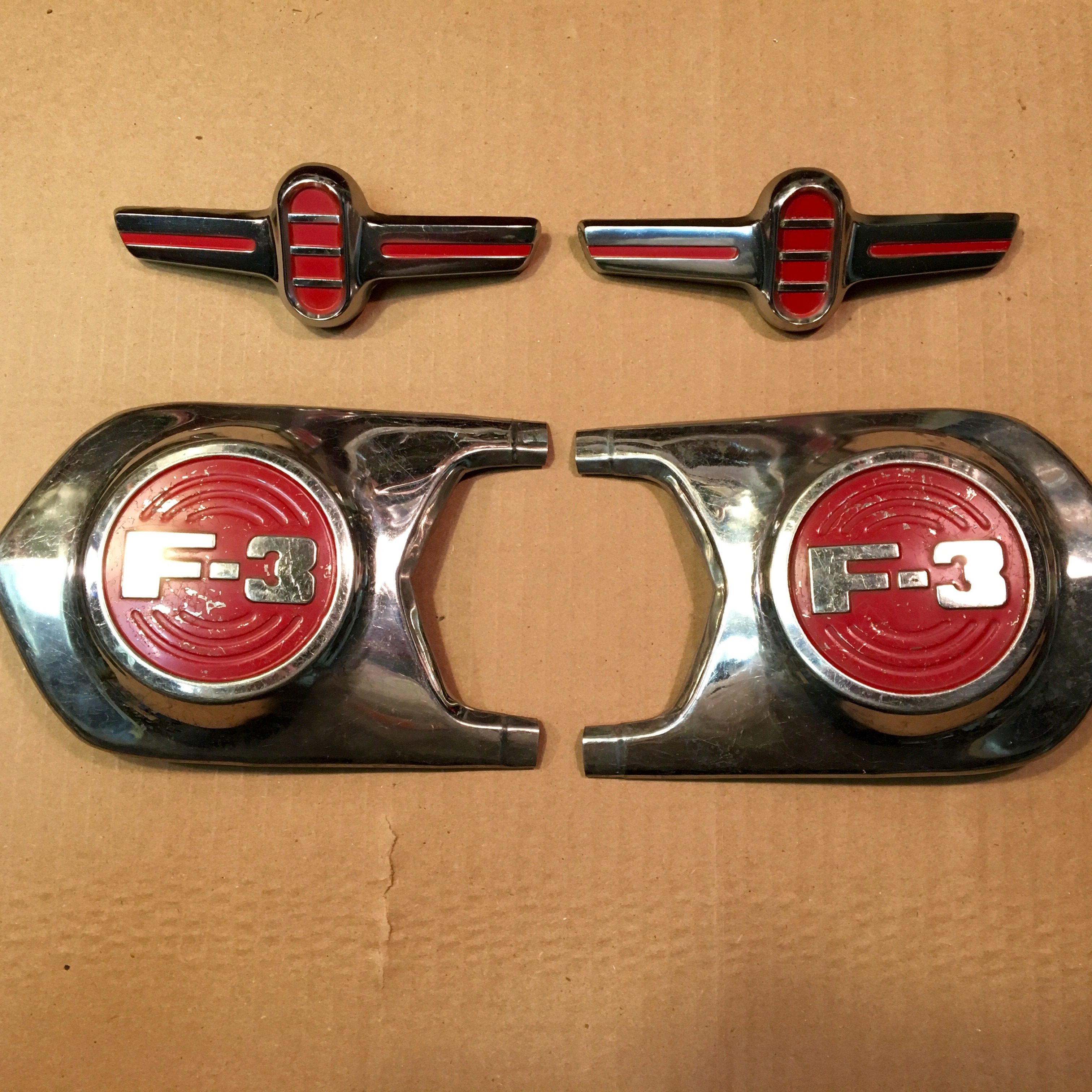
You mean like these? Not for sale. I'd suggest you watch eBay, and go to the big swap meets. And expect to spend. On one of these (the second one found on eBay after a tip from Chuck) I got lucky and bought it cheap. The first one I swallowed hard and gave the man his $150. Stu
Stu, do you think your emblems are stock? I was thinking they were painted the same color as the body. Mine does not seem to be chrome--more like pot metal--and it was certainly painted Navy gray--with a brush too like the rest of my truck.
It's 1952 only and used only on the 215 trucks. (Edit - used also on the 1952 w/ 254 big 6). The 1951 hood nose was chromed pot metal and was used on both 239 V8 and 226 I6. The 1951 had the V8 badge on the latch panel while the 226 (and 254) got no badge. Stu
Thanks Stu. I really like your emblems. I never imagined that mine was ever that fancy. I cleaned mine up, and I think it will look alright painted, but still nothing like yours. Maybe someday I'll have to look into chrome plating mine. I wasn't sure you could do that with "white" metal or whatever mine is made of.
Yeah, my original one looked like Wallace's, broken stud and all. I tried to use JB Weld to rescue it but it wasn't right. So the quest for NOS was on. I had thought about using some of the chrome paint that is now available from places like House of Color, but fixing the stud was the issue.
That reproduction pan in the LMC catalog is in the Carpenter catalog too. No clue where LMC came up with their phonie number. Carpenter lists it under the 7RC 6775-A having no hole for the breather tube. Stu
Yeah, Dennis Carpenter makes the same mistake. That pan can physically be mounted under a 1952 V8 truck, but it won't fit correctly and looks like heck. It won't fit a 215 six cylinder at all because it's too shallow to clear the oil pan.
Notice there are two small cut out areas on the leading edge of WallaceSF's old pan. There are also similar cut outs on the front edge of the earlier and repop pans, but they are more widely spaced. Those cut outs fit around frame rivets and allow the pans to fit flush up against the frame. A 1952 frame has different motor mount diagonals than the 1948-1951s, which is the reason Ford created the 2C 6775-A replacement pan.
Seems odd to me that the older style is being repop'd instead of its Ford replacement. This is also one of the better examples that shows the value of using the old parts books instead of the reprint or CD parts catalog that is totally silent to these parts. Stu