When you click on links to various merchants on this site and make a purchase, this can result in this site earning a commission. Affiliate programs and affiliations include, but are not limited to, the eBay Partner Network.
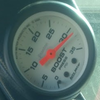
I have two issues with the ISSPRO boost gauge I have; 1) it goes to 40psi 2) The needle movement is stepped and irregular because it is not a mechanical gauge.
Number 1 is on me as I didn't think I'd buy a 38R at the time which needs a higher upper limit. Number 2 is a common "feature" of an electronic gauge that uses a signal generator.
I did some searching and decided to go with a Hewitt 0-50psi mechanical gauge. It has LED lighting so I ordered green not expecting it to match the ISSPRO. Note that Hewitt makes a dual gauge for boost and others inputs as well.
I rec'd the gauge and installed it today. It is a heavier and seemingly better built gauge although not programmable which isn't an issue to me for boost. I like the fittings and larger tubing (1/8") it came with. The gauge is a slightly larger diameter so little clearance of the gauge hole is needed but not much.
The results are that the needle moves very smooth and consistently and I'm sure it's more accurate. The lighting doesn't match the ISSPRO gauges very well-win some loose some. It matches well enough to not stand out though and in sunlight, is a very close match to ISSPRO in my limited aesthetic interpretation.
All in all, I'm happy with it.
Not dark enough to compare but the green on the ISSPRO is a darker shade.
The 38R and injectors I run hit 40psi so I wanted a 50psi gauge so that I could see what the boost is topping out at. Granted, not the case when towing, but it is with the street tune. The more significant issue for me was the gauge needle movement and accuracy inherent with mechanical gauges.
I see, makes sense now. I have the ISSPro EV2 0-40 gauge like you had, and plan to go with 160/80 injectors and a KC38R one day, so I wanted to see what you were hitting for boost because I thought the 0-40 was the right choice at the time of purchase.
The recommended boost limit from Garrett for the 38R is 40psi so having a gauge top out at 40 isn't ideal. I don't know if the KC turbo has the same range. Also, you don't want to be above 40psi with stock headbolts so I want to ensure I'm not exceeding 40 as well. I find it comforting to see the mechanical gauge respond as I expect and not exhibit the stepped movement from the signal generator which seems to move in 2psi increments.
SRBF150, I tried to rep you, but apparently I've repped you too recently before. Someone else please rep him for me, as he brings up three useful bits of information with respect to gauges:
1) Provided a relatively unheard of gauge supplier alternative to ISSPRO (which has a searchable history of faults that echo SRBF150's reported experience), that isn't Autometer (unmatched reputation for reliability), and isn't Glowshift (unmatched reputation for a lack of reliability).
2) Provided anecdotal insight in the reaction difference between a real mechanically sensing boost gauge versus an electronic stepper.
3) Provided an instrumentation tip: That gauges of all types are generally more accurate in the MIDDLE of their range, and less accurate at either end of their range scales. Hence, if your rig regularly sees more than 36 psi, a gauge that reads higher than 40 psi might be more accurate than a gauge the reads just to 40 psi, because the best practice is to discount the accuracy of the upper and lower 10% of the range scale of the gauge.
In my case, I think a 40 psi boost gauge will be plenty for the type of boost that I would ever expect to see. But the point about gauge accuracy being best in the middle of the scale is well taken. Reps intended!
SRBF150, I tried to rep you, but apparently I've repped you too recently before. Someone else please rep him for me, as he brings up three useful bits of information with respect to gauges:
I've been wanting to try the Hewitt dual gauge to compare boost and drive pressures. A friend of mine put one in his 7.3 with a Borg Warner 366sxe and holds 1:1 ratio up to 42psi.
I've been wanting to try the Hewitt dual gauge to compare boost and drive pressures. A friend of mine put one in his 7.3
Whoa... a slew of questions filled my mind when reading this...
Where did your friend mount his "drive pressure" gauge? In the cab?
How did he keep the extreme heat from the exhaust cool enough to pipe to a mechanical gauge inside the cab? Obviously, the plastic or nylon tubing supplied with the gauge would melt, so what did he use?
If he used coiled copper or stainless steel tubing, how long of a coil was necessary to cool the gasses enough to send to the gauge? Where was the coil mounted to keep it from burning other stuff on top of the engine, and how was it secured?
Where was the exhaust system tapped to thread the sensor to read the "drive" pressure?
How does he keep the sensor, and the tubing, from clogging with soot, and eventually providing a false reading?
If "drive" pressure is considered anywhere between the exhaust manifold and the exhaust "driven" turbine, and your friend mounted the pressure sensor in either the exhaust manifold or the up pipe, would it make any difference? Would the pressure be the same in either the exhaust manifold or the uppipe leading to the turbo, as the first restriction in that stream would be the turbine itself?
If so, then how would an aftermarket "drive pressure" sensor differ in any respect from the exhaust pressure sensor that Navistar already installs on the engine in the passenger side exhaust manifold?
What need is there then, for an additional gauge, when the exhaust pressure is readable from the PCM through the data link port via any Forscan, TorquePro, ScanGauge, AeroForce, Infinity, NGauge, or similar PID reading device?
Not trying to challenge your friend's set up... I'm just trying to understand what your friend did, that wasn't already done by International when the engine was built? And, what data is your friend is getting, that isn't already available through the existing OEM sensor?
Whoa... a slew of questions filled my mind when reading this...
Where did your friend mount his "drive pressure" gauge? In the cab?
Yes, in the dash
How did he keep the extreme heat from the exhaust cool enough to pipe to a mechanical gauge inside the cab? Obviously, the plastic or nylon tubing supplied with the gauge would melt, so what did he use?
He pulled his Ebp sensor and plumbed it to the ebp tube with a snubber hose and inline filter
If he used coiled copper or stainless steel tubing, how long of a coil was necessary to cool the gasses enough to send to the gauge? Where was the coil mounted to keep it from burning other stuff on top of the engine, and how was it secured?
Just the EBP tube is enough to dissipate the heat.
Where was the exhaust system tapped to thread the sensor to read the "drive" pressure?
Stock EBP sensor location.
How does he keep the sensor, and the tubing, from clogging with soot, and eventually providing a false reading?
You'll need a snubber to smooth out the exhaust pulses and an inline dryer/filter to keep the soot and moisture out of the gauge.
If "drive" pressure is considered anywhere between the exhaust manifold and the exhaust "driven" turbine, and your friend mounted the pressure sensor in either the exhaust manifold or the up pipe, would it make any difference? Would the pressure be the same in either the exhaust manifold or the uppipe leading to the turbo, as the first restriction in that stream would be the turbine itself?
If so, then how would an aftermarket "drive pressure" sensor differ in any respect from the exhaust pressure sensor that Navistar already installs on the engine in the passenger side exhaust manifold?
Same reason we run a boost gauge, even though the MAP sensor provides the same data.
The stock EBP sensor only reads up to 50psia which is only 35psig at sea level. I max out around 45psi boost, so I'm well beyond the limits of both MAP and EBP sensors.
What need is there then, for an additional gauge, when the exhaust pressure is readable from the PCM through the data link port via any Forscan, TorquePro, ScanGauge, AeroForce, Infinity, NGauge, or similar PID reading device?
Not trying to challenge your friend's set up... I'm just trying to understand what your friend did, that wasn't already done by International when the engine was built? And, what data is your friend is getting, that isn't already available through the existing OEM sensor?
Hopefully I've answered all of your questions. Here's a video of a 50-100mph run. It's shakey and I don't think he had the snubber installed yet. The red needle is boost and green is EBP (I would've done the opposite). You can see the 2 needles stay together until 40psi, then drive pressure goes up.
Thank you, The Brad, for very patiently, and non defensively, answering all those questions. Reps sent!
Is the PCM is now using the default values, since it no longer has access to the input from the stock EBP sensor?
I watched the video, and YouTube automatically fed me 5 more videos by Michael Glantz in rapid fire sequence one after the other, and the fifth such video was a daylight shot of the same gauge exhibiting the same behavior you described, only it was much clearer to look at because the camera was steadier and it was during the day. Here is that video link for anyone else interested:
Be forewarned, however, before clinking either this video link or The Brad's video link above. Michael's truck is about the smoothest accelerating 7.3L I've ever heard in 23 years of listening to that engine. I didn't even think it was a 7.3L. It sounded like a Tesla. More like, a raging team of Teslas, all in "insane" mode. Quite remarkable, actually, and I'm not very keen on high performance stuff. If you are, clicking on those videos will likely cost you some $$$$.
Thank you, The Brad, for very patiently, and non defensively, answering all those questions. Reps sent!
Is the PCM is now using the default values, since it no longer has access to the input from the stock EBP sensor?
Patiently is right! Lol. I typed that out on my iPhone at 2am with fat fingers.
There's a school of thought that believes the EPB sensor exists only to confirm EBPV operation. Some people delete the sensor and tube, others plug the tube and leave the sensor plugged in to prevent a CEL, and some have mounted the EBP sensor in the intake tract to make the pcm think the MAP pressure is the drive pressure. I'm not sure of the reasoning or benefits behind deleting the EBP sensor.
Some followup; I've been running the gauge for a little more than a week and have to say I really like the mechanical movement and accuracy. The consistency in which the boost needle moves is logical and consistent. The only negative is the green LED lighting does not match well. Recommend!
Rezvani's Latest Post-Apocalytic Monster Is a Ford F-150 Raptor Underneath
Slideshow: Called the Fortress, the 850-horsepower pickup combines Raptor underpinnings with military-inspired features, survival equipment, and a starting price of $285,000.