When you click on links to various merchants on this site and make a purchase, this can result in this site earning a commission. Affiliate programs and affiliations include, but are not limited to, the eBay Partner Network.
Ha! Sorry for the confusion. I found this thread searching for van and didn't realize I continued an F-series thread.
I feel like I have scoured the WHOLE engine compartment. The front left fender has been replaced, and I looked all around to see if the connector got tucked somewhere weird or dangled off somewhere. I was even considering the possibility that the connector has been removed. I don't think it would affect driveability.
Will my connectors almost definitely look like what I pictured (the pic with STO and STI labeled)?
Randy, you are correct!! Thank you for inspiring me to dig deeper!!
I followed a cord I thought I accounted for and found those connectors below the front of the coolant reservoir, deep down in a nook, buried in moist dirt, complete with an ant nest. Both connector units were neatly in their dock, but ants, larvae, and moist dirt were all in it some of the metal connectors are mildly corroded.
The 2 push fasteners were sticking out of the back side of the dock, but, instead of fastening it up to the fender top, someone let it fall down there and STAY down there, likely when they replaced that fender.
I don't know if it was happening with all of that moist dirt+, but I wonder if it's detrimental should the wrong 2+ wires get joined electrically by moist/wet dirt.
Found code 121 and 123, TPS issue. I did just have a heater hose leak wizzing all over the throttle body. Maybe all that hot goody destroyed the TPS? I tested the resistance of the TPS and could not get anything other than OL. I didn't know which 2 of the 3 pins to touch my Ohm probes to, but did all three possible configurations and only got OL.
Should I just go ahead and replace the TPS? If so, sucks that I have to dismount the throttle body to get to it. And does coolant flow through the throttle body?!?! 2 hoses make me think it does.
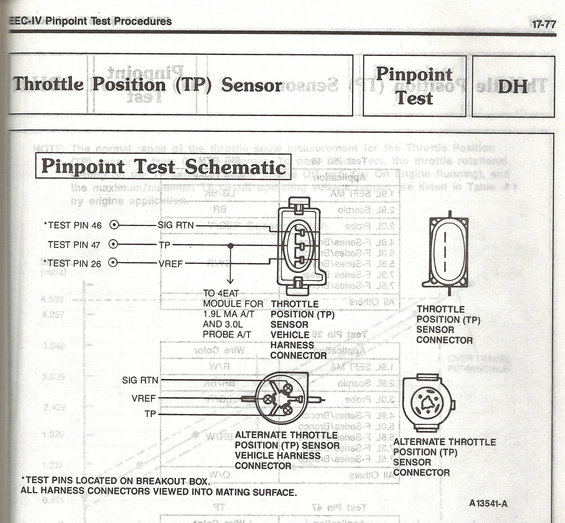
Glad you found it (the data link). The TPS is best measured with the key On, engine Off using a DVM set to DC volts. At closed throttle the voltage should be between 0.6 - 1.0 VDC. Slowly open the throttle and way=tch the output increase to ~4.5 - 5.0 VDC.
The is measured between Signal Return and the TPS output signal. Having a tough time finding a photo for you since Photobucket changed their access policies.
I believe the wire colors you are looking for are the Orange and Black ones.
Based on your codes, there is a TPS problem, but rare it's completely open circuit but is possible.
Yes, coolant is circulated through the throttlebody. Contrary to popular belief it has nothing to do with preventing icing in cold weather, there is no venturi effect, it's there to aid fuel/air atomization in cold weather according to Ford's documentation.
Randy,
Another source I read before your response said to put my multimeter's COM lead directly to battery NEG and the red test lead on the Vref wire (orange) to test for 5V coming from ECM. I got 5V there. Then it said to move the red test lead to the black wire (COM still on NEG batt.) and test for .9V to 1.5V at throttle idle position (KOEO). I did that and got 0.00, and got NO increase as I manually increased throttle.
If I do black and orange test, does it matter which probe goes to black and which to orange?
And how important is it to replace the throttle body gasket before remounting the throttle body? my throttle body came of clean, with the whole gasket still on the intake. It's just a pain to get in there to scrape the old one off, but I don't want to create more problem by leaving the old one on.
--
Jeremy
Last edited by allkindsa; Jul 19, 2017 at 04:05 PM.
Reason: Added gasket blurb
1988-1991 TPS Wire Colors
VREF - Orange/White
TP SIG - Dark Green/Light Green
SIG RTN - Black/White or Red/Gray
1992-1996 TPS Wire Colors
VREF - Brown/White
TP SIG - Gray/White
SIG RTN -Gray/Red
Motorcraft TPS Wire Colors
VREF - Orange
TP SIG - Green
SIG RTN - Black
The black wire is Signal Return so it would measure 0 volts with the meter referenced to the negative terminal of the battery.
To properly test the TPS output (KOEO) place the black meter lead on the Signal Return wire of the TPS. Yours is most likely black. Place the red meter lead on the TPS output signal wire. Yours should be green.
At closed throttle the voltage should be between 0.6 to 1.0 VDC. Slowly open the throttle, very the signal output rises steady to ~4.5 to 5 VDC.
Thanks again. TPS and IAC both tested bad. I replaced them and the van ran great.
That only lasted for a few miles. The ChkEng light came on and went off soon afterwards, within 1 minute. I almost immediately checked the code and got code 332, EGR open not detected. Ugh. EGR valve and sensor is a pain to get to, especially when engine is hot. Do you recommend just starting with testing the sensor voltage?
Make sure the vacuum source hose for the EGR circuit is plugged into the intake manifold. Follow it to the EGR Valve Regulator (EVR). From there a hose on the output side of the EVR goes to the EGR valve.
Perhaps during the R&R of the other parts you moved/broke some vacuum lines. Those vinyl hoses are known to break if you look at them too long. 20+ years in a hot environment is well past their expected service life.
The EVR is located near the coil and on the same bracket as the TAB/TAD solenoids.
I have tested the EVR resistance (harness removed) and found 36 Ohms. I've read that 30-70 Ohms is expected.
The EVR harness at KOEO tested 12.3V to ground on one lead and 2.1V to ground on the other lead. Does the one terminal stay at 12V, or does the ECM fluctuate that to control the vacuum? Is the EVR vacuum on/off, or does a pintle position move to vary the mmHg of vacuum applied to the EGR diaphragm?
Regarding the vacuum hose from EVR to EGR, I disconnected both ends and did the ol' mouth suck test. It still pulls and holds a vacuum just fine, and the rubber ends aren't deteriorated.
I have also tested the EVP Vref at KOEO and found 5V.
I do not yet own a vacuum tester to test the EVP resistance fluctuations with varied vacuum.
Would you say that my next step is to test the EVP resistance fluctuations while using a vacuum tester, before embarking on dismounting the EVP or EGR valve? I have read a lot online about carbon build-up in the EGR valve, but the EGR valve is rather hard to get to in my van. Ugh.
It's likely unrelated to my issue, but any idea what the canister is in my picture, just to the left of the throttle body? It is zip-tied to a mounting plate. It has an electrical connector on top of itself and appears to be controlling/monitoring a hose (vacuum?/vent?) that goes into the throttle body. The other end of the hose appears to go back toward the fuel tank. it's a metal tube across the valve cover, and under the van, but there is a portion of rubber hose above transmission bell housing to make the transition. That rubber hose is looking pretty cracked. I was just curious for the sake of knowledge what the canister is and does.
Wow, had no idea this thread was still active! Was going to start a new thread since my situation has evolved, but for the sake of forum cleanliness I'll try to contain it here.
Background: Been struggling with an idle issue since I bought the truck. 94 F-250 5.8l 5-speed. Causes I believe are combination of previous owner stupidity (when I bought it IAC was unplugged, throttle stop screw had been messed with, and the crankcase vent in the drivers side valve cover was routed to the round plastic thing for the A.I.R system ), plus general broken parts that you'd expect on a 94 with 192k miles.
Items Replaced:
- IAC - It was unplugged so I assumed it was bad. Could be right or wrong.
- TPS - Replacing this and tuning it in seemed to make a positive change. No more super-high idle surging.
- EGR Valve and Line (from manifold) - Line was broken. Seemed to make a positive change as well.
- Throttle cable, plastic piece was broken causing binding.
- Little ancillary things like the air filter (including the one for the crankcase vent), throttle body gasket, some questionable vacuum lines, etc.
Current situation:
Let's use today as an example, since this is a representative scenario. Drive truck for 25 minutes. Should be warmed up. Park for a half hour. Restart, it's still fairly warm. Idle appears normal, see below:
Begin driving, come to a stop sign in 2 minutes and make a complete stop. Idle is around 1000RPM. Next stop sign it could be closer to 900, or closer to 1100. Either way, it's high, but not consistent from stop to stop. Example pic below:
The fact that it CAN idle normally, as shown in the first picture, leads me to believe it could be something electronic and/or related to the A.I.R/Thermactor system. As opposed to a bad intake gasket, worn throttle body shaft, or some other standard vacuum leak. Nor do I think it's something internal to the motor. It's extremely strong, no misfiring, no smoke, no oil use, and it runs super smooth especially right after a warm start.
Now here's something I just noticed today. One of the two A.I.R solenoids is not there, and there is a connector not plugged into anything. I think this is the TAD?
Could this be another previous owner hack? Or did the higher GVWR trucks only have one solenoid? If the TAD was there wouldn't it have a vacuum line? There are no disconnected vacuum lines.
I would LOVE to get this truck side-by-side with an identical-spec truck. But with the seemingly 10000 variations of these things, that's unlikely.
Note: There are no codes since I fixed the EGR. Never had, or currently have, codes for anything else.
Just to throw another curve ball at you, I had a somewhat similar issue with my F-150 (392). When it would first start up it would fast idle and then settle into the normal 700 or so idle. I would drive a bit and then it would idle around 1000 or 1500rpm. Sometimes when shifting (5sp) the rpms would hang at whatever they were when I went to shift which made it an awkward and harsh experience. The inner sheath of the throttle cable was broken so I thought that maybe it was binding up so I replaced the cable. Nope still doing it. The root cause was the throttle shaft and linkage was binding up. Pushing the linkage against the stop screw would bring the rpms down to normal. A new (BBK) throttle body solve my issue.
Rezvani's Latest Post-Apocalytic Monster Is a Ford F-150 Raptor Underneath
Slideshow: Called the Fortress, the 850-horsepower pickup combines Raptor underpinnings with military-inspired features, survival equipment, and a starting price of $285,000.









 ), plus general broken parts that you'd expect on a 94 with 192k miles.