


Low compression and rough idle

Lead Driver


Joined: Dec 2000
Posts: 6,298
Likes: 47
From: South central, Minnesota
I've tried the ATF in the oil thing a few times in the past on other engines, but I never tried it to fix a more serious problem like this. In the past I did it just in an effort to cleanse the inside of a neglected engine. I've only put maybe 1,500 miles on this truck since I've had it and I've already changed the oil twice. I did it when I first got it, and then again when I replaced the oil pan gasket because it was leaking like a sieve.
I still need to borrow a leak down tester from someone at work to determine if it is indeed the rings at fault in the #1 hole. In any case, I need to get the ignition resolved. I like the GM HEI system because it is all contained in one unit. Plus, I have spare parts for it already. Here's the thing: I already have a DSII distributor and module. I've done a bunch of research, but still don't know exactly what is involved with wiring it up. I really don't want to go to the junk yard to source a whole new engine harness. I'd rather wire it up myself and I have no problem doing so. Can someone please tell me exactly how to dire up the DSII distributor and module?
It can't be that hard to wire up, but if I have to cut connectors off of these brand new parts to do so, and if it sounds like a big hassle, I might just see if I can send them back and get an HEI instead because they're so clean and easy to hook up. If I knew they were available for this engine I would've gone that route in the first place.
I always thought it was weird when I saw a big HEI cap under a non-GM hood. And I understand how it's a little sacrilegious, but hey, it's a viable, simple system with parts always readily available.
I still need to borrow a leak down tester from someone at work to determine if it is indeed the rings at fault in the #1 hole. In any case, I need to get the ignition resolved. I like the GM HEI system because it is all contained in one unit. Plus, I have spare parts for it already. Here's the thing: I already have a DSII distributor and module. I've done a bunch of research, but still don't know exactly what is involved with wiring it up. I really don't want to go to the junk yard to source a whole new engine harness. I'd rather wire it up myself and I have no problem doing so. Can someone please tell me exactly how to dire up the DSII distributor and module?
It can't be that hard to wire up, but if I have to cut connectors off of these brand new parts to do so, and if it sounds like a big hassle, I might just see if I can send them back and get an HEI instead because they're so clean and easy to hook up. If I knew they were available for this engine I would've gone that route in the first place.
I always thought it was weird when I saw a big HEI cap under a non-GM hood. And I understand how it's a little sacrilegious, but hey, it's a viable, simple system with parts always readily available.
Are you getting any oil smoke out the exhaust? If you are getting oil smoke then it's more then likely a ring or cylinder problem. If it's not smoking then I would lean more towards a valve sealing issue.
The DSII is pretty simple to wire up. Just don't forget to add the ballast resister( and bypass ) if it doesn't already have one. Here's a couple simple wiring diagrams for the DSII system.


The DSII isn't exactly a complicated system and it's not very hard to find parts for it. But I'm also the kind of person that carries spare parts with. If I do have a problem I like to be able to fix it myself. So I carry with a spare module, pick up coil, coil, rotor, etc. So if I do have a part failure, even out in the middle of no where, I can fix it and make it home.


Thread Starter
|
Senior User
Joined: Jul 2007
Posts: 432
Likes: 0
From: Germantown, MD
Those are excellent diagrams; better than the ones I found myself. Thank you! Now, the diagram looks simple enough, but I don't know what pieces of it I already have under the hood that I can use, and what parts I will have to create. The truck is an '86 that had a mostly working feedback carb and EEC IV ignition.
The harness in the very middle of the second diagram that connects the distributor to the ignition module, do I have that or part of that in my truck already, or am I going to have to create it? I can cut the connectors off the distributor and the module and run the wires myself, but that would make replacing the module or distributor in the future involve cutting and splicing wires...
Also, does that other two pin connector to the module from the ignition switch exist somewhere on the truck already?
I'm going out of town for the weekend. I think I'll pull that #1 plug out and fill in some ATF. When I return, I'll crank it with the plug out at first to get some of it out. I have my fingers crossed. I've been driving the truck almost everyday for the past few weeks because I don't want salt on my Caddy. I find it hard to believe that simply driving the truck and running the engine and changing the oil has not already freed up the rings if they're stuck. But, hey, I'll try anything at this point.
The harness in the very middle of the second diagram that connects the distributor to the ignition module, do I have that or part of that in my truck already, or am I going to have to create it? I can cut the connectors off the distributor and the module and run the wires myself, but that would make replacing the module or distributor in the future involve cutting and splicing wires...
Also, does that other two pin connector to the module from the ignition switch exist somewhere on the truck already?
I'm going out of town for the weekend. I think I'll pull that #1 plug out and fill in some ATF. When I return, I'll crank it with the plug out at first to get some of it out. I have my fingers crossed. I've been driving the truck almost everyday for the past few weeks because I don't want salt on my Caddy. I find it hard to believe that simply driving the truck and running the engine and changing the oil has not already freed up the rings if they're stuck. But, hey, I'll try anything at this point.
Moderator


Joined: Dec 2007
Posts: 7,987
Likes: 104
From: Boise, Idaho

If I remember right, the '86 is the odd man out, in that it is NOT plug and play for the DSII. All the other years use the same plugs and you simply plug the DSII harness into the pigtails coming out of the firewall, even if it was a feedback setup.
I've never messed with an '86 so I may be wrong though. Just remember some DSII posts a while back and that ended up being the issue they were having.
I've never messed with an '86 so I may be wrong though. Just remember some DSII posts a while back and that ended up being the issue they were having.

Cargo Master

Joined: Mar 2008
Posts: 2,589
Likes: 212
From: Washington
I have an 1986, just like you, so I can answer any "1986 questions"
General info after reading this thread....
The simplest IGN would be a DS2 Dist with a GM 4 pin module. It is easy to wire up.
The stock DS2 system needs a matched set of components, round coil with the correct in line resistor wire. The GM 4 pin module can use the newer square coil with full voltage.
Do you have excessive blow by? Oil in the air cleaner housing?
I had a lot of oil laying around the air cleaner. I found 5 out of 6 top rings broken. It still ran "OK" with the blow by and bad compress, just used a quart of oil every 800 miles.
I did a quick and dirty re ring with cast rings, rod bearing only, all done with the engine in the truck. So yes it can be done.
The bad "blow by" went away, I didn't have to add oil and more, but the compress test numbers did not really improve after the ring swap. 1-6 comp numbers... 85 90 90 110 110 130
While I truly wish my compression test number where all over 140... I just don't see it to be worth while to go back into the engine again, meaning it runs fine as is. Just to be fair my usage is just around town, no towing or long freeway trips.
Jim
General info after reading this thread....
The simplest IGN would be a DS2 Dist with a GM 4 pin module. It is easy to wire up.
The stock DS2 system needs a matched set of components, round coil with the correct in line resistor wire. The GM 4 pin module can use the newer square coil with full voltage.
Do you have excessive blow by? Oil in the air cleaner housing?
I had a lot of oil laying around the air cleaner. I found 5 out of 6 top rings broken. It still ran "OK" with the blow by and bad compress, just used a quart of oil every 800 miles.
I did a quick and dirty re ring with cast rings, rod bearing only, all done with the engine in the truck. So yes it can be done.
The bad "blow by" went away, I didn't have to add oil and more, but the compress test numbers did not really improve after the ring swap. 1-6 comp numbers... 85 90 90 110 110 130
While I truly wish my compression test number where all over 140... I just don't see it to be worth while to go back into the engine again, meaning it runs fine as is. Just to be fair my usage is just around town, no towing or long freeway trips.
Jim
Thread Starter
|
Senior User
Joined: Jul 2007
Posts: 432
Likes: 0
From: Germantown, MD
Thank you both so much for your replies! I have decided to return the DSII dist and module. Amazon will take them back for a full refund. I am going to get an HEI instead. Now, I need to decide which one... There are so many different "brands." Honestly, I bet that ALL of them use cheap parts from oversees, more or less. With that said, I'm thinking I'll get a cheapy and accept that I may have to replace some of the parts in the future. But, that's okay. I can upgrade the module and coil if or when I have to.
Wow, JimsRebel, your compression numbers are far worse than mine, no offense. That makes me feel a lot better. I bet the engine noise I'm hearing is the #1 ring pieces rattling around. It certainly does sound like it's at the front of the engine.
I just want to point out that I enriched the carb thinking that I was having a detonation issue. I raised the metering jet A LOT to see if it would quiet down at 2,000 ish RPMs. If anything it may have helped with the noise a little, but it is still very much there. The spark plugs now read rich (dark and sooty), especially on the central cylinders, and get darker towards the outer cylinders. Cylinders #1 and #6 are now a healthy looking tan, while #2 and #5 are darker and #3 and #4 are black. I guess that is the nature of the intake design which invokes inherently inefficient, uneven fuel distribution. Oh and since I raised the metering jet it now runs best at idle with the mix screw about 1/2 turn out opposed to about 2 turns out before.
Wow, JimsRebel, your compression numbers are far worse than mine, no offense. That makes me feel a lot better. I bet the engine noise I'm hearing is the #1 ring pieces rattling around. It certainly does sound like it's at the front of the engine.
I just want to point out that I enriched the carb thinking that I was having a detonation issue. I raised the metering jet A LOT to see if it would quiet down at 2,000 ish RPMs. If anything it may have helped with the noise a little, but it is still very much there. The spark plugs now read rich (dark and sooty), especially on the central cylinders, and get darker towards the outer cylinders. Cylinders #1 and #6 are now a healthy looking tan, while #2 and #5 are darker and #3 and #4 are black. I guess that is the nature of the intake design which invokes inherently inefficient, uneven fuel distribution. Oh and since I raised the metering jet it now runs best at idle with the mix screw about 1/2 turn out opposed to about 2 turns out before.
Thread Starter
|
Senior User
Joined: Jul 2007
Posts: 432
Likes: 0
From: Germantown, MD
Oh and no, mine doesn't burn much of any oil at all and doesn't smoke either. At idle if I remove the PCV valve from the valve cover it blows some smoke out of it, but it looks like a normal amount for an aged engine.
I still need to do the leak down test. I guess there's still hope that it's a valve or valve seat issue in #1 that somehow seals when I add oil for a wet compression test.
I still need to do the leak down test. I guess there's still hope that it's a valve or valve seat issue in #1 that somehow seals when I add oil for a wet compression test.
Cargo Master
Joined: Mar 2008
Posts: 2,589
Likes: 212
From: Washington
The main reason I posted my low compress reading numbers where to show that you should not reject an engine based on low compression only.
You should be using the output of the O2 sensor to adjust your mixture and also monitor this while driving. It is a very eye opening experience compared to what I thought was happening, meaning rich or lean operations.
Jim
You should be using the output of the O2 sensor to adjust your mixture and also monitor this while driving. It is a very eye opening experience compared to what I thought was happening, meaning rich or lean operations.
Jim
Thread Starter
|
Senior User
Joined: Jul 2007
Posts: 432
Likes: 0
From: Germantown, MD
In my experience, typically you do reject an engine based on low compression readings, especially when one or two are far below the others. If I understand you correctly, the point you make is that with these engines it's a different case where low compression readings are acceptable, within reason of course.
I find it strange that it makes such low compression. Even the best cylinders only made 150 psi. The two I tested wet made 195 psi! That's nearly twice as much compression with better piston ring sealing. Is this just the nature of the beast? Do the rings on these engines just kind of suck? I know it is a low compression engine to begin with at around 8:1 SCR or whatever, but still, mine drastically more compression with oil in the cylinders...
I am eagerly awaiting the arrival of my HEI distributor. I am looking forward to actually having an advance curve again. Any yes, it is definitely running very rich right now. I need to open up the carb and lean it back out some. Reading the plugs is definitely a good source for indicating the mixture. Ultimately, I think you're right in saying that I should read the oxygen sensor voltage for a more accurate and immediate indication of the mixture. Of course, this requires that I have no exhaust leaks...
I find it strange that it makes such low compression. Even the best cylinders only made 150 psi. The two I tested wet made 195 psi! That's nearly twice as much compression with better piston ring sealing. Is this just the nature of the beast? Do the rings on these engines just kind of suck? I know it is a low compression engine to begin with at around 8:1 SCR or whatever, but still, mine drastically more compression with oil in the cylinders...
I am eagerly awaiting the arrival of my HEI distributor. I am looking forward to actually having an advance curve again. Any yes, it is definitely running very rich right now. I need to open up the carb and lean it back out some. Reading the plugs is definitely a good source for indicating the mixture. Ultimately, I think you're right in saying that I should read the oxygen sensor voltage for a more accurate and immediate indication of the mixture. Of course, this requires that I have no exhaust leaks...
FTE Stories
Ford Trucks for Ford Truck Enthusiasts

Top 6 Best Deals Available on New Fords & Lincolns Right Now
Brett Foote
This Hennessey Takes the Expedition Tremor's Off-Roading Capability to the Next Level
Verdad Gallardo
Top 10 Fords at 2026 Carlisle Ford Nationals
Joe Kucinski
3 Best / 3 Worst Parts of Modern Ford Ownership
Brett Foote
10 Amazing Upgrades That Solve Common Ford Truck Owner Headaches
Pouria Savadkouei
Every 2026 Ford Engine Explained
Brett Foote
10 Ugly Ford Trucks That We Still Kinda Love
Joe Kucinski
10 Things Every Truck Owner NEEDS (2026 Edition)
Michael S. Palmer
Rezvani's Latest Post-Apocalyptic Monster Is a Ford F-150 Raptor Underneath
Verdad Gallardo
Thread Starter
|
Senior User
Joined: Jul 2007
Posts: 432
Likes: 0
From: Germantown, MD
I finally received and installed my HEI distributor! What an easy install, and simple system - that is very attractive to me.
All I did was the following: ran a 10 gauge wire from the B+ terminal of the starter relay through a 15 amp fuse to terminal 30 of a relay; ran a 10 gauge wire from the 87 terminal of the relay to the pigtail going to the B+ terminal in the HEI unit; cut the yellow wire going to the + terminal of the old TFI coil and connected it to the 85 terminal of the relay; ran a wire from the 86 terminal of the relay to ground with 14 gauge black wire; and finally cut the green wire to the - terminal of the old TFI coil and connected it to the pigtail going to the TACH output terminal of the HEI unit.
I haven't really tuned it up yet. I just set the timing to 36* total which came it at around 3,000 RPM which gave me 18* base. It runs so much better overall having a functioning timing curve. I haven't even hooked up the vacuum advance yet as I want to dial in the curve a little more first.
I have more engine noise now though, like it did before with the old feedback system. It sounds like spark knock and happens almost all the time once it is warmed up all the way. I've done a bunch of research on what might be causing this. I think the next thing I will do is remove the intake manifold to clean out carbon. I read a case where a guy had a ton of carbon clogging up the intake runners...
All I did was the following: ran a 10 gauge wire from the B+ terminal of the starter relay through a 15 amp fuse to terminal 30 of a relay; ran a 10 gauge wire from the 87 terminal of the relay to the pigtail going to the B+ terminal in the HEI unit; cut the yellow wire going to the + terminal of the old TFI coil and connected it to the 85 terminal of the relay; ran a wire from the 86 terminal of the relay to ground with 14 gauge black wire; and finally cut the green wire to the - terminal of the old TFI coil and connected it to the pigtail going to the TACH output terminal of the HEI unit.
I haven't really tuned it up yet. I just set the timing to 36* total which came it at around 3,000 RPM which gave me 18* base. It runs so much better overall having a functioning timing curve. I haven't even hooked up the vacuum advance yet as I want to dial in the curve a little more first.
I have more engine noise now though, like it did before with the old feedback system. It sounds like spark knock and happens almost all the time once it is warmed up all the way. I've done a bunch of research on what might be causing this. I think the next thing I will do is remove the intake manifold to clean out carbon. I read a case where a guy had a ton of carbon clogging up the intake runners...

Lead Driver
Joined: Jul 2009
Posts: 6,477
Likes: 19
From: Sheffield, AL
"It sounds like spark knock and happens almost all the time once it is warmed up all the way".
18 degrees BTDC static is pretty high. Back down to 12-14 degrees and see if the additional engine noise diminishes.
18 degrees BTDC static is pretty high. Back down to 12-14 degrees and see if the additional engine noise diminishes.
Moderator
Joined: Dec 2007
Posts: 7,987
Likes: 104
From: Boise, Idaho
Agreed. 18° advance is a lot.
Mine was custom curved by DUI for my engine and they said it was still "pretty" close to the stock curve they put on them. They said to set my base timing at 12° and then, if there was any issues (ie pinging), back it down 1° at a time.
Mine was custom curved by DUI for my engine and they said it was still "pretty" close to the stock curve they put on them. They said to set my base timing at 12° and then, if there was any issues (ie pinging), back it down 1° at a time.
Thread Starter
|
Senior User
Joined: Jul 2007
Posts: 432
Likes: 0
From: Germantown, MD
18 sounded high to me too, but that gave me 36 total which is right on the money, right? Anyway, I put base timing at 12 and it starts easier, but only gives me 32 total at about 3,000 RPMs, and it still makes noise once warmed up.
I adjusted the idle mixture to the highest vacuum reading which is about 18.5"Hg and pretty darn smooth. I also turned the metering jet back down a little. The plugs are a healthy tan color now.
Overall, it runs much better than it ever has since I've owned it. I just still have this really annoying engine noise once it is thoroughly warmed up. Above 2,500 RPMs under almost any load, it almost sounds like it just going to come flying apart. The idle is quite smooth now, but once it is warmed up thoroughly even at idle I have the slightest little noise, and right off idle just revving it slightly from 650 to ~1,100 RPMS it sounds like a diesel. Then, it kind of diminishes and then comes back higher up in the RPMs. It's weird, sometimes it is there, other times it's not. I guess it depends on the exact load and RPM conditions. But, it only does it when warmed up thoroughly, like after a blast down the highway.
I seriously doubt it is an ignition or timing or mixture issue at this point. I've replaced almost everything that controls ignition and fuel input and I've tried so may tunes. I don't know, but I'm happy with how it runs now. Maybe I'll figure out the noise eventually, or maybe I won't. It'll probably run forever either way.
I adjusted the idle mixture to the highest vacuum reading which is about 18.5"Hg and pretty darn smooth. I also turned the metering jet back down a little. The plugs are a healthy tan color now.
Overall, it runs much better than it ever has since I've owned it. I just still have this really annoying engine noise once it is thoroughly warmed up. Above 2,500 RPMs under almost any load, it almost sounds like it just going to come flying apart. The idle is quite smooth now, but once it is warmed up thoroughly even at idle I have the slightest little noise, and right off idle just revving it slightly from 650 to ~1,100 RPMS it sounds like a diesel. Then, it kind of diminishes and then comes back higher up in the RPMs. It's weird, sometimes it is there, other times it's not. I guess it depends on the exact load and RPM conditions. But, it only does it when warmed up thoroughly, like after a blast down the highway.
I seriously doubt it is an ignition or timing or mixture issue at this point. I've replaced almost everything that controls ignition and fuel input and I've tried so may tunes. I don't know, but I'm happy with how it runs now. Maybe I'll figure out the noise eventually, or maybe I won't. It'll probably run forever either way.
Thread Starter
|
Senior User
Joined: Jul 2007
Posts: 432
Likes: 0
From: Germantown, MD
I did some more diagnosing on the rattle noise today after warming it up. I had the slightest noise even at idle, so I went around trying to isolate it. I listened to everything thru a long 3/8" extension and realized the engine itself is pretty darn quiet!
I got underneath and sure enough I can hear it in the transmission/bell housing area. It makes the noise in neutral with the clutch out, as well as in every gear with the clutch in. I hear it when accelerating thru all the gears. It is especially loud once warmed up, and nonexistent when cold.
I did some reading on people having problems with the clutch components and flywheel, but it seems to me if that was the cause it would not depend on the temperature. I am thinking I need to drain the trans oil out, inspect it, and fill it up with new. Oh and it makes the noise regardless of what gear the transfer case is in. Plus it doesn't sound that far back.
I got underneath and sure enough I can hear it in the transmission/bell housing area. It makes the noise in neutral with the clutch out, as well as in every gear with the clutch in. I hear it when accelerating thru all the gears. It is especially loud once warmed up, and nonexistent when cold.
I did some reading on people having problems with the clutch components and flywheel, but it seems to me if that was the cause it would not depend on the temperature. I am thinking I need to drain the trans oil out, inspect it, and fill it up with new. Oh and it makes the noise regardless of what gear the transfer case is in. Plus it doesn't sound that far back.
Moderator
Joined: Dec 2007
Posts: 7,987
Likes: 104
From: Boise, Idaho
I had the same thing happen in a parts truck I bought. I drove it home and it rattled like crazy on acceleration. I thought the engine was toast.
I did some diagnostics and listening around and found out it was coming from the bell housing.
I pulled the transmission and engine and, while they were out, looked the transmission over. Nothing wrong with it. I swapped them into my Bronco and they've been solid and strong for the last 4 years, and I've never heard the rattling again.
I'm thinking that something was very loose. Maybe the transmission to engine bolts had backed out. Or one of the transmission mounts was bad.
However, on second thought, I did put in a new flywheel and clutch/pressure plate during the process.
So, I'd suggest looking over everything to be sure you don't have something loose. Then, if nothing shows up, it might be time to separate the engine/transmission and see if maybe you have something going on there. Either way, if it's like mine, you should be okay and there's nothing wrong with the major components (engine / trans).
I did some diagnostics and listening around and found out it was coming from the bell housing.
I pulled the transmission and engine and, while they were out, looked the transmission over. Nothing wrong with it. I swapped them into my Bronco and they've been solid and strong for the last 4 years, and I've never heard the rattling again.
I'm thinking that something was very loose. Maybe the transmission to engine bolts had backed out. Or one of the transmission mounts was bad.
However, on second thought, I did put in a new flywheel and clutch/pressure plate during the process.
So, I'd suggest looking over everything to be sure you don't have something loose. Then, if nothing shows up, it might be time to separate the engine/transmission and see if maybe you have something going on there. Either way, if it's like mine, you should be okay and there's nothing wrong with the major components (engine / trans).
Thread Starter
|
Senior User
Joined: Jul 2007
Posts: 432
Likes: 0
From: Germantown, MD
I am pretty sure last night when I was searching around I actually came across a thread of yours about that! Thanks a lot for all your help and for putting all your knowledge and experience out there for others.
I know my trans mount is bad and I think last night I saw my right side motor mount is bad too, which just exacerbates the noise. It also makes shifting gears less smooth. I'm going to change the fluid in the trans since it probably needs that done anyway, and go around and tighten up every bolt I can find in the area. Oh and fix those bad mounts. That'll be a good place to start.
What really gets me is that it is quiet as a mouse until warmed up. Why would that be?
Also, my clutch seems to be a bit capricious. The friction zone is right off the floor when starting out, but then while underway shifting between gears the friction zone seems to be much farther up off the floor. It wouldn't surprise me if it needs a clutch... Oh and my slave cylinder seems to be just resting on the mounting bracket. I can remove it simply by sliding it off the bracket. I don't know if it's supposed to be like that or what.
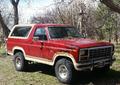
Overall, the truck has many different little issues here and there. But, it's got good bones. I think I overpaid for it at $3,000. But, it's essentially exactly what I wanted - an '81-'86 Flareside F150 4x4 300 I6 4-speed. I wanted it to be as close to my old '86 Flareside F150 as possible for parts compatibility. I just wanted the 300 over the 302. This truck is the exact same year and has the same 3.55 gearing.
I know my trans mount is bad and I think last night I saw my right side motor mount is bad too, which just exacerbates the noise. It also makes shifting gears less smooth. I'm going to change the fluid in the trans since it probably needs that done anyway, and go around and tighten up every bolt I can find in the area. Oh and fix those bad mounts. That'll be a good place to start.
What really gets me is that it is quiet as a mouse until warmed up. Why would that be?
Also, my clutch seems to be a bit capricious. The friction zone is right off the floor when starting out, but then while underway shifting between gears the friction zone seems to be much farther up off the floor. It wouldn't surprise me if it needs a clutch... Oh and my slave cylinder seems to be just resting on the mounting bracket. I can remove it simply by sliding it off the bracket. I don't know if it's supposed to be like that or what.
Overall, the truck has many different little issues here and there. But, it's got good bones. I think I overpaid for it at $3,000. But, it's essentially exactly what I wanted - an '81-'86 Flareside F150 4x4 300 I6 4-speed. I wanted it to be as close to my old '86 Flareside F150 as possible for parts compatibility. I just wanted the 300 over the 302. This truck is the exact same year and has the same 3.55 gearing.