





Break in period?

Thread Starter
|
Senior User
Joined: Oct 2016
Posts: 238
Likes: 0
Break in period?
I need to tow a trailer tomorrow just a light landscape trailer maybe 2800 pounds and I will load it with orchard grass bales so maybe 5-7k pounds loaded.
i only have 600 miles on the truck is it ok to tow or do I need to wait 1000 miles is this an actual thing people do or more of a personal preference?
thanks
i only have 600 miles on the truck is it ok to tow or do I need to wait 1000 miles is this an actual thing people do or more of a personal preference?
thanks
Post Fiend
Joined: Apr 2004
Posts: 5,158
Likes: 35
From: North of Salt Lake City
The reason for the break-in period is not so much for the engine but for the drive line. Specifically the rear differential. The concern is heating up the rear end before the metal has had an opportunity to properly temper via normal to light use. Pulling a bunch of weight too quickly will create a lot of heat in the rear end. If you take it easy and give the gears a chance to cool the metals will be happier.
By the way, has anyone else noticed the foil-wrapped insulated brake line that passes behind the rear differential? If that's not an indication of the heat that can be generated, I don't know what is.
By the way, has anyone else noticed the foil-wrapped insulated brake line that passes behind the rear differential? If that's not an indication of the heat that can be generated, I don't know what is.

Cargo Master


Joined: May 2007
Posts: 3,336
Likes: 4
From: Western New York

The reason for the break-in period is not so much for the engine but for the drive line. Specifically the rear differential. The concern is heating up the rear end before the metal has had an opportunity to properly temper via normal to light use. Pulling a bunch of weight too quickly will create a lot of heat in the rear end. If you take it easy and give the gears a chance to cool the metals will be happier.
By the way, has anyone else noticed the foil-wrapped insulated brake line that passes behind the rear differential? If that's not an indication of the heat that can be generated, I don't know what is.
By the way, has anyone else noticed the foil-wrapped insulated brake line that passes behind the rear differential? If that's not an indication of the heat that can be generated, I don't know what is.
Post Fiend
Joined: Apr 2004
Posts: 5,158
Likes: 35
From: North of Salt Lake City
Hmmm... I've never heard of the metal brake lines going bad. At least not on newer vehicles that haven't been sitting out in the pasture for a couple of decades. But I don't live in the salty East either. I find it interesting that Ford felt the need to insulate them from heat. My 2011 had an aluminum differential cover with fins on it to help dissipate heat but those covers went away pretty quickly in 2012 I think. It shows two things. Enough heat is generated to affect braking and second, I'm glad that Ford pays this level of attention to engineering detail.
All this speaks to the importance of a break-in period for the ring and pinion. I don't understand the metallurgy but find it interesting. Now I'm going to start checking the diff case temperature when I'm towing in addition to the brakes and tire temps.
All this speaks to the importance of a break-in period for the ring and pinion. I don't understand the metallurgy but find it interesting. Now I'm going to start checking the diff case temperature when I'm towing in addition to the brakes and tire temps.
Trending Topics

Logistics Pro


Joined: Jan 2013
Posts: 3,778
Likes: 153
I need to tow a trailer tomorrow just a light landscape trailer maybe 2800 pounds and I will load it with orchard grass bales so maybe 5-7k pounds loaded.
i only have 600 miles on the truck is it ok to tow or do I need to wait 1000 miles is this an actual thing people do or more of a personal preference?
thanks
i only have 600 miles on the truck is it ok to tow or do I need to wait 1000 miles is this an actual thing people do or more of a personal preference?
thanks
Now EpicCowlick has a legit point. I have used modified Ford Dana 60's in my off road Jeeps, I get them from a company https://www.dynatrac.com and they recommend a 500 mi break-in, which is to say in HIGH TECH engineering lingo...don't let the pumpkin get hotter than you can put your hand on till you get 500 mi on it.
I would say this is sage advice for the longevity of that axle set. If you get out there smoke it with less than 500 mi its not likely to bite you in the butt for several years and miles down the road.
As you have 600 mi on your rig, then you are good and for it!
FTE Stories
Ford Trucks for Ford Truck Enthusiasts

Rezvani's Latest Post-Apocalytic Monster Is a Ford F-150 Raptor Underneath
Verdad Gallardo
Top 10 Most Expensive Ford Trucks Ever Sold on Bring a Trailer
Joe Kucinski
2027 Ford Super Duty Buyer's Guide (Every Model, Engine, & Package)
Brett Foote
Top 10 Ford Truck Tragedies
Joe Kucinski
AEV FXL Super Duty - the Super Duty Raptor Ford Doesn't Make
Brett Foote
Lobo Vs Lobo: Proof the F-150 Lobo Should Be Even Lower!
Michael S. Palmer
Ford's 2001 Explorer Sportsman Concept Looks For a New Home
Verdad Gallardo
10 Best Ford Truck Engines We Miss the Most!
Joe Kucinski
2026 Shelby F-150 Off-Road: Better Than a Raptor R?
Brett Foote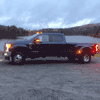
Hotshot
Joined: Apr 2013
Posts: 10,120
Likes: 652
From: NH


Notice how both the brake line and e-brake cable going to the right rear wheel are both only shielded on the right side of the differential, and continue on well past the differential...yet the left side of the brake line and e-brake cable are not shielded at all, despite sitting right on top of the differential?
I guess the way to truly tell if I'm right would be to look at a gas F-350 dually, which will be hard to find, since it is the only gas truck to share the M275 / M300 (My truck is an M300 in the pic).
I'd bet a gas 250 or 350 does not have that shielding. The exhaust during a regen radiates 1200F heat. The diff gets nowhere near that hot.
Thread Starter
|
Senior User
Joined: Oct 2016
Posts: 238
Likes: 0
so i had the day off today so last night we drove to the bay area for dinner and i volunteered to drive lol because i find any excuse to drive now a days. so by the time we got home i had about 980 miles on the truck and now i won't have any second thoughts when i will be towing and will take a bigger trailer and get extra bales to cover me thru the winter.
thanks all for the replies
thanks all for the replies
Post Fiend
Joined: Apr 2004
Posts: 5,158
Likes: 35
From: North of Salt Lake City
Except I don't think the differential is why the line is wrapped. I think it is to protect the fluid from getting too hot when the truck is regenerating. I had already taken a few pics of the undersides of my dually, so take a look:
Notice how both the brake line and e-brake cable going to the right rear wheel are both only shielded on the right side of the differential, and continue on well past the differential...yet the left side of the brake line and e-brake cable are not shielded at all, despite sitting right on top of the differential?
I guess the way to truly tell if I'm right would be to look at a gas F-350 dually, which will be hard to find, since it is the only gas truck to share the M275 / M300 (My truck is an M300 in the pic).
I'd bet a gas 250 or 350 does not have that shielding. The exhaust during a regen radiates 1200F heat. The diff gets nowhere near that hot.
Notice how both the brake line and e-brake cable going to the right rear wheel are both only shielded on the right side of the differential, and continue on well past the differential...yet the left side of the brake line and e-brake cable are not shielded at all, despite sitting right on top of the differential?
I guess the way to truly tell if I'm right would be to look at a gas F-350 dually, which will be hard to find, since it is the only gas truck to share the M275 / M300 (My truck is an M300 in the pic).
I'd bet a gas 250 or 350 does not have that shielding. The exhaust during a regen radiates 1200F heat. The diff gets nowhere near that hot.
More Turbo
Joined: Oct 2016
Posts: 552
Likes: 22
Hmmm... I've never heard of the metal brake lines going bad. At least not on newer vehicles that haven't been sitting out in the pasture for a couple of decades. But I don't live in the salty East either. I find it interesting that Ford felt the need to insulate them from heat. My 2011 had an aluminum differential cover with fins on it to help dissipate heat but those covers went away pretty quickly in 2012 I think. It shows two things. Enough heat is generated to affect braking and second, I'm glad that Ford pays this level of attention to engineering detail.
All this speaks to the importance of a break-in period for the ring and pinion. I don't understand the metallurgy but find it interesting. Now I'm going to start checking the diff case temperature when I'm towing in addition to the brakes and tire temps.
All this speaks to the importance of a break-in period for the ring and pinion. I don't understand the metallurgy but find it interesting. Now I'm going to start checking the diff case temperature when I'm towing in addition to the brakes and tire temps.
But aren't brake lines made out of aluminum? They shouldn't rust.
Had the aluminum diff cover on my 08, I think that was the first year of it. They are definitely concerned about the heat that is generated there.
i'm not sure if I've seen any of the other manufacturers do anything more than put a stamped metal cover on.
Logistics Pro
Joined: Jan 2013
Posts: 3,778
Likes: 153
I noticed the brake line wrap last week. I like the idea and the attention to detail.
But aren't brake lines made out of aluminum? They shouldn't rust.
Had the aluminum diff cover on my 08, I think that was the first year of it. They are definitely concerned about the heat that is generated there.
i'm not sure if I've seen any of the other manufacturers do anything more than put a stamped metal cover on.
But aren't brake lines made out of aluminum? They shouldn't rust.
Had the aluminum diff cover on my 08, I think that was the first year of it. They are definitely concerned about the heat that is generated there.
i'm not sure if I've seen any of the other manufacturers do anything more than put a stamped metal cover on.
There is a LOT of meat in that axle set and it holds a lot of oil and that is there approach to keeping those things cool, lots of beef and lots of oil. I have installed those axle sets by myself and trust me it is a hellva of job.
Cargo Master
Joined: May 2007
Posts: 3,336
Likes: 4
From: Western New York
I have had a lot of experience with galvanized metal lines going bad but I also have a tendency to keep vehicles longer than most plus live in the rust belt. Rust damage usually starts where the line is in contact with the frame and especially at the clips where moisture can be trapped. About once every three months I push the brake pedal all the way to the floor and hold it for 1 minute as a hydrostatic test in the driveway. Better to break the brakes there than approaching a line of stopped vehicles. Just last week I had to replace the transmission cooler lines from the transmission to the radiator because the stretch over the crossmember and closest to the exhaust manifold was completely rotted away and covered with dark brown rust scales. Hate the smell of MerconV running down my arm and in my hair. Please bring me a new truck so I can start all over again.