When you click on links to various merchants on this site and make a purchase, this can result in this site earning a commission. Affiliate programs and affiliations include, but are not limited to, the eBay Partner Network.
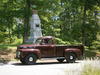
So instead of going all in last winter I tried to cheap out on the rebuild of the '49 Flat head.
It runs like a watch, smooth....
However, I am loosing coolent, I'm pretty sure it's going out the exhaust as the tail pipe is wet. What would be the most likely place? Cracked head or Block? I am pretty sure it's not the head gasket as I replaced it and checked the heads and block for flatness with a straight edge.
There is no oil in the radiator, There is no water in the oil. I have a 4psi cap on a new radiator, there are no exterior leaks.
They can crack in the exhaust passages, to the water jacket. How much water are you losing? Are you parking on a clean slab where you can tell if there's a leak?
If you pull the exhaust manifolds you should be able to see if there's a leak into the exhaust.
Have you run the truck on the road, enough to get the engine to operating temperatures, burn the plugs clean? If so, you can pull the plugs and if a coolant is going into a cylinder the plug will look a lot different than the plugs in a normal environment. As mentioned, do you have a recovery tank?
It looses about a quart every 30 miles or so.
It lives in a clean dry cement floored garage, there are no external leaks.
I do have a coolent recovery bottle.
I have not retorqued the heads, that sounds like the simplist and cheapest place to start.
You might ask a local engine rebuilder if they have some blocks of block sealer you could buy...We used to get reman engines and every one had a cube of black whatever it is in the water pump area. I can't remember one that had a water leak. A quart a week is a small enough leak it just might fix it.
Did you use your original cap on the radiator? Some replacement radiators have a different dimension between the top and bottom sealing surfaces. I found with my new radiator using a modern radiator cap vs my old one worked better. The pressure of the cap just changes the boiling point of the radiator fluid which helps prevent water pump cavitation. But if you are running a stock flathead that shouldn't be a big deal. Of course it does raise the pressure in the system but only by the difference in the cap rating (10 psi?) which isn't much and should be OK as long as your hoses, etc. are in good condition.
Mine has been rebuilt. It's not "old" stock, but the upper tank is tall and with only one stiffener front-to-back. A "new" aluminum or a new brass radiator specifrically designed for 10+ psi would undoubtedly do fine.
If your engine is clean, you simply don't need more than 4 psi.
It is a new aluminum radiator, with a new 4 psi cap. If you fill to the top in will push coolant into the overflow bottle.
Had a friend follow me around yesterday and he said there is some white smoke and you can definitely smell anti freeze, So we know where it's going, out the exhaust, now what to do?
I So we know where it's going, out the exhaust, now what to do?
Try torquing the head bolts as suggested above. Good luck.
Edit: At this point, you can probably pull the plugs and identify where it is leaking.....But, that is a moot issue.