


Recent UOA show high "K" values..


Thread Starter
|
Fleet Mechanic


Joined: Nov 2005
Posts: 1,508
Likes: 87
From: North Carolina, Raleigh
Recent UOA show high "K" values..
My just received UOA show potassium levels high vs last report.
On last report potassium levels looked normal at 8, which was at 3400 mile on new rotella 15w40 regular oil change done by PO right before i bought truck in aug 2014.
the most recent UOA (6600 miles) all the sudden show potassium level through the roof at 1175.
I check oil regularly and see no water. Don't smell or see diesel in radiator tank, plus i had a fs-2500 bypass filter installed right after the first UOA.
could there be a issue with bypass filter. Truck how has 171K miles and only thing that PO told and and i can find in service records was Water pump was replaced at like 85K miles.
they recommend change oil and resample in 3K miles.
ideas..???
On last report potassium levels looked normal at 8, which was at 3400 mile on new rotella 15w40 regular oil change done by PO right before i bought truck in aug 2014.
the most recent UOA (6600 miles) all the sudden show potassium level through the roof at 1175.
I check oil regularly and see no water. Don't smell or see diesel in radiator tank, plus i had a fs-2500 bypass filter installed right after the first UOA.
could there be a issue with bypass filter. Truck how has 171K miles and only thing that PO told and and i can find in service records was Water pump was replaced at like 85K miles.
they recommend change oil and resample in 3K miles.
ideas..???

Logistics Pro
Joined: Jun 2005
Posts: 4,243
Likes: 16
From: AZ
You might want to post the UOA so responders see the whole data set. I know of no other source of potassium other than antifreeze. Can't see how the bypass filter could be involved, but God knows, I have been wrong before. Good luck on solving this!
Logistics Pro
Joined: Jun 2005
Posts: 4,243
Likes: 16
From: AZ
Carl, I have done some other reading about sources of K in oil analysis and if there could be a source other than coolant. It seems a spike in K could be caused by flux, the stuff used in soldering metal together. Does that new filter assembly you installed have any solder joints in it? That might be the source....and if it did, it obeys my maxim of "the last thing you changed is responsible for the new problem".

Posting Guru
Joined: May 2013
Posts: 1,199
Likes: 2
From: Oklahoma
Potassium can also be attributed through Oil Additives. I had a report with high K and it was the result of either Lucas Syn Oil Stabilizer, or ArchOil additive. I had used both.
Nevertheless, I've run straight oil for three cycles and my levels are returning back to normal.
Is your coolant level consistent?
Nevertheless, I've run straight oil for three cycles and my levels are returning back to normal.
Is your coolant level consistent?

Hotshot


Joined: Nov 2006
Posts: 11,286
Likes: 263
From: North of Greenville
The potassium, if not from antifreeze infiltration, is not going to hurt anything. The only risk associated with running an additive which has high K is that it WILL mask an event of antifreeze infiltration. It should be noted, though, that the use of potassium in engine oil additives has been pretty much completely discontinued because of this kind of confusion they can create for the vehicle owner/operator.
Yet another potential culprit is if the lab runs a potassium containing hydraulic oil (i.e EH) before running your sample, they may not have flushed their equipment adequately and traces of the potassium additive in the previous sample could show up in your test results.
Yet even one more potential is that you may have the beginnings of a leak from which the potassium levels have slowly built up but the leak itself is not yet large enough for the glycol or water content to be detected by the lab's test equipment.
I would recommend catching another TWO samples and have them tested at TWO Different and INDEPENDENT labs who are not associated with one another (one of the labs being the same lab you used initially as a double check). There are many labs to choose from. Let these followup test results guide you, and if you still are worried without any other signs of antifreeze infiltration, you should decrease your OCI's until you figure it out.
Yet another potential culprit is if the lab runs a potassium containing hydraulic oil (i.e EH) before running your sample, they may not have flushed their equipment adequately and traces of the potassium additive in the previous sample could show up in your test results.
Yet even one more potential is that you may have the beginnings of a leak from which the potassium levels have slowly built up but the leak itself is not yet large enough for the glycol or water content to be detected by the lab's test equipment.
I would recommend catching another TWO samples and have them tested at TWO Different and INDEPENDENT labs who are not associated with one another (one of the labs being the same lab you used initially as a double check). There are many labs to choose from. Let these followup test results guide you, and if you still are worried without any other signs of antifreeze infiltration, you should decrease your OCI's until you figure it out.
Thread Starter
|
Fleet Mechanic
Joined: Nov 2005
Posts: 1,508
Likes: 87
From: North Carolina, Raleigh
figured it out,,
archoil was added to oil at same time as fs-2500 install which was after the first UOA.
so the archoil jumps up "K" values.. what does the potassium do for the engine
ps the TBN went from 8 on last UOA to a 9 on this latest one.
here is pic of entire report.
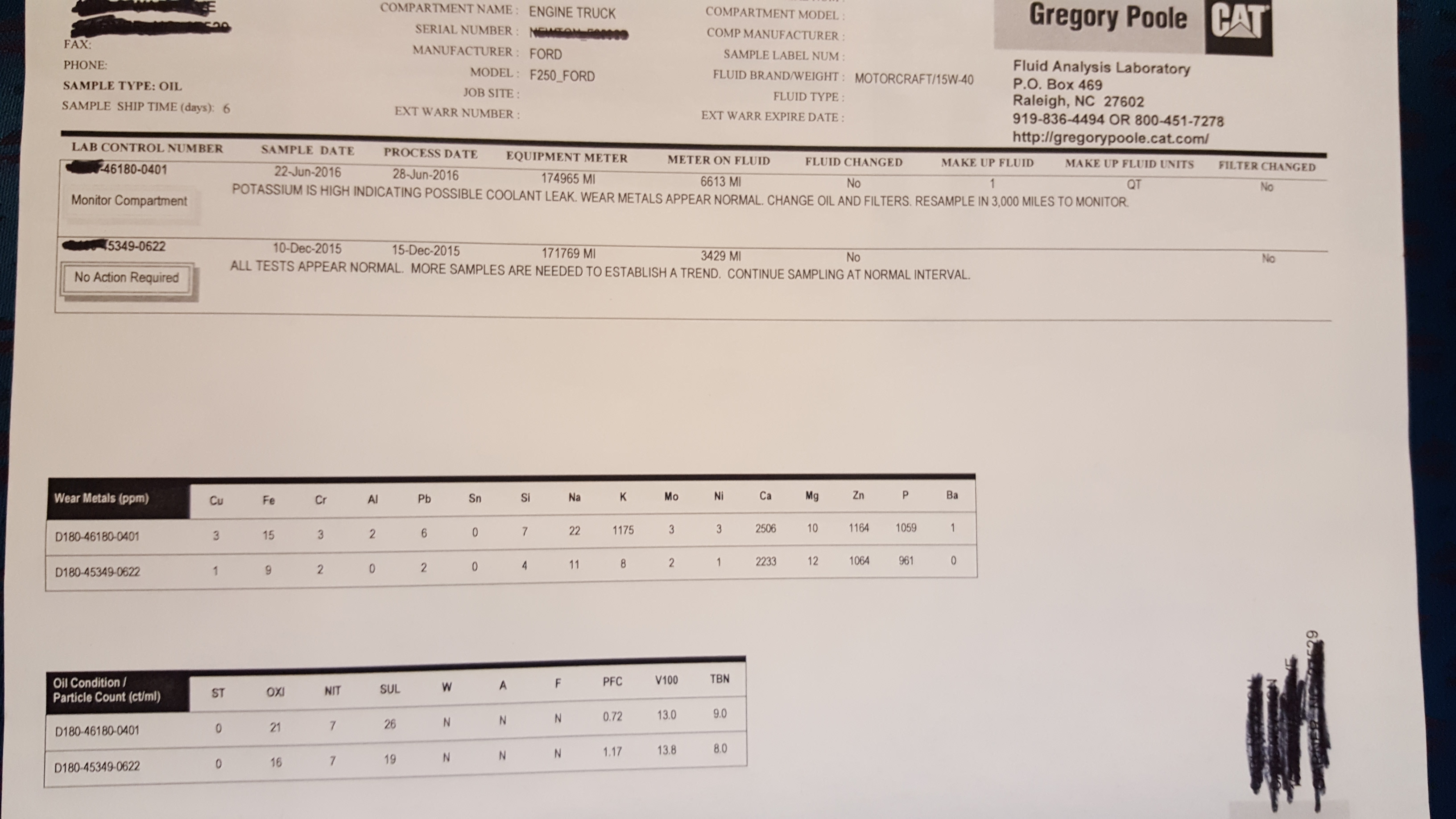
archoil was added to oil at same time as fs-2500 install which was after the first UOA.
so the archoil jumps up "K" values.. what does the potassium do for the engine
ps the TBN went from 8 on last UOA to a 9 on this latest one.
here is pic of entire report.
Hotshot
Joined: Nov 2006
Posts: 11,286
Likes: 263
From: North of Greenville
Below is a link to a BITOG thread where the role of potassium (as part of Potassium Triborate) is discussed as a tenacious lubricant film-depositing component.
However, keep in mind that the discussion in the link is now 14 years old, and the use of potassium for oils used in glycol-cooled engines have been widely abandoned because of the potential confusion created by the presence of potassium... it makes you think you've got a coolant leak into the lube system!
Boron Additives | Technical and White Papers | Bob Is The Oil Guy
However, keep in mind that the discussion in the link is now 14 years old, and the use of potassium for oils used in glycol-cooled engines have been widely abandoned because of the potential confusion created by the presence of potassium... it makes you think you've got a coolant leak into the lube system!
Boron Additives | Technical and White Papers | Bob Is The Oil Guy

Thread
Thread Starter
Forum
Replies
Last Post
L-ight
1999 - 2003 7.3L Power Stroke Diesel
24
Oct 19, 2017 09:55 AM
AllaboutMPG
1999 - 2003 7.3L Power Stroke Diesel
6
Jan 20, 2015 08:51 PM
rosa70
1999 - 2003 7.3L Power Stroke Diesel
8
Nov 30, 2004 07:30 AM






